 SWBTEC


Excavator Slewing Ring Bearing:Analysis Of Its Key Role
Author:Vesna Jovanović
Vesna Jovanović is an academic at the University of Niš, Faculty of Mechanical Engineering, Serbia, specializing in slewing bearings and load analysis in construction machinery. Her research focuses on the slewing platform drive mechanisms of hydraulic excavators, including axial and rotary bearing load characteristics under various operational positions and conditions, mathematical modeling, equivalent load calculation, and experimental verification. She has co-authored multiple publications with collaborators such as Dragoslav Janošević and Nikola Petrović on dynamic and static loads of excavator slewing bearings, as well as the effects of digging position and posture. Jovanović also teaches courses related to mobile machinery design, hydraulic and electric drive systems, and transport machinery. Her work contributes to the structural design, selection, and reliability improvement of slewing bearings in the construction machinery industry.
Working Principle Of Excavator Slew Ring Bearing
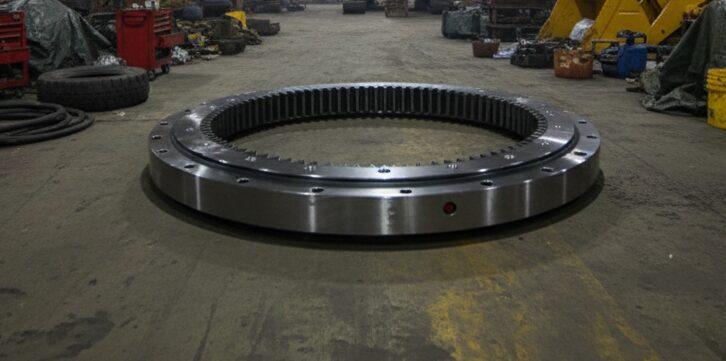
What is a slewing ring bearing?
Slewing bearing is the key component for the excavator to achieve 360 degree rotation on the upper body. It is precisely because of it that the excavator can easily complete a series of actions such as digging, lifting, rotating and unloading in place, which greatly improves the efficiency of the operation.
Working principle depth analysis
The first is the force analysis. When the excavator is working, its superstructure will be subjected to huge axial force, radial force, and more importantly, overturning moment. This overturning moment is particularly critical. It tries to overturn the excavator, and the slewing bearing must firmly “grasp” the upper and lower bodies to resist this force. This is why the structural design and material selection of the slewing bearing are very particular, and it is necessary to ensure that its strength and rigidity can withstand these complex loads.
Let’s talk about its transmission mechanism. Slewing ring bearings do not work independently. It is usually coordinated with the rotary reducer and rotary motor. The slewing motor provides power, and after the slewing reducer decelerates and increases the torque, it drives the ring gear of the slewing bearing to rotate, thereby driving the entire upper body to rotate. The design of this transmission chain ensures that the excavator can achieve smooth and accurate rotation operation under various working conditions.
As for the different types, our common slewing bearings are mainly single-volleyball, double-volleyball and cross-roller.
The structure of the single-volleyball type is relatively simple, the carrying capacity is moderate, and it is often used in light to medium-sized excavators.
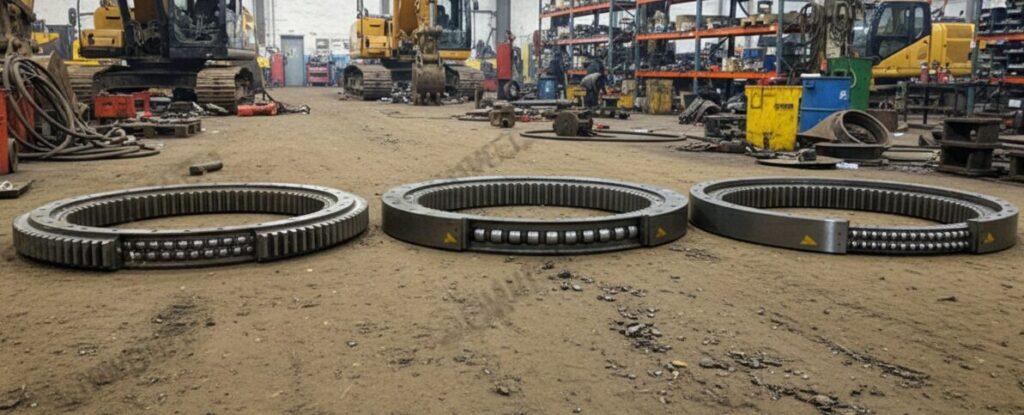
The double volleyball type has a higher carrying capacity, can withstand greater axial force and overturning moment, and is widely used in medium-sized excavators.
Cross roller type, its rollers are 90 degrees cross arrangement, can bear axial force, radial force and overturning moment at the same time, and high precision, good rigidity, so in large tonnage, heavy load excavator, and some special engineering machinery with high rotational accuracy requirements, cross roller slewing bearing is the first choice.
Diagnosis And Analysis Of Common Failures In Slewing Ring Bearings
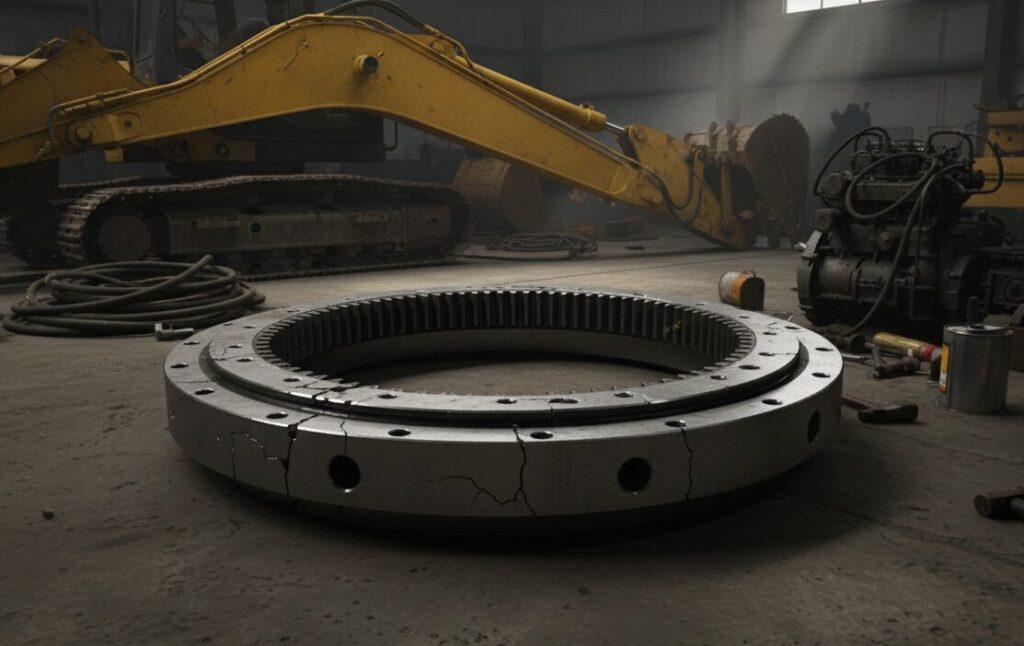
Wear
Wear is one of the most common problems of slewing ring bearings.
Performance: When you hear abnormal noise when the excavator rotates, or feel that the rotation gap is obviously increased, or even the rotation movement is no longer smooth and smooth, and the fuselage shakes, it is mostly the bearing wear.
Reason: poor lubrication is the main reason, the bearing is in a state of dry friction for a long time. Secondly, long-term overload operation of the equipment, or operation under harsh working conditions, will also accelerate wear. In addition, if the pre-tightening force is improper in the early assembly, or the bearing itself has material defects, it will also bury hidden dangers for the later wear.
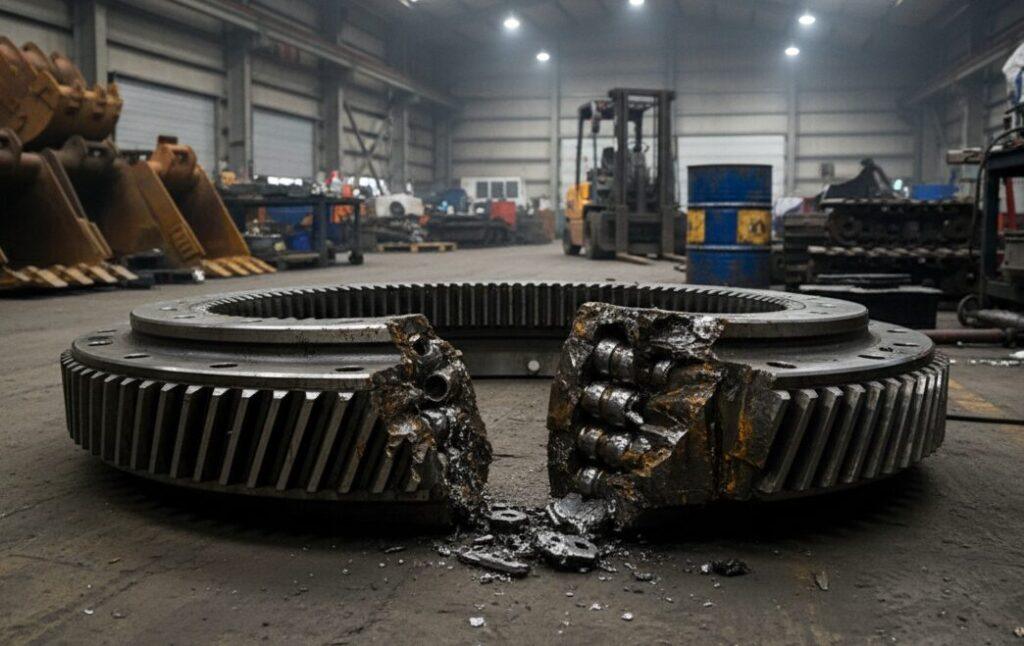
Cracks & Fractures
Performance: If you hear a violent impact sound from the rotary mechanism, or the rotary action is suddenly stuck, or even completely unable to rotate, then you should be alert to whether there is a crack or fracture.
Cause: fatigue damage is the main cause of cracks, long-term alternating load, metal structure will gradually fatigue. In addition, sudden impact loads, such as violent impacts during work, may also cause cracks or even fractures. The defects of the material itself and the stress concentration on the structure are also causes that cannot be ignored.
Seal Failure
Performance: The most intuitive manifestation of seal failure is grease leakage, and you will see obvious oil stains around the bearing. At the same time, if the seal is damaged, dust and moisture will take advantage of it.
Consequences: The loss of grease directly leads to insufficient lubrication of the bearing and accelerated wear. The intrusion of dust and moisture will not only aggravate wear, but also cause corrosion of raceways and rolling elements, and eventually cause early failure of bearings.
Loose/Fractured Bolts
Fastening bolt is the key to connect the slewing bearing with the upper and lower frame. Its looseness or fracture directly threatens the operation safety of the equipment.
Performance: When you hear an abnormal sound of the slewing mechanism, or feel that the whole machine has obvious shaking during the slewing, or even in extreme cases, the slewing mechanism has the risk of separation, then check the fastening bolts immediately.
Reason: Many times, the loosening of the bolts is caused by insufficient pre-tightening force during installation. The long-term vibration and impact of the equipment will also cause the bolts to gradually loosen. In addition, the material fatigue of the bolt itself is also an important reason. The strength of the bolt will gradually decrease after long-term load.
How does the preliminarily judge the fault type?
- Listen: Listen carefully for the rattle when turning. Wear is usually a continuous squeak, while cracks or breaks are often intermittent.
- Look: Observe whether there is grease leakage around the bearing, whether there are signs of loosening of the bolts, and whether the body shakes abnormally when rotating.
- Touch: under safe conditions, touch the bearing part with your hand to feel whether there is abnormal vibration or heat. These intuitive feelings can often provide important clues.
Effective Maintenance & Repair Strategies
Daily inspection
For slewing ring bearings, daily inspection is the 1 line of defense.
- Lubrication check: Add grease regularly. Don’t wait until you hear the rattle to think of lubrication! The raceways and tooth surfaces inside the slewing bearings require continuous lubrication to reduce friction and wear. I usually recommend a strict lubrication cycle based on the intensity of equipment use and environmental conditions.
- Bolt inspection: Regularly check and tighten the bolts to ensure the pre-tightening force. The slewing bearing and the main frame are connected by a large number of bolts, and the preload of these bolts is very important. Loose bolts will lead to stress concentration, and even cause bolt fracture, it is not a small trouble. My experience is that after initial use and during regular inspections, you need to check and retighten with a torque wrench, which cannot be ambiguous.
- Seal Inspection: Look for leaks or damage. The seal is a key barrier to prevent contaminants such as dust and moisture from entering the interior of the slewing bearing. If the seal is found to have signs of aging, cracking or grease leakage, it must be replaced in time. Otherwise, sand and water into the bearing life will be greatly reduced.
- Rotary clearance inspection: Professional methods to measure, judge the degree of wear. This is a more professional check. As the use time increases, wear will occur between the raceway and the rolling body, resulting in an increase in the rotation gap. Through professional measurement methods, the degree of wear can be judged and the basis for adjustment or replacement is provided. It’s like doing a physical examination of the device to see what’s really going on inside it.
Importance and Best Practices of Lubrication
Grease type selection: select the appropriate EP grease according to the ambient temperature, load, etc. Greases with excellent extreme pressure performance (EP) must be selected in high temperature, high load or extreme cold environments. Different working conditions have different requirements for grease. If you choose the wrong one, you are irresponsible for the equipment.
Filling method and cycle: emphasize uniform filling to avoid single point overdose. When adding grease, make sure that the slewing bearing rotates slowly so that the grease can be evenly filled into the inside of the raceway. Avoid overfilling at a certain point, which is not only wasteful, but may also cause damage to the seal. When filling, observe whether there is fresh grease extrusion at the waste oil port to judge whether the filling is in place.
Installation and removal
Correct lifting and placement. The weight of the slewing bearing is not light, and a special sling must be used when lifting to ensure uniform force and avoid deformation. Make sure that it is placed smoothly to prevent bumping.
Installation surface flatness inspection and treatment. This is an easily overlooked but vital link. If the mounting surface is uneven, it will cause uneven force on the slewing bearing and accelerate wear. The flatness must be checked with a feeler gauge and other tools, and polished if necessary.
Bolt tightening sequence and torque requirements. Bolts must be tightened in the diagonal, graded and symmetrical order specified by the manufacturer, and the torque must be strictly controlled.
Emphasize the importance of professional tools and personnel. The installation and removal of slewing bearings must be completed by trained professional technicians using professional tools.
How to extend the life of slewing ring bearings
In addition to daily maintenance and correct installation, there are some tips that can help us extend the life of the slewing ring.
Avoid overload and impact. This is obvious. Overload and sudden impact will bring huge instantaneous load to the slewing bearing, which can easily cause raceway indentation and rolling body damage. When operating, the operator should try to avoid violent rotation, sudden braking and other behaviors.
Regularly clean the sundries of the slewing gear ring. If dirt, stones and other debris are accumulated on the rotary ring gear, it will not only increase the wear, but also may cause the gear to jam or damage. After the daily homework, take a few minutes to clean up, you can save a lot of trouble.
Special maintenance considerations in winter and high temperatures. In extremely cold weather, the grease will become thick and require special attention when starting. In a high temperature environment, the performance of the grease may decrease, requiring more frequent inspection and filling. These are the experiences I have summed up in my practical work, and different environments require different coping strategies.
