 SWBTEC


Slewing Bearing Wear Measurement
To accurately measure the wear of a slewing bearing, the first task of the on-site maintenance engineers is to keep an eye on the “tilt gap”. The most reliable operation is to find four equal dividing points between the fixed circle and the rotating circle and set up the percentage table with the magnetic seat. The tilting load is then applied by means of a boom or counterweight, the maximum and minimum pressure differences are manufactured and the total displacement value is recorded. For equipment such as excavators or cranes, if the reading exceeds the threshold of 1.5mm to 3.0mm, it means that the raceway wear is quite serious and must be intervened immediately. In addition, don’t jump to conclusions after the test. You must go to the original manufacturer’s instructions to check correctly. Before the test, you must confirm that the bolts are not loose and there are no problems with lubrication, so as to avoid being fooled by false data.
Tilt Gap And Axial Play
The core of slewing bearing wear measurement is to find out to what extent the “openness” of the internal raceway is large. Tilt clearance is the hardest indicator of bearing health. When the equipment dries up for a long time, large companies such as cranes and excavators will generate huge axial and radial loads when working. These forces will repeatedly ravage the steel balls or rollers inside, thinning the raceway surface and causing the gap to become so large. Staring at this data is the only way we can predict the failure in advance before the equipment completely collapses and causes huge downtime losses.
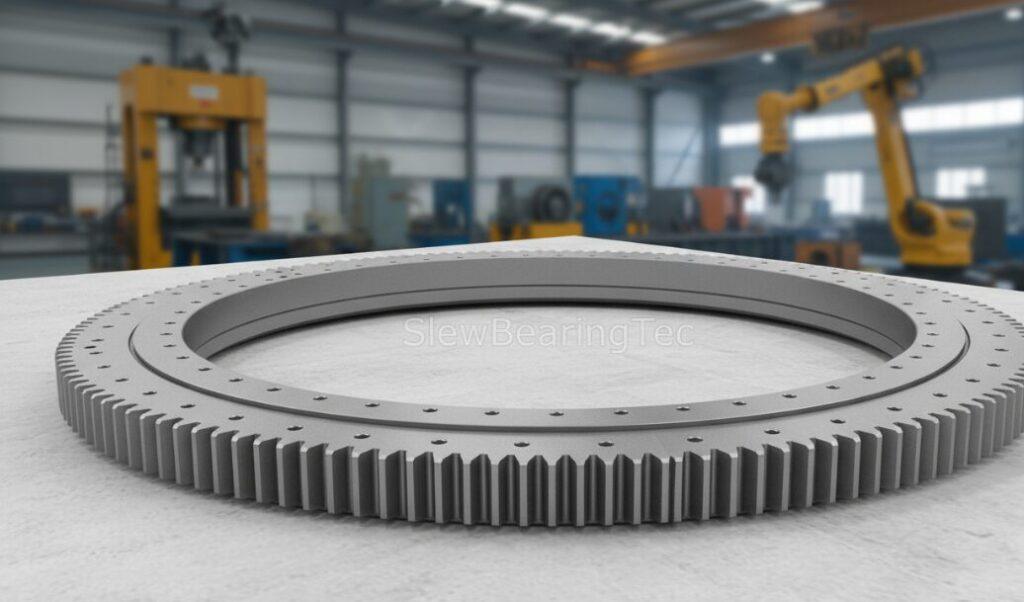
Standard Four-Point Measurement
Since we need to test, where and how to put the tools is very critical. Use a percent table with magnetic seats because we need to catch micrometer-scale movements.
Isometric distribution points: Measuring four points 90° apart, the wear of the slewing bearing is usually uneven, there is always some frequent force “hard-hit areas”. Multi-point measurements allow you to see the true wear distribution across the bearing ring.
Fixing ring vs. Rotating ring: The percentage is connected across the fixed and rotating parts of the machine. As long as your mounting structure is stiff enough, the number jumping on the watch head is the true clearance inside the bearing.
Apply Tilt Load And Record Displacement
Static measurements are of little reference value. You have to simulate that pressure when the machine is working to measure the real displacement.
Maximum pressure: Extend the boom as far as it will go, or move the counterweight to its limit so that the bearing reaches the highest point of forward tilt and write down the percentile reading.
Minimum pressure: Reverse operation to allow the load to run to the other side of the raceway.
Calculation: The difference between these two extreme positions is the tilt gap we are looking for. This dynamic test can directly reveal what the internal parts have become due to loss.
Single Row Ball Slewing Bearing
Single-row ball slewing bearings are divided into internal tooth, external tooth and toothless structure, which are suitable for a variety of transmission needs.
Double Row Ball Slewing Bearing
Double-row ball slewing bearings are specially designed for super-heavy load scenarios.
Slewing Bearing With External Gear
The external gear internal flange slewing bearing integrates the advantages of external gear transmission and internal flange mounting.
Slewing Bearing With Internal Gear
The internal tooth and external flange slewing bearing is characterized by the combination of internal tooth transmission.
Slewing Bearing Without Gear
Gearless double flange slewing bearing is light weight and compact.
Cross Roller Slewing Bearing
Single-row cross roller slewing bearing adopts roller cross layout, large contact area, can synchronously and efficiently withstand axial and radial loads and overturning moment,
Permissible Limits And Raceway Wear
After getting the reading, the next step is to compare the table with the industry standard or original factory standard. Although the bearing requirements are different for different raceway diameters, 1.5mm to 3.0mm is a recognized red line for medium and large slewing rings.
Effect of diameter: Large bearings do naturally allow for greater clearance. Once a reading approaches 3.0mm, it often means that the harden layer of the raceway has been almost ground.
Severe Wear: If your data breaks these thresholds, it’s typical “severe raceway wear”. At this point, the risk of structural failure or misaligned gear pairs will double, and there is no other way except repair or replacement.
Bolts And Lubrication
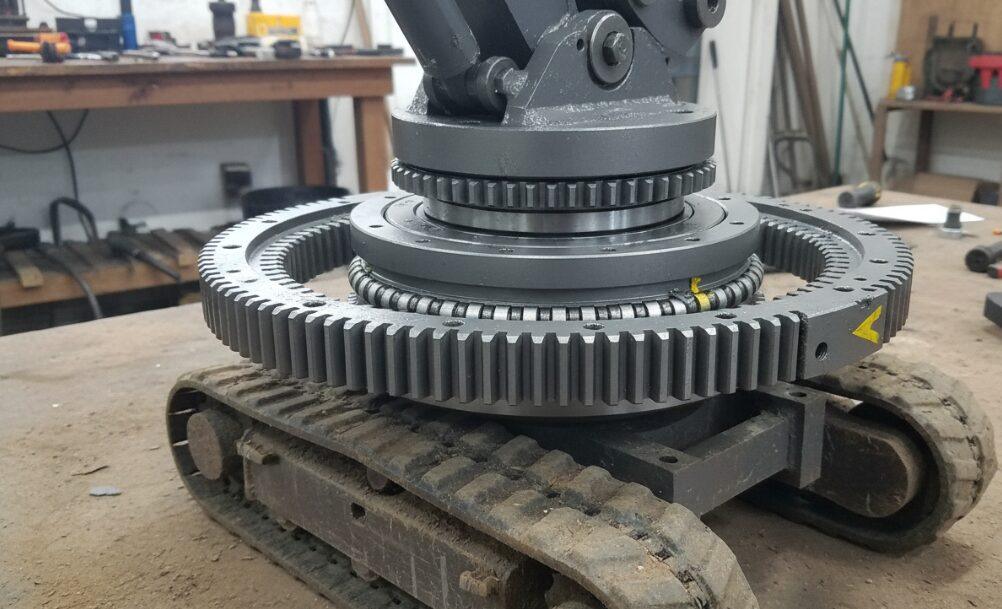
Before you sign a wear report, you need to eliminate any distractions that could cause “fake data”.
Bolt preload: If the mounting bolt is loose, the measured displacement will be frighteningly large, looking like a broken bearing. Therefore, before testing, review the bolt torque according to the manufacturer’s standards.
Lubrication status: Lack of oil will cause the hands to jump abnormally, and old, dry and hard grease may temporarily “pad” the gap. It is best to turn the bearing a few times before testing and divide the grease evenly before doing anything.
Professional Advice On Slewing Support Maintenance
If the measured results show that the device has reached its wear limit, finding a high-quality replacement is better than anything else. SWBTEC’s products perform quite well in the area of resistance to tilt loads, and their tolerance control is fully compatible with those strict industry standards. With this level of components, you can ensure that the wear readings of your equipment remain within a safe range for a long period of time. If you can’t hold the measurement data in your hand, or want to replace the machine with more durable bearings, you can go directly to the SWBTEC official website to talk to their engineering team.
Author: Mark Sterling
I’ve spent my career in the field, troubleshooting complex slewing ring issues for cranes, excavators, and offshore platforms worldwide. My focus is on turning rigid technical standards into practical, reliable maintenance strategies. By sharing my hands-on insights, I aim to help fellow engineers and technicians master precision measurements, prevent catastrophic failures, and significantly optimize the lifespan of their critical industrial assets.
