 SWBTEC


Slewing Bearing Replacement Guide: Fit and Load Checks
A worn slewing bearing can look straightforward to replace: measure the outside diameter, find a ring that seems similar, and schedule the installation. The difficulty is that the bearing is also a structural connection. It carries axial and radial forces and a tilting moment while one machine structure turns relative to another. A replacement has to fit the surrounding parts and work under the machine’s actual duty.
For an excavator, crane, or industrial turntable, use the original part number and controlled drawing as the starting point. If those records are missing, measurements of the old unit help reconstruct the interface, but wear or previous repairs may have changed what you can measure. The checks below help turn a visual match into an engineering comparison.
Identify The Bearing You Are Replacing
First establish which ring is fixed and which rotates. Record the bearing’s overall height, inner and outer diameters, center opening, locating features, and the bolt circle, hole size, and hole type on each ring. A matching outside diameter does not tell you whether the mounting holes will align or whether the rotating structure will clear nearby parts.
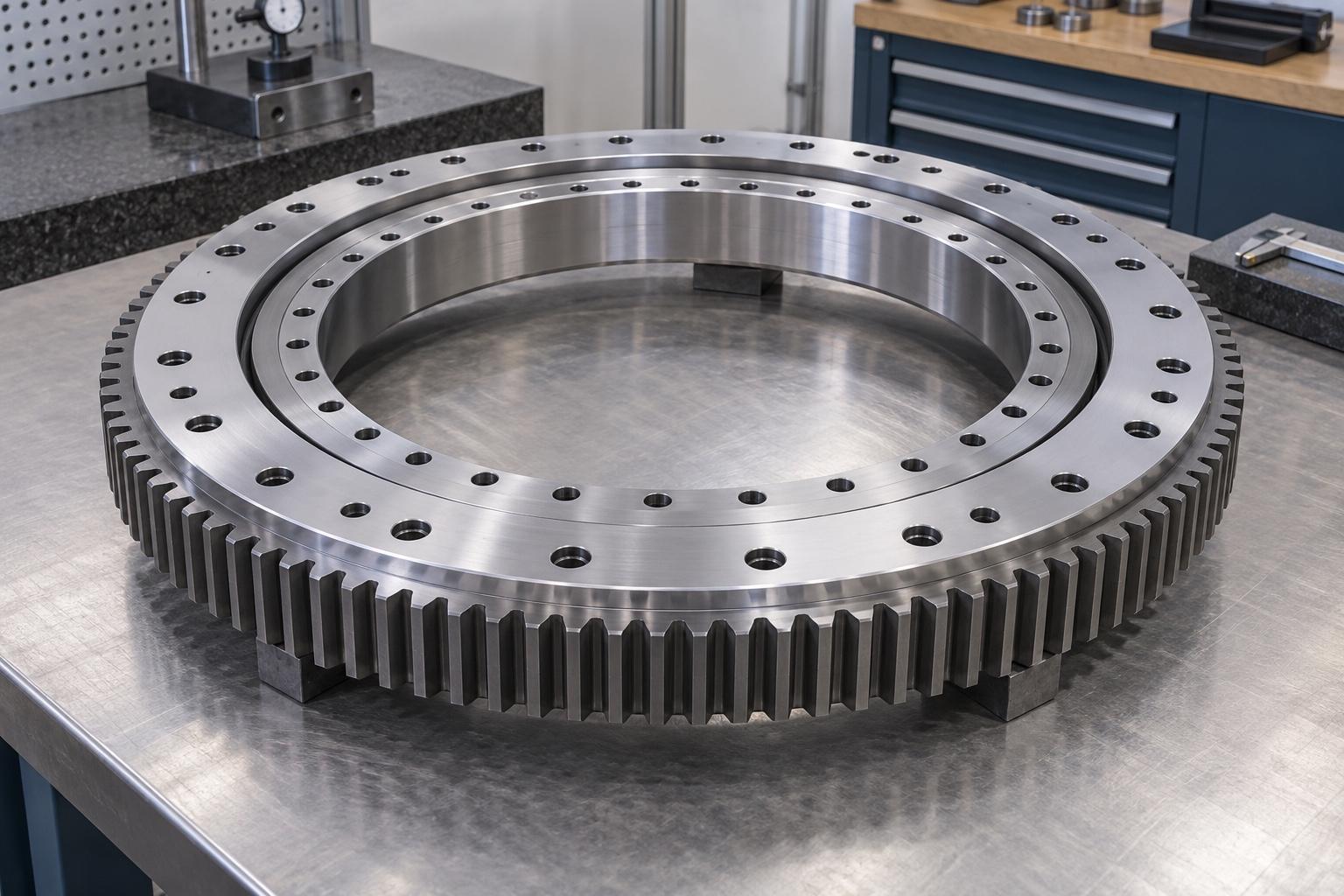
Next identify the gear arrangement. An external gear needs room around the bearing for the pinion, guard, and service access. An internal gear uses space within the opening. A toothless bearing leaves the drive to another part of the machine. If the existing bearing is geared, compare the tooth geometry and pinion interface as well as the location of the gear. Changing gear position is a drive-layout change, not a simple bearing swap.
Slewbearingtec’s product range includes external-gear, internal-gear, and toothless slewing bearings, along with single-row ball, double-row ball, and three-row roller designs. Those are useful families to compare, but the exact product drawing must decide whether a candidate fits. The phrase “slewing bearing” alone does not specify a rolling-element design, gear arrangement, or load capacity.
Recheck The Duty, Not Just The Dimensions
The old unit’s dimensions say what was installed; they do not prove that its capacity was right for every current operating condition. Collect the axial force, radial force, and tilting moment that occur together in each important case. Note how often each case occurs, rather than combining unrelated peak values into one artificial load. Include starting, stopping, reversing, shock, and any change in attachment or operating cycle.
Motion also changes the assessment. Continuous rotation, intermittent positioning, and repeated small-angle oscillation expose the raceways to different loading and lubrication patterns. A load check for the raceway should be paired with a check of the mounting bolts and supporting structure. For a geared bearing, the gear and pinion need their own check for transmitted force, backlash, contact pattern, and lubrication. A passing bearing load curve cannot by itself approve the whole assembly.
If the replacement changes from a ball design to a roller design, or changes the number of rows, treat it as a design change. The same envelope can contain different internal geometry, stiffness, clearance, and load distribution. Ask for a comparison based on the same operating cases and mounting assumptions.
Inspect The Surfaces That Carry The New Ring
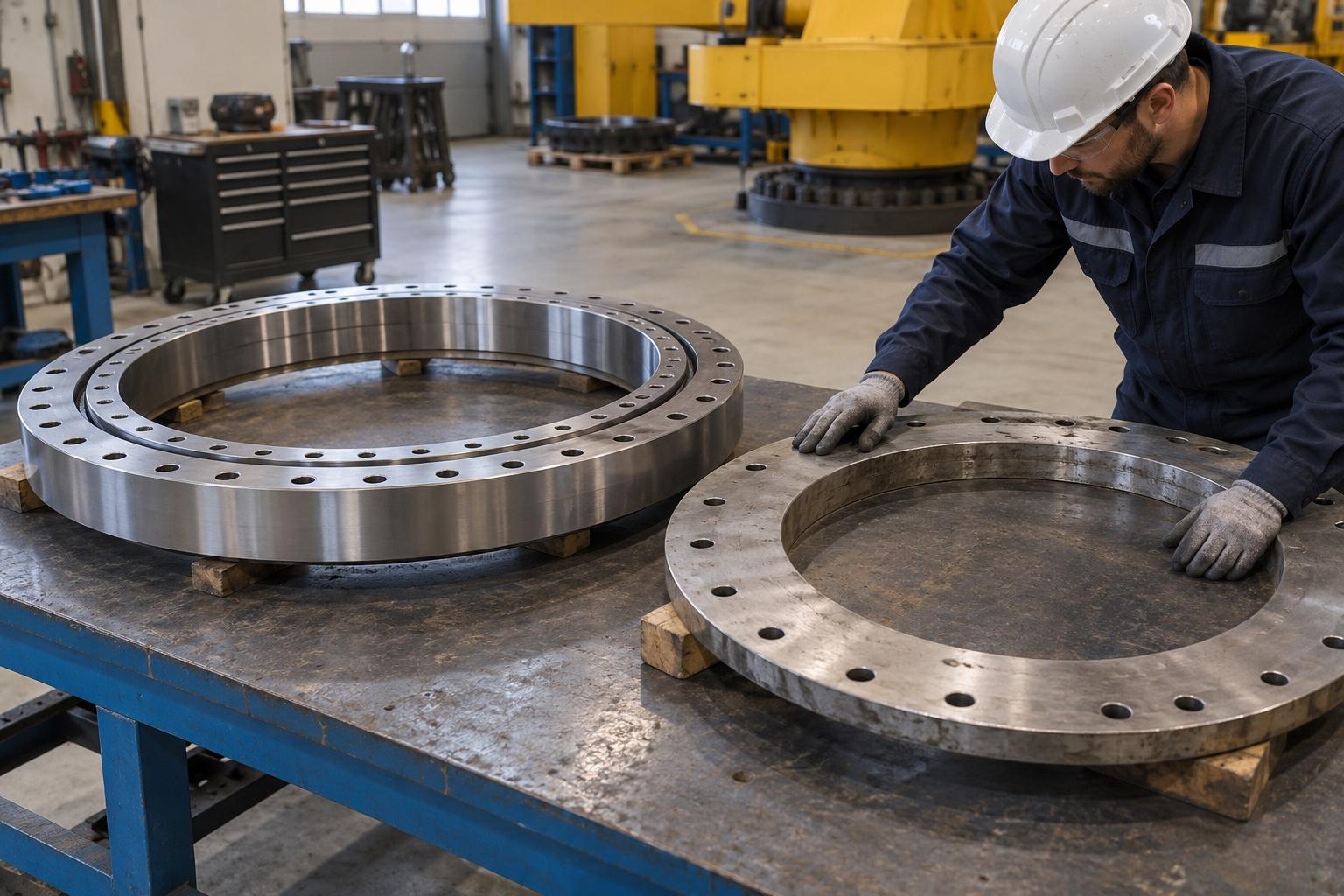
A new slewing bearing depends on clean, sufficiently flat, and stiff mounting faces. Local gaps or flange distortion can concentrate load in the raceway and bolts even when the bearing looks correct on paper. Check both mating structures against the selected product’s installation requirements before finalizing the order. Increasing bolt preload cannot correct a poor support surface.
Plan the installation details at the same time: the location of any marked soft zone or filling plug, the specified bolt tightening method, access for grease points, and the gear mesh where applicable. The raceway and gear teeth may need separate lubrication attention. Seals should be checked during installation and kept clear of water and debris in service.
An unexpected increase in drive effort, noise, or impact during rotation is a reason to stop and investigate. The source may be the gear mesh, lubrication, mounting face, preload, or a load the assembly was not assessed to carry. Replacing the ring without understanding the previous failure can leave that cause in place.
What To Send With A Replacement Inquiry
Send the machine model and serial number, original bearing identification, controlled drawings if available, and clear photos of the mounting and drive arrangement. Include the simultaneous load cases, movement pattern, environment, desired life, and any known failure history. State which ring rotates and whether the request covers only the bearing or also the pinion, reducer, motor, brake, or other parts.
Ask the supplier to identify the proposed bearing by a controlled drawing and to show how the raceway, bolts, gear, and installation conditions have been checked. For a first replacement or a change of supplier, confirm the interfaces and relevant inspection items on a sample before committing to a larger order. That review is more useful than comparing two rings by diameter and price alone.
