 SWBTEC


Slew Bearings: How To Choose The Right Gear Layout
When a rotating machine needs a slew bearing, the first drawing often settles only the ring diameter. The drive arrangement is a separate decision. A bearing with teeth on its outer edge, teeth inside its opening, or no teeth at all can occupy a similar envelope yet require a different pinion position, guard, and maintenance route.
The practical starting point is the complete rotating assembly. Identify which structure is fixed, which ring turns, where the drive can be mounted, and what must remain accessible after assembly. Only then does the choice between external gear, internal gear, and gearless slew bearings become meaningful.
What The Gear Does—And What It Does Not
Gear teeth allow a pinion to apply turning force to a bearing ring. They do not determine the bearing's rolling-element arrangement or prove its load capacity. The raceway carries the combined axial force, radial force, and overturning moment; the gear transmits drive force. Each needs to be checked for the machine's operating cases.
That distinction prevents a common specification error. An external-gear bearing and an internal-gear bearing are not interchangeable simply because their outside diameters match. The tooth location changes the pinion's position and available clearance. A gearless ring requires a separate way to rotate or position the supported structure.
External Gear: Keep The Drive Outside The Ring
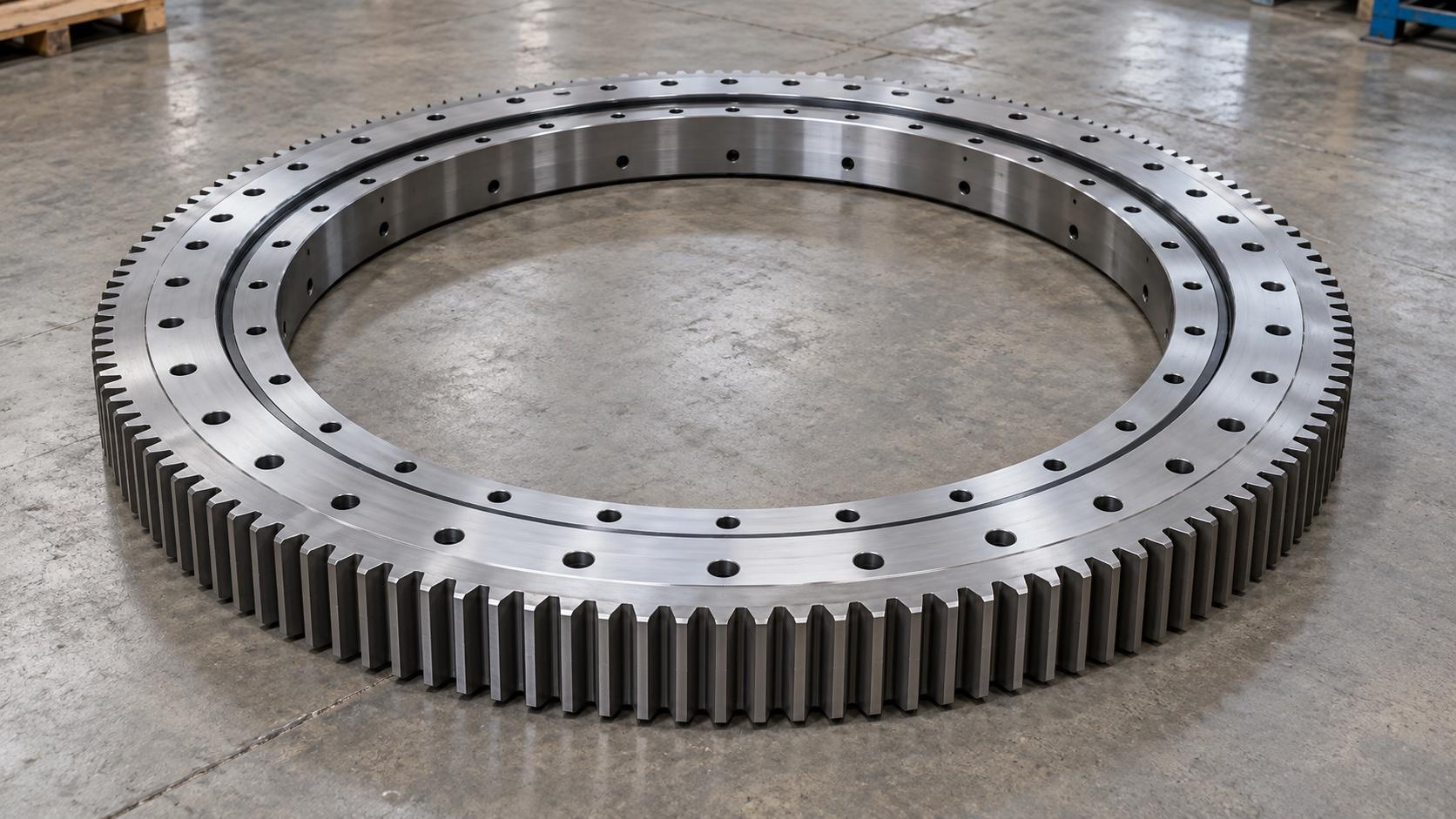
An external gear places its teeth around the outside circumference. It is a logical candidate when the machine has room beside the ring for a pinion and its drive, and when that area can be reached for inspection. Slewbearingtec has an external-gear slewing bearing in its product range, but the product drawing must confirm the precise ring, flange, and mounting-hole arrangement for a given machine.
Before choosing it, look beyond the bearing envelope. Allow space for the pinion, shaft support, gear guard, lubrication, and safe service access. Check whether surrounding frames, covers, or moving equipment would interfere with the mesh. The gear and pinion must be evaluated together for the actual drive loads, including changes in direction where applicable.
Internal Gear: Reserve Space Inside The Opening
An internal gear locates its teeth on the inner circumference. This can make sense when the drive can sit inside the ring opening and the space outside the bearing is needed for other structures. Slewbearingtec also lists an internal-gear configuration; it should be compared using its own approved drawing, not assumed to share the interfaces of an external-gear model.
The central opening is valuable machine space. Confirm that the pinion, shaft, guards, cables, pipes, and access for inspection can coexist there. Internal teeth may be less exposed to the outside environment, but that does not eliminate the need to inspect and lubricate the mesh. If access is poor after assembly, a seemingly compact layout may become difficult to maintain.
Gearless: Separate Support From The Drive
A gearless slew bearing has no integral gear teeth. It is worth considering when rotation will be driven by another mechanism or when the bearing is used mainly as a rotating support. Slewbearingtec's range includes a bearing without gear, so this is a genuine product configuration rather than a geared ring with its teeth omitted from a drawing.
The drive method still needs an explicit design. Specify how torque reaches the rotating structure, how movement is held or stopped, and whether the separate drive changes loads on the bearing or its mountings. A gearless bearing may simplify the ring interface, but it does not remove the need to check the complete assembly.
Check The Bearing And Drive As One System
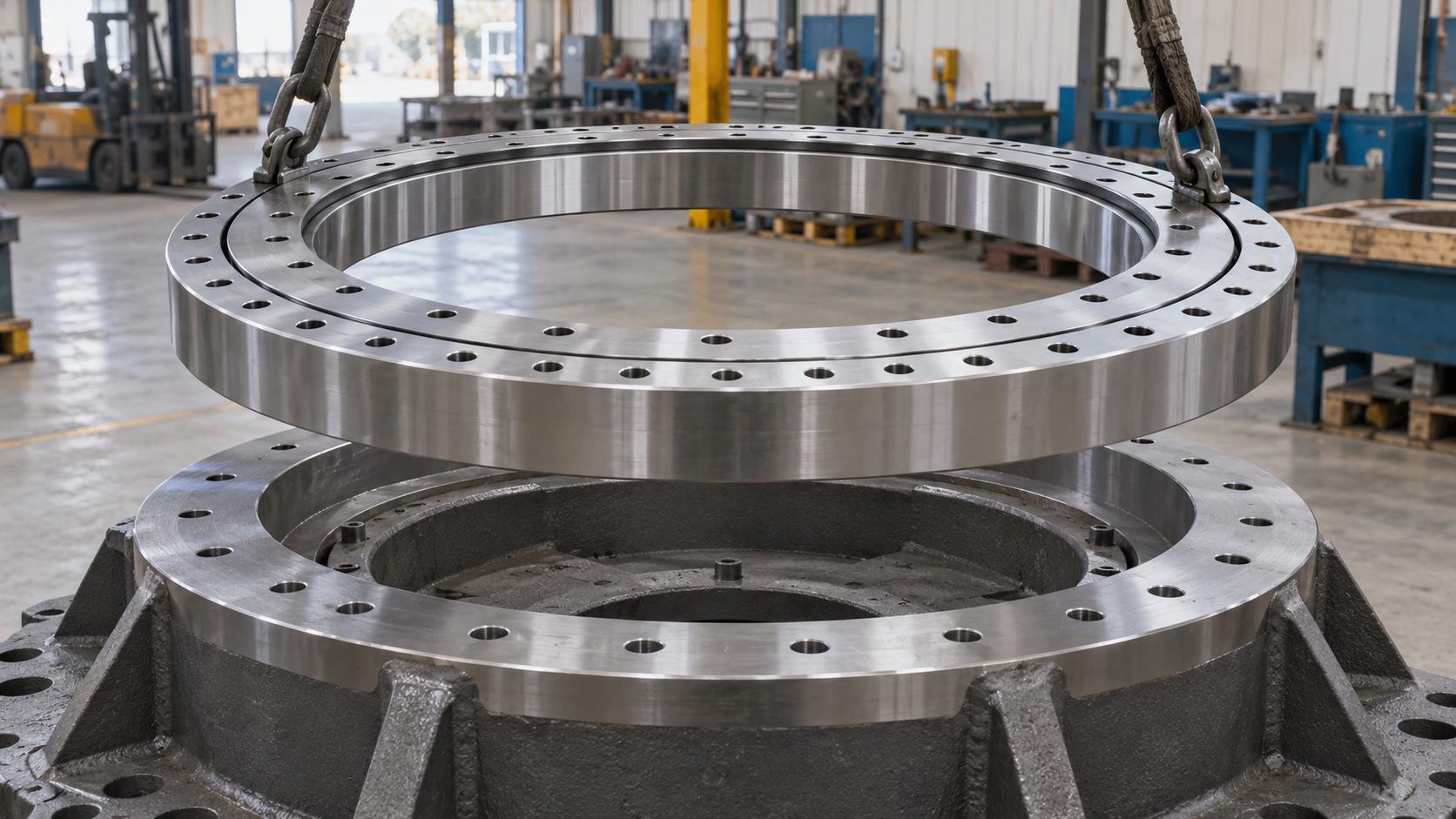
Once a gear location looks workable, bring the mechanical interfaces onto one drawing. Record the inner and outer diameters, overall height, locating features, both bolt circles, hole sizes and types, and the identity of the fixed and rotating rings. For a geared unit, add gear data and the intended pinion arrangement. Confirm clearance throughout the full movement range, not only at one parked position.
Next, check the loads that occur together in each relevant operating condition. A useful case includes axial and radial forces, overturning moment, motion direction, and the turning or holding demand. The bearing raceway, mounting bolts, support structure, and gear mesh need their own evaluations. A suitable gear location cannot compensate for an inadequate bearing or flexible mounting surface.
Installation also affects the result. The selected product's instructions should govern mounting-face condition, bolt tightening, initial lubrication, and any marked soft zone or filling-plug position. Plan separate access to the raceway and the gear teeth where a gear is present. These details are easiest to solve while the assembly is still on the drawing board.
What To Send For A Useful Quotation
Send the machine layout, the mounting drawing, and a clear view of the space available inside and outside the bearing. State which ring rotates, the planned drive position, the movement pattern, and the simultaneous load cases. If the request replaces an existing unit, include its identification and controlled drawing if available. Measurements taken from a worn bearing are helpful, but they should be checked against the machine interface.
Ask for a proposed model and drawing that make the gear position, mounting pattern, and supply scope unambiguous. Specify whether the quotation covers only the slew bearing or also the pinion and other drive components. That turns a broad product name into an assembly that can actually be reviewed before purchase.
