 SWBTEC


High Precision Slewing Bearing
In the field of mechanical design, the definition of high-precision slewing bearing (High Precision Slewing Bearing) has never been vague. From the perspective of technical selection, its core indicators must meet the P5 or even P4 accuracy level under the ISO 492 standard. This means that, regardless of the diameter, the axial and radial runout are usually tightly controlled between 0.01mm and 0.03mm.
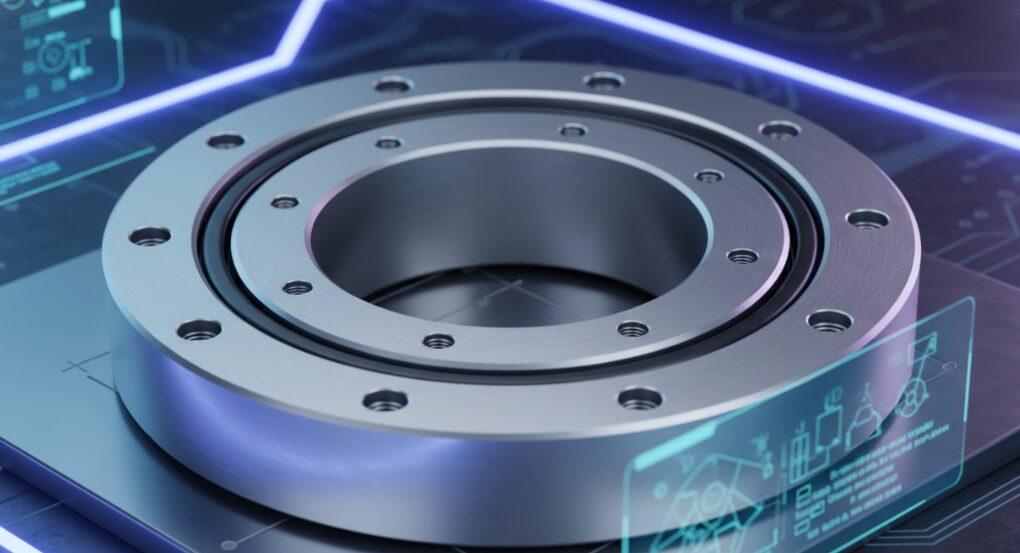
To achieve this kind of uncompromising precision satisfactory rotation accuracy, luck alone isn’t enough. This often requires a set of integrated manufacturing approach: first, the raceway must be ground to mirror-level accuracy; second, negative clearance (that is, what we often call “preload”) is introduced to completely eliminate shaking, and then cross roller configuration or high-grade steel balls are used to support anti-overturning rigidity. In order to ensure that the chain does not drop under complex dynamic and static loads, the material must be high-purity 42CrMo or 50Mn steel, and the raceway must undergo precise induction hardening. Only by pressing the gear backlash to a minimum and keeping the starting torque highly consistent can the micron-level positioning accuracy be achieved in medical CT, optical tracking or semiconductor equipment.
Disassembly Standards: ISO 492 P5 And P4 Levels
In the circle of high-performance motion control, ordinary supports often show up after running. Really qualified “high precision” must be hard to knock ISO 492 P5 or P4 standard. These grades have nearly severe limits on axial and radial runout.
For those of us who deal with drawings every day, 0.01mm to 0.03mm are definitely not just cold numbers, they are the pins of system stability. When a support reaches the P4 level, even under large diameter conditions, the deviation during rotation will be suppressed to a minimum, directly avoiding the geometric error of the end application from the source. Behind this precision is the implementation of a complete set of manufacturing processes that go beyond conventional commercial supports, and every detail must be strictly guarded.
Full Rotation Accuracy By Preload And Structure
The essential difference between ordinary slewing bearings and high-precision versions is often hidden in the internal gap. High-precision slewing bearings are usually designed with “negative clearance”, which is the industry’s customary “preload”.
In the assembly stage, we will apply internal load through control means to completely strangle the “play” between the rolling body and the raceway. I personally prefer the cross roller configuration-the rollers are staggered at 90 degrees. This geometric structure with high-precision steel ball, can significantly improve the anti-overturning rigidity. This means that the support can still berock-solid stability when it is subjected to radial, axial and overturning moments at the same time, and will ensure system reliability on the micron-level precision.
Single Row Ball Slewing Bearing
Single-row ball slewing bearings are divided into internal tooth, external tooth and toothless structure, which are suitable for a variety of transmission needs.
Double Row Ball Slewing Bearing
Double-row ball slewing bearings are specially designed for super-heavy load scenarios.
Slewing Bearing With External Gear
The external gear internal flange slewing bearing integrates the advantages of external gear transmission and internal flange mounting.
Slewing Bearing With Internal Gear
The internal tooth and external flange slewing bearing is characterized by the combination of internal tooth transmission.
Slewing Bearing Without Gear
Gearless double flange slewing bearing is light weight and compact.
Cross Roller Slewing Bearing
Single-row cross roller slewing bearing adopts roller cross layout, large contact area, can synchronously and efficiently withstand axial and radial loads and overturning moment,
Hard Core Material: 42CrMo With Induction Hardening
Durability and accuracy are parallel, and no one can do without them. In order to maintain the accuracy of P5/P4 after millions of cycles, the material must be thick. In the practical application of SlewBearingTec, we basically only exclusively utilize high purity 42CrMo or 50Mn steel.
The good thing about 42CrMo is that its fatigue strength and toughness are high enough, especially suitable for fine work under heavy loads.
Regarding induction hardening, we require that the raceway must reach a specific HRC hardness depth. This step is critical: both to ensure that the contact surface wear-resistant, but also to maintain enough toughness to absorb core impacts.
The final raceway grinding is the highlight. After heat treatment, the raceway should be ground to the mirror level, which is not only to look good, but also to reduce friction and ensure the consistency of starting torque. This is the last pass to reach the runout tolerance standard.
Performance Index: Gear Backlash And Starting Torque
In precision positioning tasks, the interface between the support and the drive system is also a “deep pit”. High precision slewing bearings in the design must consider the gear backlash reduced to a minimum. Whether you have internal teeth or external teeth, the tooth profile must be precision machined to ensure smooth meshing with the pinion.
The smoothness of the starting torque is very critical in some sensitive applications. Imagine if the torque of a medical scanner or optical tracker suddenly jumps during movement, and the entire trajectory is destroyed. By optimizing the internal geometry and lubrication flow path, we ensure that the support provides a smooth and predictable spinning experience like silk over the entire speed range.
“Battlefield” Of High Precision Slewing Bearing
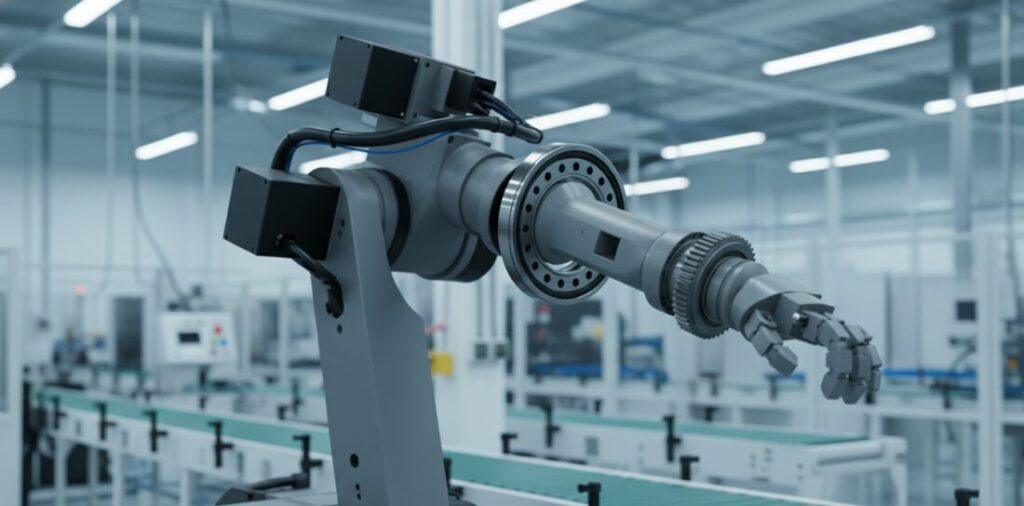
This sub-millimeter positioning capability has made it a necessity for high-tech industries:
Medical CT scanner: to ensure that the frame does not vibrate when rotating at high speed, which is the premise of taking clear medical images.
Optical tracking system: Provides the necessary stability for remote sensors and laser communication terminals to ensure that targets can still be deadlocked at long distances.
Semiconductor manufacturing: In wafer handling and the movement of lithography components, even a deviation of microns can mean that entire batches of chips are scrapped.
Combining advanced metallurgy, rigorous heat treatment and special internal structure, these high-precision slewing bearings from SlewBearingTec are essentially designed to meet the world’s most complex engineering challenges.
Author: James Reynolds
Hi, I’m a senior mechanical engineer at SlewBearingTec with over a decade of hands-on experience in high-performance motion control. My career has been defined by a relentless pursuit of “obsessive-compulsive” rotation accuracy. I specialize in navigating the rigorous ISO 492 P5 and P4 standards, focusing on the intricate balance between negative clearance (preload) and anti-overturning rigidity. From selecting high-purity 42CrMo steel to perfecting induction hardening and mirror-level grinding, I am dedicated to helping engineers solve the world’s most complex positioning challenges in medical, optical, and semiconductor industries.
