 SWBTEC


Heavy Duty Slewing Bearing
When choosing a heavy slewing ring, you must not only stare at the unit price. This is actually doing risk management: through technical accuracy and full life cycle reliability, the operation and maintenance costs down.
High-performance heavy-duty slewing bearings must have several hard indicators: high-quality 42CrMo or 50Mn steel, deep quenched raceways that can withstand extreme axial, radial and overturning moment loads, and gears that are finished to reduce backlash. If you want less downtime and more years of work, the purchasing team will have to knock down the manufacturing details of the manufacturer: is the induction heat treatment process rigorous? Is the lubrication system integrated? ISO quality inspection report is complete? The best bearing is not the most expensive, but the most suitable for your specific working conditions-whether it is wind power, excavator or large turntable, only the torque capacity and tolerance control balance is good, in order to ensure that the equipment is still stable in the harsh industrial environment.
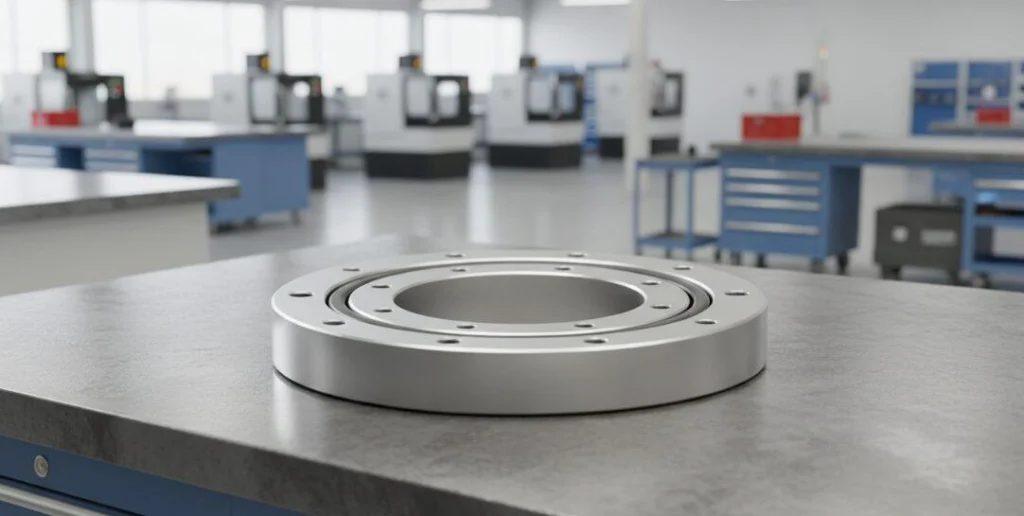
Material Specifications
The foundation of any high-performance slewing bearing is derived from raw materials. If the purchasing decision only depends on who has the stock, it is irresponsible for all kinds of hidden dangers of its own equipment. The key depends on whether the chemical properties of the steel meet the standards.
42CrMo: If your working condition requires extremely high fatigue resistance and impact toughness, it must be right. It maintains excellent structural integrity under severe load fluctuations and is the “gold standard” for heavy rotating equipment.
50Mn: If your application scenario focuses more on surface wear resistance and high core hardness, then 50Mn is actually quite enough.
Find out these material differences, you will naturally have a bottom when looking at the manufacturer’s quotation, to ensure that the selected steel number can match the actual stress level of the equipment.
Single Row Ball Slewing Bearing
Single-row ball slewing bearings are divided into internal tooth, external tooth and toothless structure, which are suitable for a variety of transmission needs.
Double Row Ball Slewing Bearing
Double-row ball slewing bearings are specially designed for super-heavy load scenarios.
Slewing Bearing With External Gear
The external gear internal flange slewing bearing integrates the advantages of external gear transmission and internal flange mounting.
Slewing Bearing With Internal Gear
The internal tooth and external flange slewing bearing is characterized by the combination of internal tooth transmission.
Slewing Bearing Without Gear
Gearless double flange slewing bearing is light weight and compact.
Cross Roller Slewing Bearing
Single-row cross roller slewing bearing adopts roller cross layout, large contact area, can synchronously and efficiently withstand axial and radial loads and overturning moment,
Load And Backlash Management
Slewing bearing is the “heart” of rotating machinery. Once it goes wrong, the whole equipment will be basically paralyzed. The cost is not as simple as a little maintenance fee. In the technical specifications, there are two points that must be stuck:
Deep Hardening of the Raceway: The raceway is the primary contact surface for the rolling elements. The quenching depth is not enough, and the raceway surface will quickly peel off and deform under the compound impact of extreme axial, radial and moment loads. This is often the most direct cause of early failure.
Precision gear machining: gear accuracy directly determines how long the rotation is flat and the drive system can last. The “backlash”, that is, the gap when the gears are engaged, must be strictly controlled. If the amount is too large, vibration, noise, and accelerated wear will all come to the door, and the life of the entire system will end.
The Technical Specifications To The Standard Work Conditions
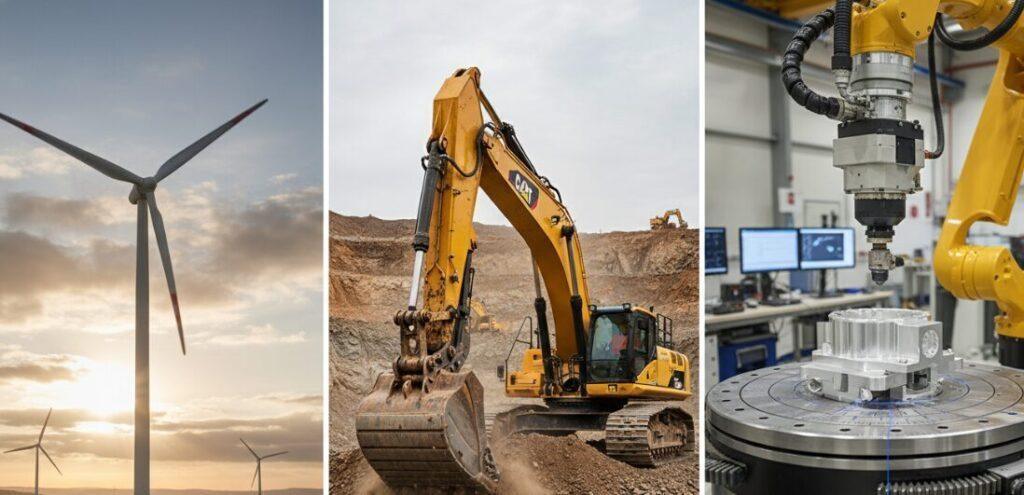
There are no “universal” bearings on the market, only the “most suitable” ones. You need to accurately align technical parameters with specific equipment requirements:
Wind turbine: the fatigue life requirements are extremely high, but also anti-corrosion, usually need to add a special coating with 42CrMo steel.
Heavy excavator: the impact load is large, the direction changes, the focus is on the impact resistance and root strength of the raceway.
Large rotary table: the pursuit of high rotation indexing accuracy, tolerance control must be strict.
The torque, speed, and load characteristics of the application scenario are one-to-one with the manufacturer’s data sheet to achieve this. Whether it is initial purchase expenditure or long-term maintenance expenditure, you can achieve the optimal solution.
Author: Alex Sterling
I am a mechanical engineering consultant specializing in heavy machinery supply chains. With over 15 years of experience in the field, I’ve witnessed countless projects face costly delays due to “cost-effective” bearing failures. When I’m not auditing production lines, I’m helping industrial firms optimize their reliability and reduce long-term operational costs.
