
 SWBTEC


What Is A Slewing Ring Bearing
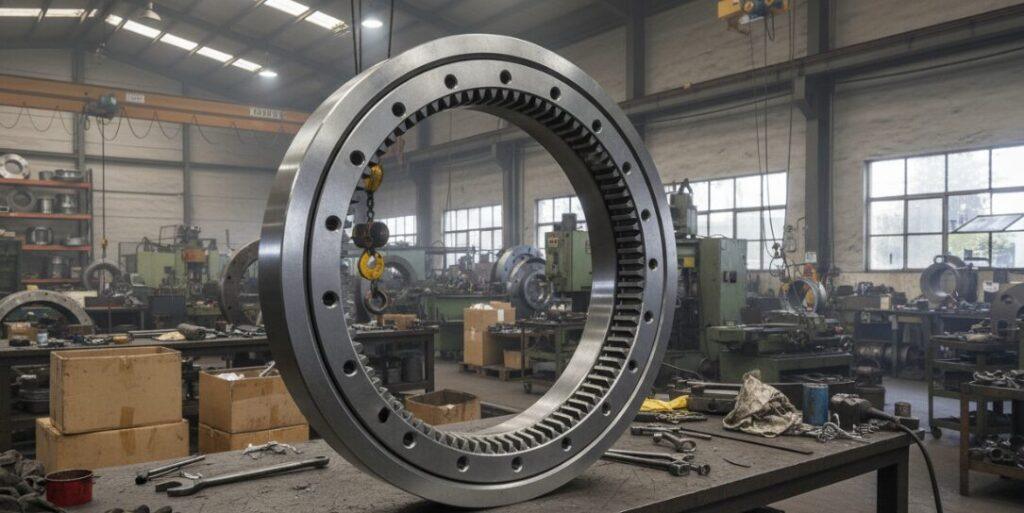
A slewing ring bearing is a complete, ready-to-install rotational system component designed to simultaneously handle complex, combined loads—specifically high axial forces, radial forces, and critical tilting moments—within a single, compact unit. A slewing ring bearing’s core function is to serve as a structural connection point between two machine parts, facilitating controlled, heavy-duty rotation while transmitting significant loads. Its primary value lies in its integrated design, which incorporates features like internal or external gearing for driving the rotation, mounting holes for direct bolting to a structure, and robust sealing. This eliminates the need for a complex assembly of separate components like kingpins, washers, and multiple bearing sets. When selecting a slewing ring, the most critical parameter to define is not just the axial or radial load, but the tilting moment load, as this often dictates the required size, internal geometry (e.g., four-point contact ball, crossed roller, or multi-row roller), and the stiffness of the bearing and its supporting structure, directly impacting the entire machine’s operational precision and long-term reliability.
The Power Of An Integrated Rotating System
The most defining characteristic of the slewing bearing is its “integrated” design, which offers a simplified solution for heavy-duty rotary applications.
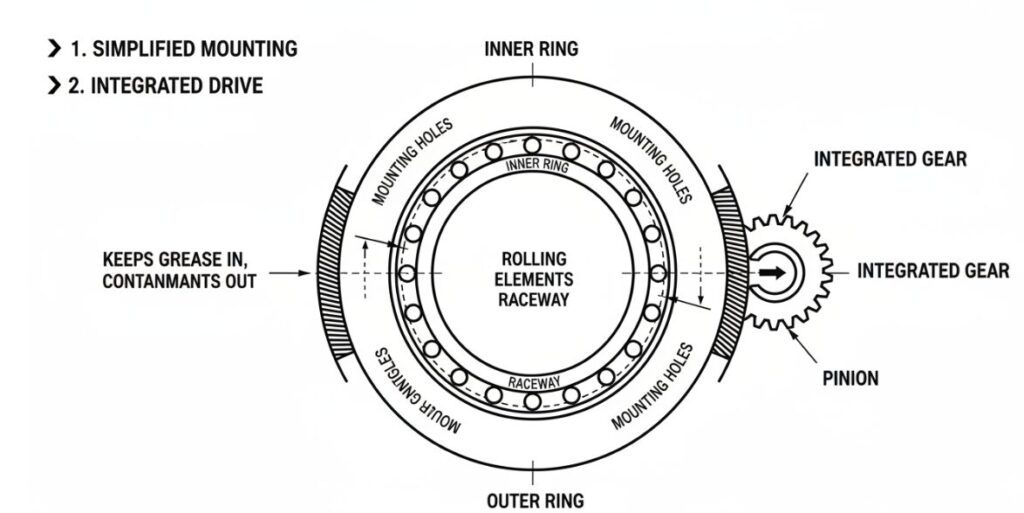
- Simplified Mounting: With mounting holes designed directly on the inner and outer rings, the bearing can be bolted directly to the machine frame and the rotating structure. This ensures a safe and direct transmission of loads.
- Integrated Drive: The inclusion of gears on the inner or outer ring is a game-changer for the drive system. This ring gear can mesh directly with a pinion to provide the necessary torque for precise rotational movement. This built-in feature eliminates the need for external gears or other drive mechanisms, reducing the total number of parts, minimizing assembly time, and significantly lowering the risk of alignment errors between separate components.
- Robust Sealing: A key integration feature is its robust seal, designed to retain grease while protecting the internal raceway and rolling elements from contaminants such as dust, dirt, and moisture. This is fundamental to ensuring performance and longevity for equipment operating in harsh conditions.
The Core Functionality Of Slewing Ring Bearing
From an engineering perspective, the central problem that slewing bearings solve is the management of complex and concurrent loads. In heavy machinery like excavators, cranes, and wind turbines, forces are rarely simple or unidirectional. A component is often subjected to:
- Axial force: This load runs parallel to the bearing’s axis of rotation, such as the weight of a crane boom and its lifted load.
- Radial force: This force acts perpendicularly to the axis of rotation, like the lateral force from wind or the centrifugal force generated by a rotating structure.
- Overturning moment load: This is the most complex and often the most critical load. It is the tilting force that attempts to lift one side of the bearing while compressing the other. This moment is generated when a load is applied at a distance from the bearing’s centerline, a common scenario in equipment with long booms or arms.
The unique internal geometry of the slewing bearing, featuring deep raceways and a large number of rolling elements, is specifically developed to simultaneously resist these composite forces. This ensures that the equipment can rotate stably, smoothly, and safely under immense pressure.
The Key Role Of The Overturning Moment In Type Selection
While axial and radial load capacities are important, the overturning moment is frequently the decisive factor in the selection of a slewing bearing. Underestimating the moment load can lead to catastrophic failure, excessive wear, or a complete loss of operational accuracy.
The magnitude of the overturning moment directly influences the size and internal design of the bearing. To accommodate different load conditions, slewing bearings are available in several internal structures:
- Four-Point Contact Ball Bearings: This common design utilizes a single row of steel balls, with each ball making four points of contact with the raceway. It is a versatile solution capable of handling moderate levels of axial, radial, and moment loads, making it suitable for a wide range of applications.
- Crossed Roller Bearings: This type of bearing employs cylindrical rollers arranged in a crisscross pattern, with each roller perpendicular to the adjacent one. This configuration provides a larger contact area, resulting in higher rigidity, stronger load capacity, and more precise rotation compared to ball bearings of the same size. This design is ideal for applications that require high accuracy under heavy torque loads.
- Multi-Row Roller Bearings: For the most demanding applications, such as large cranes, tunnel boring machines, and offshore platforms where axial loads and overturning moments are exceptionally high, multi-row roller or roller/ball combination bearings are used. These designs distribute massive loads across multiple rows of rollers to ensure maximum stability and durability.
Ultimately, the correct evaluation of the overturning moment is foundational. It not only ensures the integrity of the bearing itself but also determines the stiffness of the entire rotating system. A bearing that deforms excessively under torque will severely impact the machine’s accuracy and can lead to the premature failure of both the bearing and its surrounding components. This underscores the direct link between proper bearing selection and the long-term operational reliability of the equipment.
Author :Benjamin
As a specialist with a deep focus on industrial and mechanical components, I spent several years analyzing the technical problems of slewing bearings. In this article, I break down the core functions and critical selection parameters of slewing ring bearings to help professionals make more informed decisions when sourcing these vital components for their heavy-duty applications.
