 SWBTEC


Slewing Ring Bearing Maintenance to Extend Qquipment Life
In the field of large-scale equipment, the effective maintenance of slewing bearing, in my opinion, mainly relies on three cornerstones: regular lubrication (especially the removal of old grease when rotating in rotation), regular verification of bolt torque, and inspection of seal integrity. These three points can effectively prevent pollutant intrusion and raceway spalling, and they are also the fundamental guarantee for avoiding catastrophic failures and costly downtime.
Slewing bearing maintenance process
Based on my on-site experience, improper lubrication accounts for the vast majority of the causes of bearing failure. This is not merely about adding grease; The key lies in adding the correct annotations. The following is a set of maintenance operation procedures that I have summarized for you to follow on site.
Lubrication
One common mistake made by many operators is to apply grease vigorously when the bearing is stationary. This will create “pressure points” while leaving dry zones.
- Select the appropriate grease: Be sure to consult the equipment manufacturer’s (OEM) manual. Generally, lithium-based extreme pressure (EP) grease (NLGI No. 2) is suitable for most slewing bearings, but in extreme temperature environments, synthetic grease may need to be considered.
- Clean the oil nozzles: Before connecting the lubrication gun, please make sure to wipe each oil nozzle clean. You surely don’t want to drive the sand into the raceway.
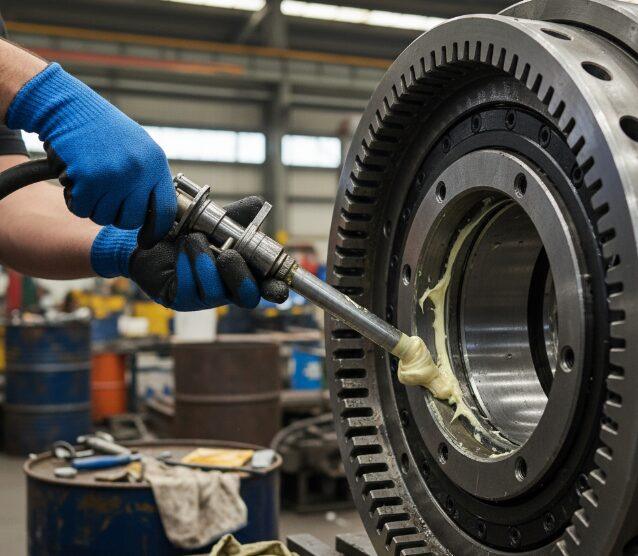
- While oiling and rotating: Inject grease into the oil nozzle while the equipment is rotating slowly.
- “Drain old grease” principle: Keep pumping until you see fresh grease squeezed out from the edge of the sealing ring around the entire circumference. This is the key point. Old grease can carry contaminants, moisture and metal particles. If it is only injected without being discharged, it is actually no different from grinding the bearing with sandpaper paste, and the consequences would be unimaginable.
- Frequency: Generally speaking, it is a rule of thumb to lubricate every 100 operating hours. However, in dusty or humid environments (such as demolition or dredging operations), this interval should be shortened to every 50 hours, or even daily checks are required.
Bolt torque inspection
A loose bolt, in my opinion, is the first domino of bearing failure. Once a bolt loses its tension, the load will be transferred to other bolts, triggering a chain reaction failure.
- Initial inspection: The bolt torque should be checked once within the first 50 hours after the new equipment is put into operation.
- Routine inspection: After the initial running-in period, it is recommended to check the bolt torque every 1,000 to 2,000 hours.
- The “10% Inspection Method”: The “10% Inspection Method” I personally recommend is as follows: When conducting a quick inspection, you don’t need to check all the bolts one by one. Randomly select 10% of the bolts for torque inspection. If any of them is found to be loose, my suggestion is that you must conduct a 100% comprehensive inspection of all the bolts.
- Visual aid: I have always recommended using a paintbrush to draw a line on the bolt head and the ring. If these lines are misaligned, you can immediately know that the bolts have loosened without having to use a torque wrench to check them one by one.
Sealing inspection
The sealing ring can be regarded as the “gatekeeper” of the slewing bearing. If the sealing ring is damaged, water will enter and the grease will be lost.
- Check whether the rubber sealing ring has cracks, tears or hardening.
- Check whether it is in the correct position. Sometimes, excessive grease pressure may also push the sealing ring out of its groove.
- If the sealing ring is damaged, please replace it immediately. It should be noted that the cost of replacing a rubber sealing strip is far lower than that of remanufacturing or refurbishing a bearing worth $10,001.
Troubleshooting Common Symptoms
- Grinding or clicking sounds: This usually indicates that the raceway is damaged or the balls/rollers are peeling off. And hearing a “bang” usually means that an installation bolt has broken.
- “Jamming” or “shaking”: If the rotation is not smooth and there is a feeling of jamming or lag, it is very likely that the lubrication is seriously insufficient or the tooth surface of the gear ring is damaged.
- Metal debris in grease: When you drain the old grease, catch some with a white cloth. If you see thin metal sheets, it indicates that wear has begun to occur.
Establishing a Preventative Maintenance (PM) Schedule
It is essential to implement a strict preventive maintenance plan
- Mandatory log: Every time technicians lubricate the slewing bearing, a record must be kept. Without records, there will be no vouchers.
- Grease analysis: For high-value assets, it is recommended to send grease samples to the laboratory for analysis annually. They can detect iron or moisture content that is invisible to the naked eye, allowing you to plan for replacement months in advance instead of passively responding after a malfunction occurs.
- Clearance measurement (tilt test): Measure the tilt clearance (axial clearance) of the bearing once a year. Compare it with the baseline data when the equipment is new. If the clearance exceeds the manufacturer’s limit, a spare bearing must be ordered immediately to be ready for replacement when the next planned shutdown occurs.
Frequently Asked Questions
Question: Can I mix greases of different brands?
Answer: Based on my experience, in general, mixed use should be avoided. Incompatible thickeners (such as mixing lithium-based grease with polyurea grease) may cause the grease to liquefy and flow out of the bearing. It is recommended to insist on using the same model or thoroughly rinse it clean before replacement.
Question: How do I know that my slewing bearing needs to be replaced?
Answer: Excessive clearance (tilt) in the structure, metal blocks in the discharged grease, or stiffness even after lubrication during rotation are all major signs. Of course, the most scientific way to confirm the wear limit is still to test it with a dial indicator.
About the Author: Mark Miller
I’m Mark Miller, a Senior Field Application Engineer with over 20 years of boots-on-the-ground experience in heavy machinery. From remote mining sites to busy container ports, I’ve diagnosed thousands of slewing ring failures that could have been prevented. My mission is simple: to bridge the gap between OEM manuals and real-world application, helping you extend the life of your equipment through proper lubrication and rigorous maintenance protocols.
