 SWBTEC


Slewing Ring Bearing Maintenance: A Practical Field Guide
The rotary support connects two sets of large structural parts, which must bear axial and radial forces as well as hard top overturning torque. That’s why routine maintenance is by no means as simple as “getting five or two shots of butter every now and then”. The stiffness of the bearing ring, fastening bolts, sealing lip, ring gear tooth surface, pinion and even base will cause the equipment to slip during rotation. A truly effective maintenance procedure requires keeping a close eye on the entire assembly and catching any anomalies before minor problems worsen into unplanned downtime.
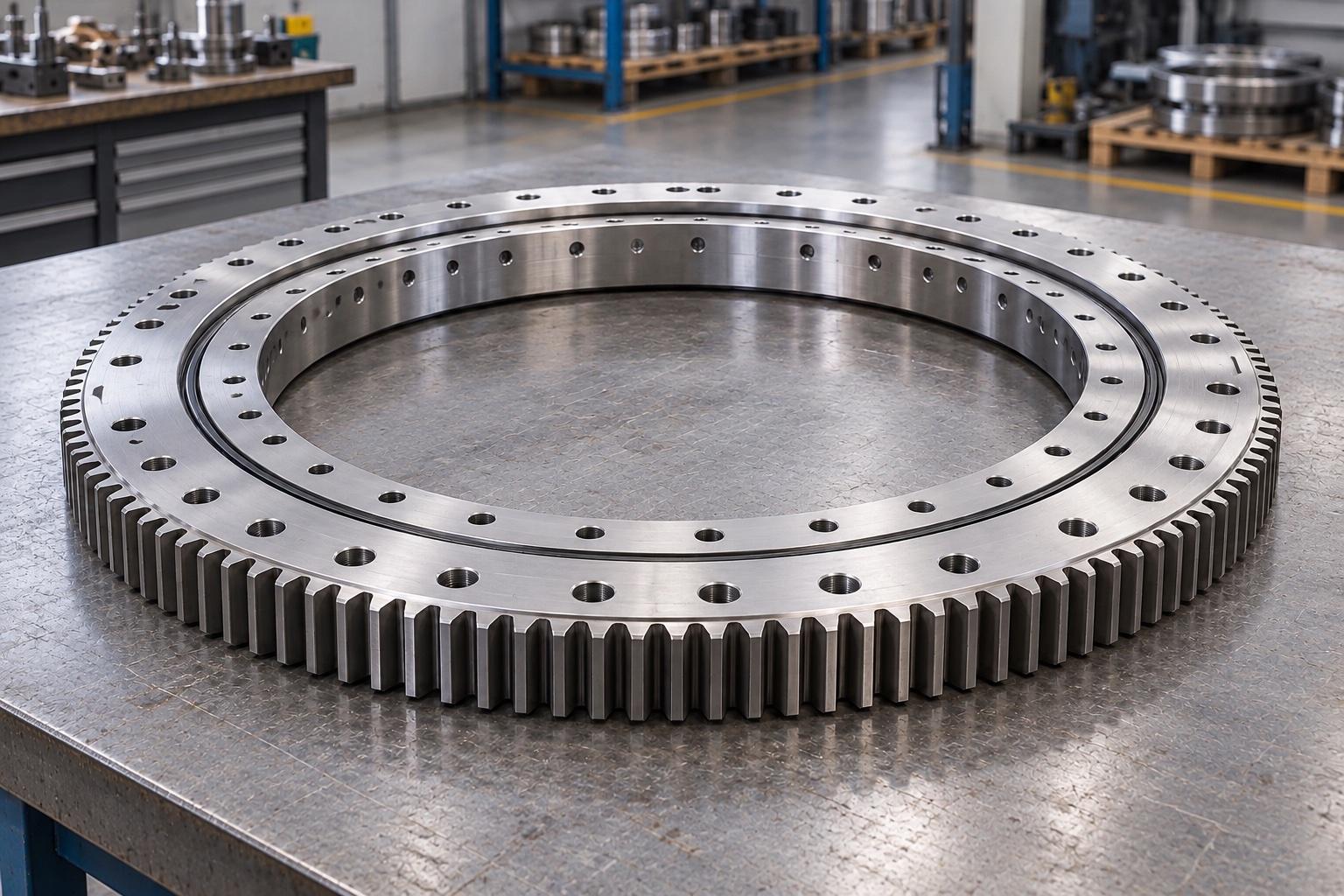
First Find The Bottom Of The Bearing On Your Hand
Don’t rush to determine the maintenance cycle, first understand what model is hanging on the equipment. Find the specific position of the raceway nozzle, distinguish whether it is an internal tooth or an external tooth, and understand how the drive assembly engages and transmits the gear. If a bearing with a sealing lip is equipped with an exposed gear pair, it is usually two completely different sets of lubrication work ——filling the raceway with oil does not mean that the tooth surface has also been rubbed with oil.
Manufacturer’s drawings and random technical information must be compared with the overall machine maintenance plan. The grease brand number, oil filling volume, oiling method, bolt inspection specifications and wear and retirement limits all have to be carefully considered for the specific model and working conditions. For example, a crane that is soaked in salt spray by the sea all year round must never follow the maintenance procedures of an indoor light-load turntable. Don’t think that it can be used randomly just because it looks similar.
Whether The Wear Is Significant Or Not, First Look At The Initial Reference Line
After the new bearing is assembled and the initial test run is completed, be sure to immediately remember “the original background color”: rotation smoothness, operating noise, driving current or pressure, sealing lip fit status, open tooth contact marks, and the original clearance or overturning deformation required by the factory. If the overturning clearance method or sinking measurement method is used, the measurement point position, the overall machine posture, the direction of force, the measurement tool and the meter printing method must all be solidified in black and white.
Subsequent test data will only be of reference value when compared under the same working conditions and postures. If the arm angle changes slightly, or if more things are hung on the hook, the measured shaking momentum will vary greatly, even if there is no wear inside the bearing. When looking at data, we need to look at the long-term development trend. A single isolated data point cannot explain the problem; conversely, even if the value measured in a certain time is still within the tolerance range, as long as the value increases sharply compared with the last time, it must be stopped for in-depth investigation.
The Raceway And Gear Ring Must Be Lubricated Separately
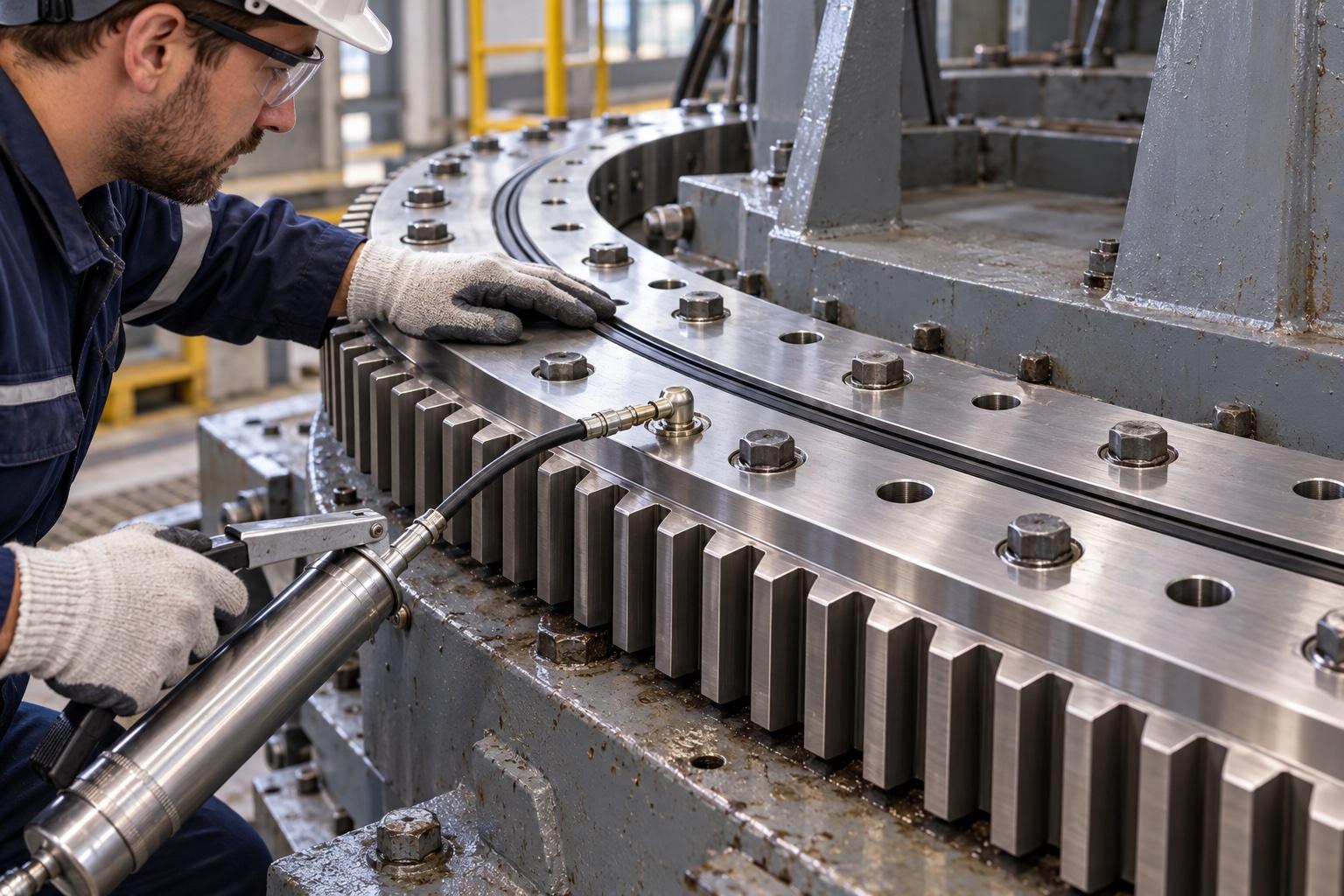
Before filling the gun with oil, verify the grease brand number. Taking Slewbearingtec’s product specifications as an example, bearings are usually only filled with trace amounts of EP2 anti-rust grease when they leave the factory. Therefore, after the equipment is installed in place, the first thing to do is to completely fill the raceway with oil. The standard specifies a normal operating fat replenishment cycle of 50 to 60 operating hours. However, this is only a benchmark. Once you encounter situations with large dust, wading, high temperatures, or frequent equipment flushing, this cycle must be decisively shortened.
When fat replenishment is carried out, as long as the on-site safety conditions allow, oil must be injected while rotating or swinging the equipment so that the new fat is evenly distributed throughout the entire load-bearing raceway. Keep your eyes on the sealed lips and the squeezed waste oil at all times: if the waste oil is black, smelly, or mixed with water droplets, mud, sand or even metal particles, don’t just wipe it clean and quickly find the source of the dirt. In addition, the more grease you beat, the better. Excessive pressure or excessive fat injection will directly overturn the sealing lip and cause long-term oil leakage.
For structures with gear rings, the open tooth meshing surface must be inspected and lubricated separately according to the gear transmission rules. Focus on observing the changes in tooth surface oil film thickness, abnormal grinding, pitting, cracks and tooth surface contact area. Gear grease and raceway grease are usually not the same oil, so avoid mixing them for ease of use.
Keep The Dirt Out Of The Raceway
Carefully feel the sealing lip along the entire circle to see if there are any cuts, cracks, local degrooving or long-term leakage. Once the seal breaks, sediment and water vapor will be driven in continuously. However, minor damage to the seals does not mean that the raceway has been completely scrapped. First, consider the condition of the old oil discharged and the operating vibration situation before assessing whether major repairs are needed.
When cleaning debris from the outer ring of the bearing, be careful not to use a spatula or rag to push the dirt hard into the sealing seam. High-pressure water guns or car wash nozzles must not be used directly to press against the sealing lip. If the sealing ring in a certain area is replaced and broken, do not replace it with a new rubber part. It is most likely caused by different bearing centers, deformation of the ring load, scratches on the journal or corrosion of the cleaning agent. The underlying cause must be identified.
Bolts, Bases And Gears Mesh, None Of Them Can Leak
The flange fastening bolts themselves are part of the bearing system. When inspecting the bolts as planned, check for fretting wear marks, loosening, breakage, corrosion, and cracking and deformation of the steel structure base below. Bolt preload cannot be confirmed by just anti-loosening markings or by looking at it with the naked eye. It must be strictly tested according to the torque or stretching method given by the main engine manufacturer. Blindly tightening the bolt by taking a large wrench will actually disrupt the original preload distribution balance of the entire bolt.
Gear meshing inspection cannot be performed at only one angle; it must be performed slowly, sweeping all the visible tooth surfaces throughout the entire turn. If a sudden tightness occurs when turning to a certain local angle, or the contact surface is severely biased to one side, it is usually due to the pinion axis being skewed, the radial runout of the large gear ring exceeding the standard, or the base steel structure being locally deformed under force. When the operating noise becomes louder, tooth side clearance, lubrication failure, bolt loosening, base plane difference, reducer working conditions and bearing own failure are all within the suspected range. A rise in motor current or a sudden increase in hydraulic system pressure is just an external appearance and a clue for investigation. Avoid drawing conclusions blindly.
When A Hard Shutdown Is Necessary
If you hear a new metal impact sound, abnormal vibration, obvious mechanism jamming, a sudden increase in driving resistance, or see severe seal collapse, ring gear peeling and teeth gnawing, immediately cut off the power shutdown in accordance with the overall machine safety regulations. If the equipment has experienced accidents such as severe overload, tipping collision, wading and soaking, it must be stopped immediately for a special physical examination, even if there are still several weeks until the next planned maintenance. Continuing to operate under hard load can often turn a small, repairable dark injury into a major accident that renders the entire machine obsolete in just a few minutes.
Whether to dispose of the property on site or return it to the factory for replacement must be based on actual measurement data and project stress assessment. Tearing of the sealing lip can be repaired externally, but the risk level is completely different if the ferrule develops fatigue cracks, the raceway is severely stripped, or the tooth root is broken. It is strictly prohibited to use the wear limits of other bearing models to invalidate them. It is even more strictly prohibited to privately re-weld and grind bearing rings on site without official approval.
Keep Your Ledger In Points, Not In Form
For each maintenance, please do not check the two boxes “normal” on the record sheet. Write down the bearing number, the total machine working hours or number of rotary cycles, the working conditions at that time, the grease brand number and gram count, the sealing and tooth surface color, the bolt random inspection value, the clearance or overturning amount measured by the meter, the slight noise, and the handling actions taken, one by one. If the measuring tool or the marking point is changed in the middle, it must be specifically noted.
A continuous and solid data ledger can make people see at a glance whether it is normal reading fluctuations or dark damage growing inside the bearing, and also facilitate the finalization of the next overhaul window period. For Slewbearingtec bearings, understanding their assembly drawings and technical specifications is the basic work. The subsequent inspection rhythm must be adapted to local conditions and flexibly adjusted according to the actual load intensity and harsh environment of the equipment. A set of procedures that can be repeatedly executed by frontline maintenance personnel and withstand data review is considered a truly effective procedure.
