 SWBTEC


Slewing Ring Bearing Applications
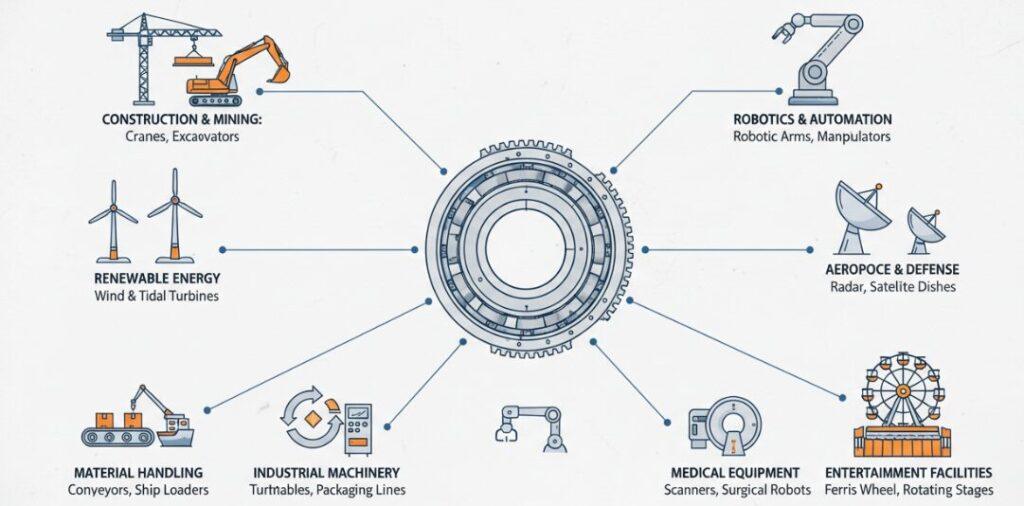
The slewing bearing in the field of heavy machinery, this thing can be said to achieve low-speed, heavy-duty rotation of the “joint”. Whether it is a behemoth such as a crane or an excavator, or a wind turbine, or even a sophisticated surgical robot, it is needed to provide strong support to handle 360-degree rotation, tilt and positioning.
Without specific development, it may be difficult for you to imagine how wide its application span is-from construction sites to aerospace, to amusement parks near your home, it is everywhere.
Simply sort out the main application industries:
- Construction and mining: cranes, excavators, shield machines, stacker-reclaimer.
- Renewable energy: wind generators (yaw/pitch), tidal turbines.
- Robotics and automation: robotic arms, industrial manipulators, automatic positioning systems.
- Aerospace and defense: radar systems, satellite dishes, missile launchers.
- Medical equipment: CT/MRI scanners, surgical robots.
- Material handling: conveyor system, ship loader.
- Industrial machinery: turntable, indexing table, packaging line.
- Entertainment facilities: rotating stage, Ferris wheel.
Why Is It?
There is an engineering logic behind this. The slewing bearing can handle extremely high radial force, axial force and overturning moment at the same time; it does not pursue high speed, but specializes in continuous rotation or accurate indexing at low speed; and many designs directly integrate gears (with drive interface) and sealing system, eliminating the need for complex transmission chain design.
Below I combine specific scenes to talk about how these bearings work in various fields.
Construction And Mining Applications
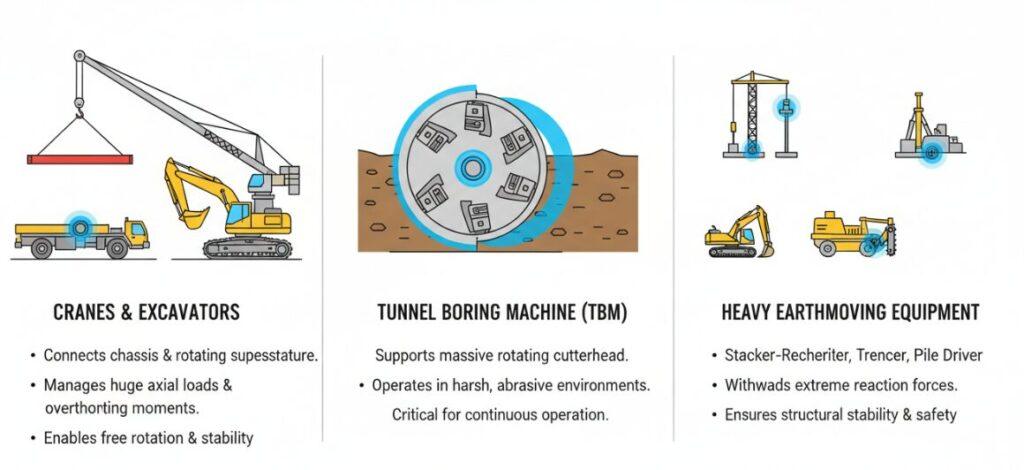
It is a key component connecting the stationary chassis and the rotating superstructure.
- Cranes and excavators: Whether it is a mobile crane hoisting steel beam, or excavators digging trenches, slewing bearings have to bear a huge axial load and overturning moment. It must ensure that the car structure can rotate freely, but also as stable as a mountain.
- Tunnel boring machine (TBM): TBM is known to those who engage in underground infrastructure. The huge cutterhead has to be propelled in rock and soil, all supported by strong bearings to rotate. The environment here is extremely harsh. Once the bearing lies in the nest, the whole project will have to stop.
- Heavy earthmoving equipment: equipment such as stacker-reclaimer, trencher and pile driver will have huge reaction force when operating heavy tools. The function of slewing bearing here is to ensure stability and safety.
Single Row Ball Slewing Bearing
Single-row ball slewing bearings are divided into internal tooth, external tooth and toothless structure, which are suitable for a variety of transmission needs.
Double Row Ball Slewing Bearing
Double-row ball slewing bearings are specially designed for super-heavy load scenarios.
Slewing Bearing With External Gear
The external gear internal flange slewing bearing integrates the advantages of external gear transmission and internal flange mounting.
Slewing Bearing With Internal Gear
The internal tooth and external flange slewing bearing is characterized by the combination of internal tooth transmission.
Slewing Bearing Without Gear
Gearless double flange slewing bearing is light weight and compact.
Cross Roller Slewing Bearing
Single-row cross roller slewing bearing adopts roller cross layout, large contact area, can synchronously and efficiently withstand axial and radial loads and overturning moment,
Renewable Energy: Wind And Tidal Energy
As the demand for clean energy grows, the application of slewing bearings in this field becomes critical. This piece of reliability requirements are even higher than mining machinery-after all, it is a nightmare to change bearings at sea or at a height of 100 meters.
- Wind turbine: There are usually two key positions on a wind turbine to use it. One is the yaw bearing , which is responsible for turning the nacelle towards the wind direction to maximize the wind catching efficiency. The other is the pitch bearing, which is responsible for adjusting the blade angle, controlling the speed and protecting the equipment during feathering in high winds.
- Tidal turbines: The principle is similar to wind power, but the thrust generated by underwater currents is greater, which poses a very high challenge to the bearing capacity and sealing anti-corrosion performance.
Robotics And Automation Precision
- Robots and manipulators: Robots on industrial assembly lines require bearings to be “zero-play” and highly rigid. Whether it is welding or spraying, positioning must be accurate, there can be no shaking.
- Automatic positioning system: In automated factories, the precise rotation of the positioning table is directly related to the connection of the manufacturing process. The slewing bearings here enable seamless integration of complex manufacturing processes.
Aerospace And Defense Systems
In this area, reliability is the overriding indicator. These slewing bearings typically operate in high stress and even extreme environments.
- Radar and satellite systems: In order to track high-speed moving objects or maintain communication with satellites, ground-based radar antennas require extremely smooth, vibration-free rotation, and extremely high pointing accuracy.
- Defense equipment: Optical targeting systems such as missile launchers and spacecraft rely on these components for rapid and precise indexing to ensure where to hit at critical moments.
Medical Equipment Technology
Many people may not think, the medical industry is also a large slewing ring. The core appeal here is smoothness and silence.
- CT and MRI scanners: The gantry of the CT machine rotates around the patient at high speed. Slewing bearings must not only be stable, but also quiet. If the vibration is too large, the image will be blurred; if the noise is too large, the patient experience will be poor.
- Surgical Robotics: This is a high-end application. The compact and precise slewing support allows the robot arm to simulate the dexterity of the human hand, which is the key to minimally invasive surgery.
Material Handling And Industrial Machinery
The efficiency of logistics and manufacturing depends to a large extent on the continuous movement capacity provided by the slewing ring.
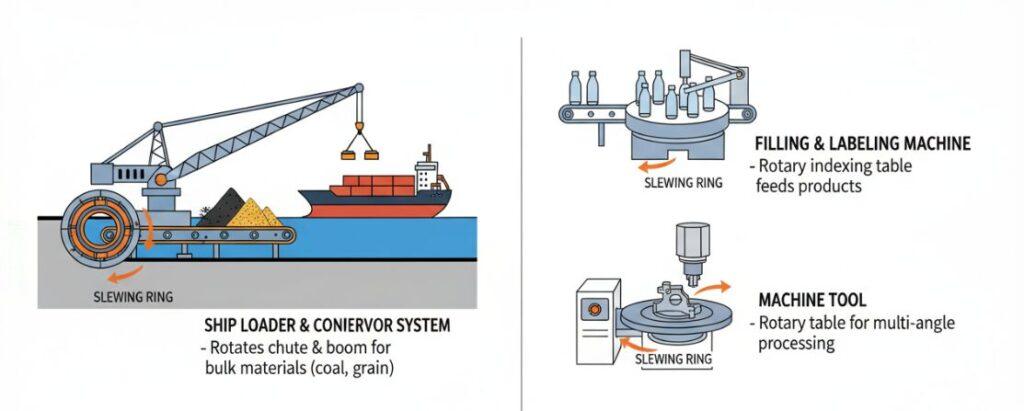
- Material handling: The port’s large ship loader and conveyor system uses these bearings to rotate the chute and boom to handle the efficient handling of bulk materials such as coal and grain.
- Industrial processing: the filling line and labeling machine in the factory use the rotating indexing table to feed the products into the station one by one. The same is true for machine tools, which rely on rotary tables to process complex parts from multiple angles.
Applications In The Entertainment Industry
In the entertainment industry, there are actually two words: safety.
- Rides: From giant Ferris wheels to spinning teacups, slewing bearings support the weight of the entire structure and visitors. The design margin here is usually large and must be foolproof.
- Rotating stage: theater and concert scene, the switching of large sets depends entirely on the slewing ring underneath. It has to be switched in a few seconds, and it has to be quiet and not interfere with the performance.
Why The Industry Preferred Slewing Ring?
Looking at the circles, you will find that although the application scenarios are very different, the reasons why engineers choose slewing bearings are actually very uniform:
- Handle complex loads: It is specially designed to handle high radial forces, axial weights and overturning moments at the same time. It is difficult for ordinary bearings to do this on a single structure.
- Specially optimized for low speed: many applications require slow, controllable rotation or precise indexing, rather than the high speed of thousands of revolutions of the motor, and the slewing bearing just fills this niche.
- High integration: Many designs come with internal or external teeth, and the pinion is directly driven. Coupled with the integrated sealing and lubrication system, maintenance is relatively worry-free.
- The design is varied: from balls to rollers and even polymer materials, it can adapt to a variety of environments from clean rooms to muddy mines.
In general, this is a precision component that is born to solve “large load and complex motion.
Author: Robert Stone
“I’m a mechanical engineer specializing in rotary motion solutions. With over a decade of experience in heavy machinery design, I provide in-depth technical insights into slewing ring bearing applications, helping industries select the right components for heavy loads and precision movement.”
