 SWBTEC


Slewing Bearing Wear Measurement
Most commonly, the traditional “swing test” (Rocking Test) is used. This involves taking a dial gauge to measure the clearance increment under a specific torque and comparing it with factory data. However, technology has made rapid progress in recent years. There are more and more online monitoring systems with built-in sensors, such as BCM. It is really convenient to see data in real-time without downtime. Of course, no matter how technology changes, daily inspection of bolt tightness and appearance is still the basic action that must be done.
In order to ensure the structural integrity of large heavy machinery, no matter which way you use, the process must be standardized. Below I will combine field experience to talk about these two types of measurement methods in detail.
Rocking Test Practical Operation
Until today, the “swing test” is still the industry’s quantitative assessment of bearing wear “gold standard”. Simply put, this method is to measure the overturning clearance to see how far the current state deviates from the factory standard.
This video demonstrates how to perform a rocking test on a crane’s swing bearing:
Step 1: Preparation And Safety
Before the actual measurement, the working conditions must be prepared, which is directly related to the accuracy of the data. Bearings must be unloaded and the structural position must be aligned. For example, when measuring cranes, I will require the boom to be strictly centered. Why? Because you have to neutralize the partial load, otherwise your benchmark reading is definitely crooked, and the data measured later has no reference value.
Step 2: Instrument Erection
Be sure to suck the magnetic seat firmly and must use a high-precision dial indicator with an accuracy of at least 0.01mm. The early wear of the slewing bearing is very small. If the sensitivity of the table is not enough, you can’t measure the key deviation.
Step 3: Establish A Datum Point (Zero)
To measure “clearance”, you must first have a zero point. Apply a known moment to the structure—for example, operate the boom upward to allow the bearing to be compacted in one direction. When the structure is completely stabilized, return the table to zero. This establishes the baseline for the measurement.
Step 4: Measure Clearance (Play)
Next, a reverse torque is applied, or the structure is “shaken” in reverse. At this time, you will see the hands start to go and record the maximum value of the swing of the hands. This value represents the total clearance (total clearance) at that point.
Step 5: Repeat And Contrast
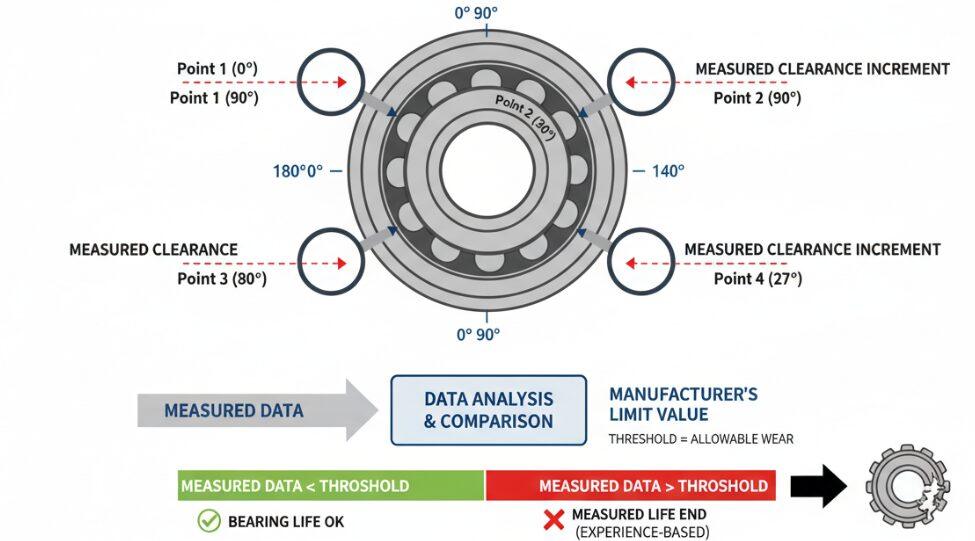
For large bearings, measuring only one point is not enough. You need to measure a few more points around the bearing, usually every 90 degrees. When analyzing the data, compare the measured clearance increment with the manufacturer’s limit value. Generally speaking, the threshold value = the allowable wear amount of the original clearance. If the measured data exceeds this total, judging by experience, the life of this bearing is basically coming to an end.
Bearing Condition Monitoring System (BCM)
For projects that don’t want to stop for testing or save on labor costs, digital monitoring systems (BCM) do provide a huge advantage.
Integrated Sensors
For advanced systems like the BCM, sensors are integrated directly into the bearing assembly. When the machine is working, it continuously monitors axial and radial wear, completely eliminating the need for shutdown inspection.
Remote Access And Security
Data can be transmitted via Bluetooth or viewed directly on the web. This means that the maintenance team can monitor bearing health while standing in a safe area. This greatly reduces the security risk that we used to have to climb up and down to manually check.
Operational Efficiency
The core advantage of BCM is efficiency. It can provide early warning, so that you have plenty of time to schedule and change spare parts, rather than waiting for the machine to suddenly break down and be forced to stop work.
Essential Daily Checks
Although measuring clearance is the key to judging life, other auxiliary checks can also reflect the health of the bearing.
Bolt Tightness
Uneven load distribution is one of the culprits of accelerated wear. The bolts must be checked regularly with a calibrated torque wrench. Only when the bolt tension is appropriate can the load be evenly distributed on the raceway, otherwise the local stress will concentrate and the bearing will collapse quickly.
Lubrication Analysis
Grease is the “blood” of the slewing bearing. In addition to regular oil injection to ensure smooth operation, it is also important to check the discharge of the old oil. If metal particles, even fine iron filings, are found in the old oil, this is usually physical evidence that the internal raceways or rollers are already grinding and peeling.
Single Row Ball Slewing Bearing
Single-row ball slewing bearings are divided into internal tooth, external tooth and toothless structure, which are suitable for a variety of transmission needs.
Double Row Ball Slewing Bearing
Double-row ball slewing bearings are specially designed for super-heavy load scenarios.
Slewing Bearing With External Gear
The external gear internal flange slewing bearing integrates the advantages of external gear transmission and internal flange mounting.
Slewing Bearing With Internal Gear
The internal tooth and external flange slewing bearing is characterized by the combination of internal tooth transmission.
Slewing Bearing Without Gear
Gearless double flange slewing bearing is light weight and compact.
Cross Roller Slewing Bearing
Single-row cross roller slewing bearing adopts roller cross layout, large contact area, can synchronously and efficiently withstand axial and radial loads and overturning moment,
Signs Of Wear
You can watch this video to learn about the signs of a failing swing bearing:
Once the following signs appear, you must arrange the measurement immediately:
Tilt Or Play Becomes Larger
This is the most intuitive physical indicator. If the structure feels “loose” during operation, or the inclination obviously exceeds the manufacturer’s limit, there is a high probability that it needs to be replaced.
Digital Alarm
If the equipment is equipped with a BCM system, do not ignore the alarm about excessive wear or excessive water content of the grease.
Abnormal Noise
Bearing News has also mentioned before that if there is a grinding sound or clicking sound during rotation, it is definitely a strong signal of serious internal wear and must be stopped immediately for investigation.
Timetable
A reliable inspection plan is the key to preventing catastrophic failure.
Regular Inspection
It is usually recommended to test once a year, or strictly in accordance with the manufacturer’s manual. If you find a sudden increase in the trend of wear, you have to encrypt the inspection frequency.
Review After Overhaul
After any major maintenance work, the bearing clearance must be measured again. This ensures that the system remains within a safe operating range after repair.
Author: Mark Davis
“I am a heavy machinery maintenance specialist with over 14 years of experience in structural diagnostics. I specialize in slewing bearing wear measurement, helping operators transition from traditional Rocking Tests to advanced digital BCM systems.”
