 SWBTEC


Slewing Bearing Repair
Slewing bearing repair, simply put, involves disassembling, inspecting, and refurbishing worn large-diameter bearings to restore them to their original factory specifications. This process is not only as simple as changing the rolling elements and sealing rings, but also thoroughly cleaning the raceway and even using thermal spraying technology when necessary. This set of down, not only can fix things, but also greatly reduce the time of equipment downtime.
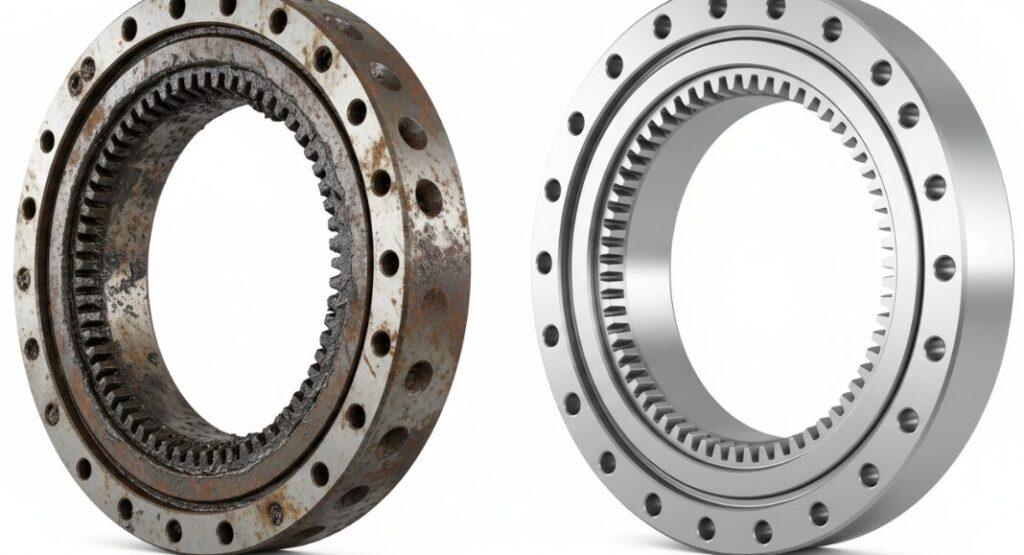
The Key Link Of Slewing Bearing Maintenance
If you want the repaired parts to be as good as the new ones, you must have a standard process for smashing details. This is by no means just washing with cleaning agent, it is a systematic engineering repair.
Dismantling and cleaning: First of all, the bearings must be completely disassembled to remove all the old sludge and pollutants. Only when it is washed clean can the real condition of the metal surface-such as whether there are dark injuries-be exposed.
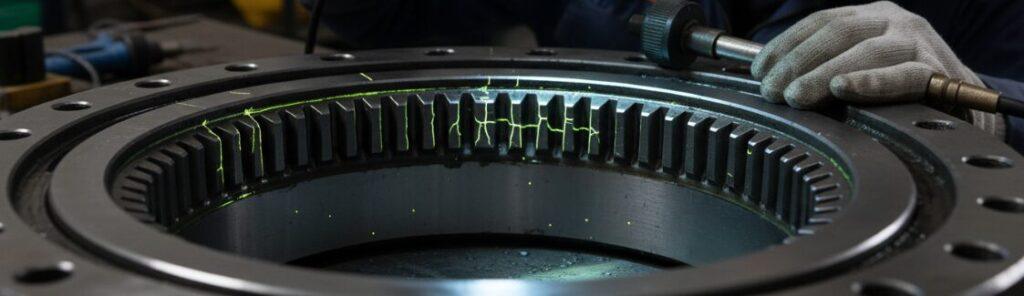
Non-Destructive Testing (NDT): We’ll check the raceway with magnetic particle inspection. Many tiny cracks or subcutaneous fatigue are invisible to the naked eye, but this thing can be found out.
Hardening and renovation: According to the results of flaw detection, if the hardness of the raceway is not enough, it must be hardened again to make up for the durability.
Parts replacement: In order to restore the bearing clearance to the best condition, the worn rolling elements (whether balls or columns), cages and spacers must be replaced with new ones.
Sealing and relubrication: Finally, install a new sealing strip to prevent dirt, and re-grease in strict accordance with the specifications, which can be assembled.
Advanced Repair Means: Thermal Spraying
Sometimes we will encounter raceway or surface wear is particularly serious, simple polishing is certainly not enough. At this time, “thermal spraying” is the preferred solution.
This is like “filling the flesh” of the bearing and spraying molten metal onto the worn area. This has two main purposes: the 1 is to make up the size back to the original geometric shape; the 2 is that the coating material sprayed on is usually more advanced than the base metal, which can make the bearing more wear-resistant and corrosion-resistant in future use.
In-Plant Vs On-Site Repair
Now the maintenance service, flexibility is a big advantage.
Off-line maintenance (return to the factory): if you want to make a full remanufacturing, you still have to pull the bearing back to a special factory. After all, there are heavy equipment and controlled environments where precision can be highest.
Online maintenance (on-site): But for those huge machines, the logistics cost of disassembly and transportation is too high and time-consuming. At this time, we go directly to the site for repair, which can greatly reduce the downtime.
Single Row Ball Slewing Bearing
Single-row ball slewing bearings are divided into internal tooth, external tooth and toothless structure, which are suitable for a variety of transmission needs.
Double Row Ball Slewing Bearing
Double-row ball slewing bearings are specially designed for super-heavy load scenarios.
Slewing Bearing With External Gear
The external gear internal flange slewing bearing integrates the advantages of external gear transmission and internal flange mounting.
Slewing Bearing With Internal Gear
The internal tooth and external flange slewing bearing is characterized by the combination of internal tooth transmission.
Slewing Bearing Without Gear
Gearless double flange slewing bearing is light weight and compact.
Cross Roller Slewing Bearing
Single-row cross roller slewing bearing adopts roller cross layout, large contact area, can synchronously and efficiently withstand axial and radial loads and overturning moment,
The Reason For Choosing Repair Over Replacement
In most cases, I would recommend prioritizing repairs for practical reasons:
Save money: Again, spend half the money on the same thing, and the budget saved can be used for other operational needs.
Continuation: Professional remanufacturing can extend the service life of the bearing and fill up the return on investment of the equipment you bought.
Performance recovery: Our goal is to repair after the same performance as new, never lower the operating standards of the equipment.
Situations Requiring Replacement Of Slewing Bearing
Of course, maintenance is not a panacea. During the on-site evaluation, if you encounter the following two situations, don’t hesitate to replace them directly:
Structural damage: If the main structure of the bearing ring has been cracked, or the degree of deformation exceeds the limit of thermal spraying and grinding, it must be scrapped for safety.
Life exhaustion: If the bearing has completely exceeded the designed fatigue life and the internal metal fatigue is too deep, the repair is also white at this time, so it is better to replace the whole set directly.
Daily Maintenance
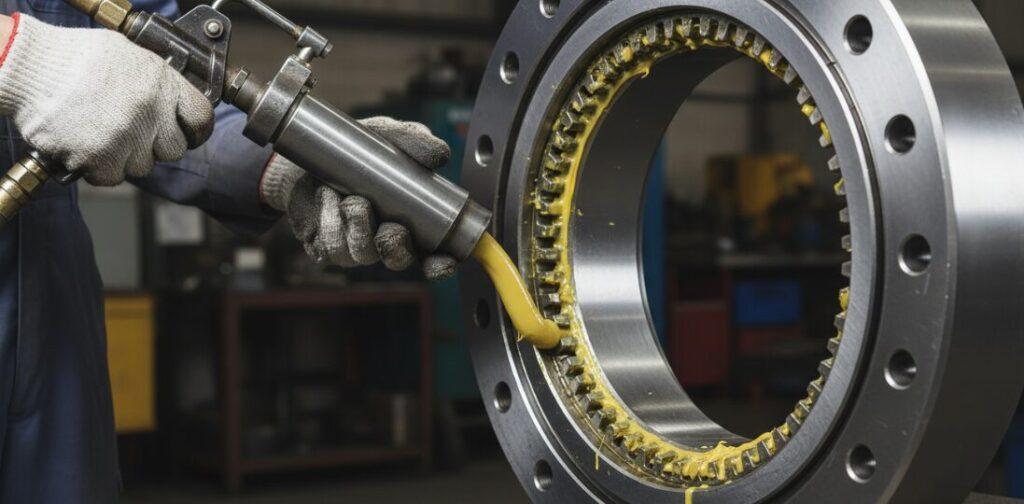
Lubrication: it must be regularly oiled according to the manufacturer’s recommendation. Grease can not only reduce friction and heat dissipation, but also form a barrier to block pollutants.
Patrol inspection should be in place:
Listen: If you hear a friction or click, there is a high probability of a problem inside.
Test: Keep an eye on the gap to see if it has become larger or if the bearing has become “loose.
Look: Keep the appearance clean and don’t let the 1 pile of debris damage the seal.
Keep an eye on the bolt: Mounting the bolt is as important as the bearing itself. According to my observation, many failures are actually caused by loose bolts. The maintenance team must check regularly and tighten to torque specifications. Once the bolt is found to have signs of fatigue or rust, immediately replace it, otherwise the force is uneven, the raceway will soon be scrapped.
Author:David Wilson
I am a Senior Mechanical Engineer specializing in heavy machinery components. With over 13 years of experience in slewing bearing repair and remanufacturing, I focus on helping industries extend equipment lifespan through advanced restoration techniques like thermal spraying and proper maintenance protocols.
