
 SWBTEC


Slewing Bearing Dimensions
Slewing bearing diameters typically span from compact 100mm (4 inches) units for precision automation up to massive 15,000mm (49 feet) segmented rings for offshore cranes. While custom solutions exist, the most common “stock” dimensions found in the industry feature an Outer Diameter (OD) between 300mm and 5,000mm and an Inner Diameter (ID) ranging from 120mm to over 4,000mm. When selecting a bearing, you must validate more than just the geometric envelope; you must simultaneously cross-reference the Mounting Hole Patterns (integral tapped or through-holes), the Cross-Sectional Profile (such as the rectangular MT series), and the Rolling Element Type (Ball vs. Roller). These physical dimensions directly dictate the bearing’s capacity to handle the critical “Holy Trinity” of loads: Moment, Thrust, and Radial forces.
Span Lineage Of The Diameter Of The Slewing Bearing
When engineers start searching for slewing bearing sizes, the first variable is almost always the size of the application. The physical envelope of these bearings varies greatly depending on the industry use case.
Compact Size (100mm Level)
At the lower end of the size spectrum, we see bearings with a diameter of about 100mm (about 4 inches). This type of compact size is essential for fields that seek high precision rather than mere “brute force.
Application scenarios: precision automation equipment, medical robots and small radar bases.
Size concerns: In this size range, my requirements for size tolerances are usually very stuck, the purpose is to ensure zero backlash (zero backlash) and silky smooth rotation in a limited space.
“Spot” Standard (300mm – 5,000mm Outer Diameter)
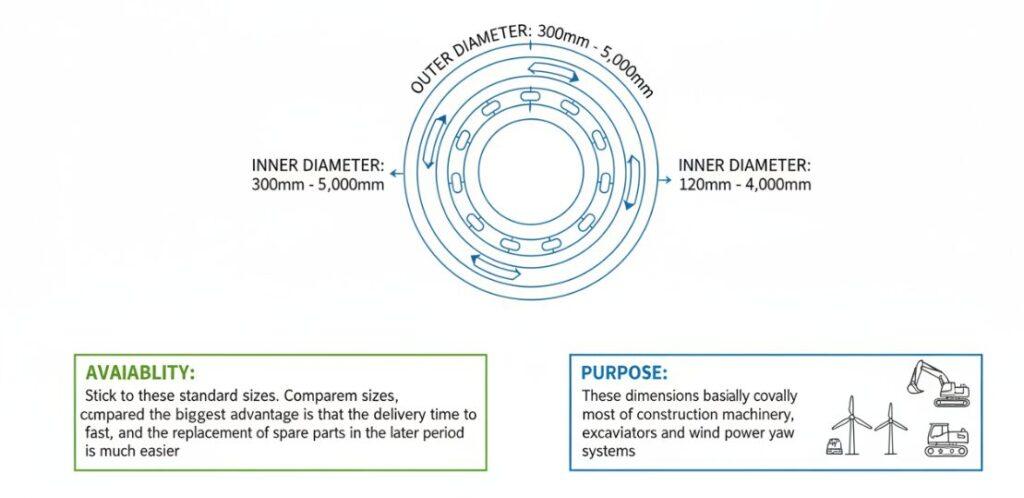
The vast majority of industrial applications fall within the standard spot size range. Manufacturers usually standardize products with an outer diameter of 300mm to 5,000mm and an inner diameter of 120mm to 4,000mm.
Availability: Stick to these standard sizes. Compared with custom sizes, the biggest advantage is that the delivery time is fast, and the replacement of spare parts in the later period is much easier.
Purpose: These dimensions basically cover most of the construction machinery, excavators and wind power yaw systems.
Giant Segmented Ring Gear (Up To 15,000mm)
For those extreme engineering feats, the size of the slewing ring can reach a staggering 15,000mm(49 feet).
Segmented design: Restricted by transportation restrictions, bearings of this size are rarely monolithic. They are designed as “Segmented Rings” and then assembled on site.
Application scenarios: Giant offshore cranes and heavy tunnel boring machines (TBMs) require this extreme diameter to disperse huge structural loads.
Verify Key Geometric Features Beyond Id And Od
Although the inner and outer diameters define the approximate installation space, for successful integration, the specific geometric features mentioned in the technical overview must be studied in depth.
Mounting Hole Pattern
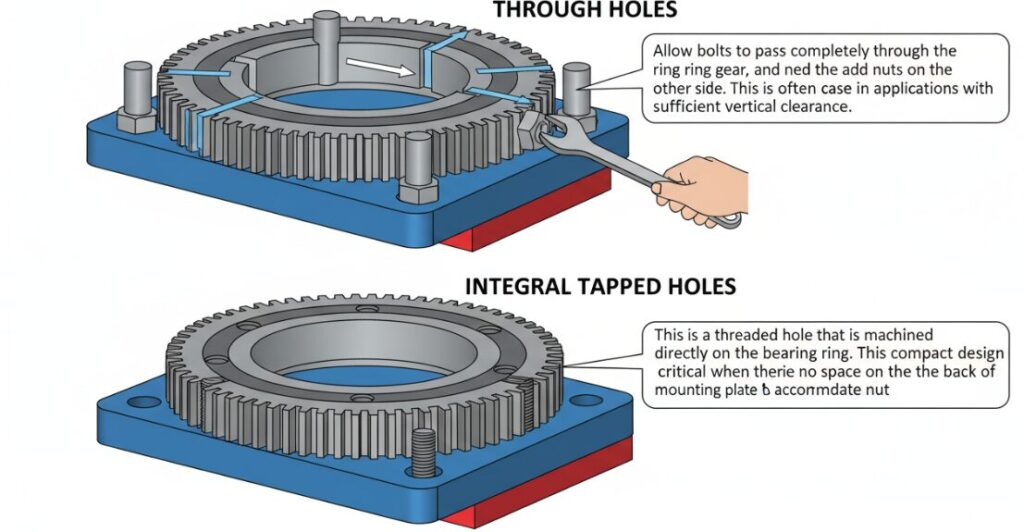
The dimensions of the mounting holes are as important as the size of the ring gear itself. You must verify the hole pattern according to your mounting surface:
Through holes: Allow bolts to pass completely through the ring gear, and need to add nuts on the other side. This is often the case in applications with sufficient vertical clearance.
Integral tapped holes: This is a threaded hole that is machined directly on the bearing ring. This compact design is critical when there is no space on the back of the mounting plate to accommodate the nut.
Cross-Sectional Profile
The cross section-that is, the height and width of the ring gear itself-determines the stiffness of the bearing.
Rectangular profile (e. g. MT series): Rugged rectangular section provides high rigidity.
The trade-off between profile and space: larger cross-sectional size means higher load-carrying capacity, but also requires more vertical installation space. Engineers must find a balance between bearing height and available housing size.
Rolling Element Type Dimension
The internal dimensions of the rolling elements (balls vs. rollers) will fundamentally change the performance curve of the bearing under the same ID/OD envelope.
Rollers: Usually require slightly different raceway sizes, but provide a higher contact area, suitable for heavier loads.
Balls: Using point contact, there are usually different internal clearance sizes, which are more suitable for scenarios with high speed or low friction requirements.
SLEWING BEARING
Rigorous Internal Quality Control、Expert Engineering & Innovative Design Capabilities、20 Years of Expertise in Slewing Bearing Manufacturing、Expert Engineering & Innovative Design Capabilities.
How Size Determines Carrying Capacity
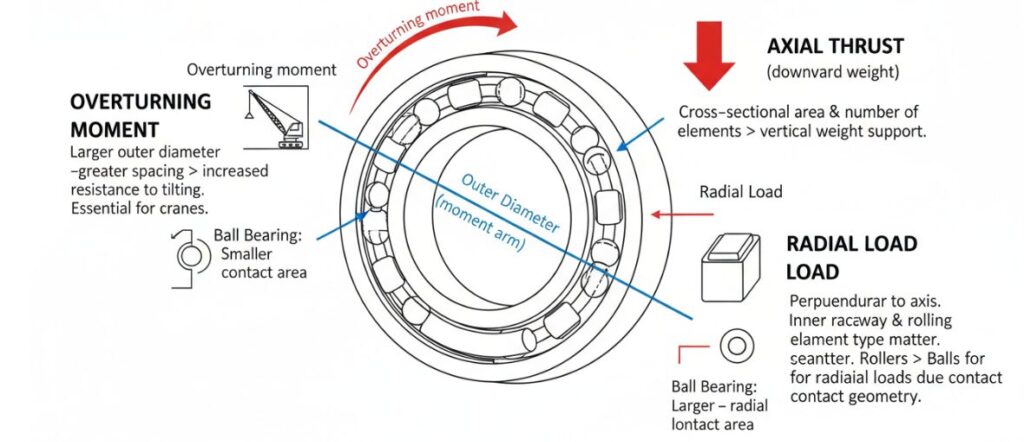
The physical dimensions of the slewing bearings are not arbitrary; they are mathematically tied to the ability to handle forces. As mentioned earlier, these dimensions determine the bearing’s ability to handle the “stressed iron triangle.
Overturning Moment
Overturning moment refers to the tilting force exerted on the bearing. Here, the diameter dimension acts as a moment arm. The larger outer diameter allows for greater spacing between the rolling elements, thereby significantly increasing the bearing’s ability to resist overturning moments. This is why cranes need such large diameter bearings-to offset the leverage generated by the boom.
Axial Thrust
The thrust force is the pressure applied parallel to the axis of rotation (I. e. the downward weight). The cross-sectional area and the number of rolling elements (determined by the circumference/diameter) determine how much vertical weight the bearing can support without deformation.
Radial Load
The radial force is perpendicular to the axis of rotation. Here, the inner dimensions of the raceway and the type of rolling elements are the main factors. According to experience, under the same size, roller bearings can usually withstand higher radial loads than ball bearings, which is entirely due to the geometry of the contact area.
Author:Alex
I am a Senior Mechanical Engineer specializing in rotary motion control. With over a decade of experience in slewing bearing design and application, I help engineers navigate complex dimension charts to select the perfect structural components for heavy-duty and precision machinery.
