 SWBTEC


Roller Bearings vs Ball Bearings:What’s The Difference
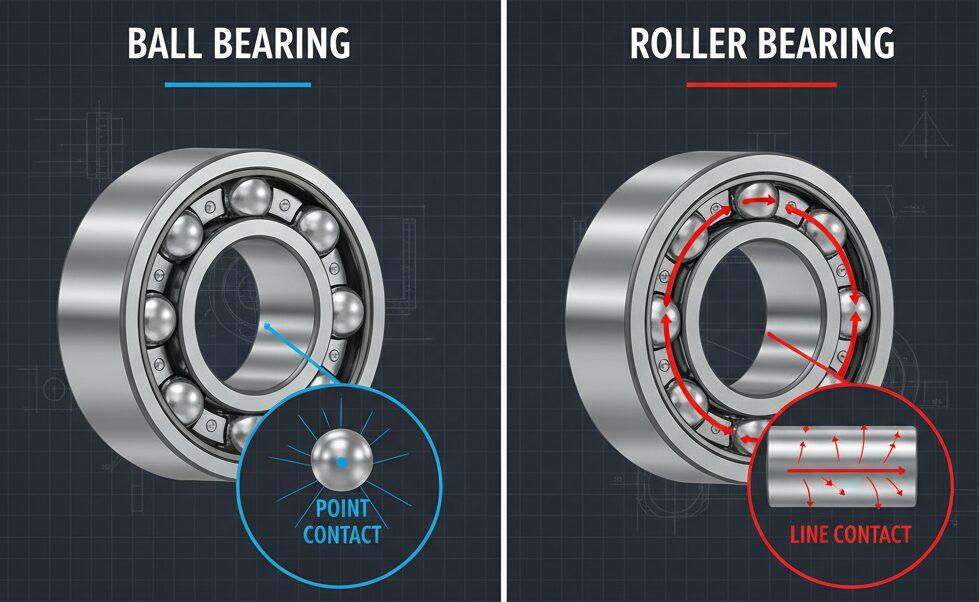
When comparing roller bearings vs ball bearings, the key difference lies in how each type handles load and friction. Ball bearings use small spherical balls that create point contact, making them ideal for high-speed and low-friction applications. In contrast, roller bearings rely on cylindrical or tapered rollers that form line contact, allowing them to carry much heavier loads and withstand shock forces.
In this guide, we’ll break down the complete comparison of roller vs ball bearings, including their structure, performance, and ideal applications. You’ll also learn about needle roller bearings vs ball bearings, and how to choose the right bearing roller for your machinery. Whether you’re designing new equipment or replacing old parts, understanding these different types of bearings will help you make a smarter, more efficient choice.
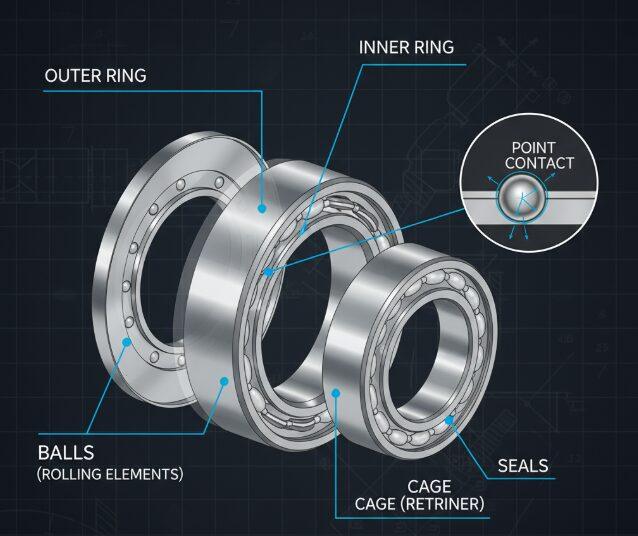
What is a Ball Bearing?
Ball bearings are mainly composed of inner ring, outer ring, rolling elements, cage and seals. These small steel balls are the core of it. They roll between the inner and outer rings to achieve relative movement. Its design concept is to reduce friction through point contact.
Advantages and limitations of ball bearings
First, it is suitable for high speed and medium load. Ball bearings perform very well in many occasions where speed is required, such as high-speed motors. Secondly, it has a low coefficient of friction and smooth operation, which is essential for equipment that requires high precision and low noise. Finally, ball bearings can withstand both radial and axial loads. Although its axial load capacity is relatively limited, it is sufficient for most low and medium axial force application scenarios.
The biggest problem with ball bearings is their point contact characteristics. This means that under the same load, the contact stress of the ball bearing will be relatively high, so the carrying capacity is relatively low. This is why in heavy-duty applications, we usually do not prefer ball bearings. In addition, it is not sensitive to impact loads. If the equipment is frequently subjected to severe impacts, the life of the ball bearing may be greatly reduced.
Based on its characteristics, the typical application scenarios of ball bearings are very extensive. In the projects I have come into contact with, from household motors, washing machines and vacuum cleaners, to small industrial gearboxes, pumps and fans, to precision instruments and medical equipment with high precision requirements, almost all of them can be seen.
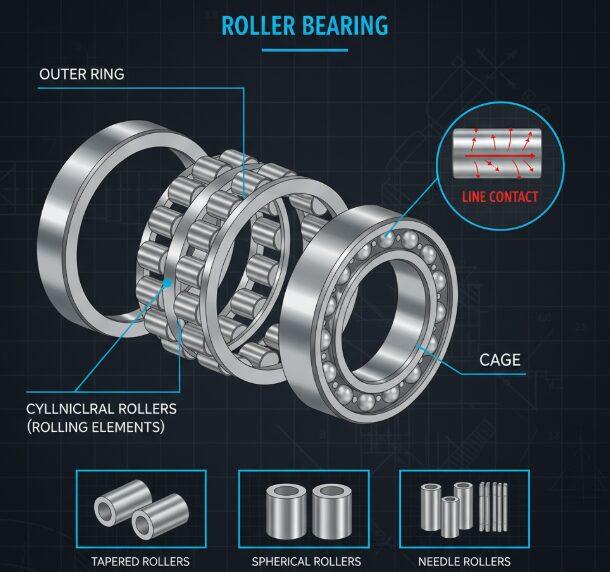
What is a Roller Bearing?
From a structural point of view, the core of roller bearings lies in their rolling bodies, which are no longer spherical, but diverse geometric shapes, such as cylindrical, conical, spherical, and slender needle rollers. It is these different rolling elements that give roller bearings the ability to cope with various complex working conditions. They are usually composed of an inner ring, an outer ring, rolling elements and a cage, and some designs omit the cage, such as full-fill roller bearings.
Advantages and limitations of roller bearings
Advantages:
- Strong carrying capacity: This is the most significant advantage of roller bearings. Since the rolling body and the raceway are in line contact (or approximate line contact), the contact area is much larger than the point contact of the ball bearing, so the load can be much higher. This means that in heavy machinery, I almost always give priority to roller bearings.
- Withstand heavy loads and shock loads: This line contact feature also makes roller bearings more robust in the face of shock and vibration and less prone to plastic deformation.
- Excellent radial and axial load-bearing capacity: Tapered roller bearings, in particular, are designed to withstand large radial and unidirectional axial loads at the same time. This is very important in automobile wheels and other occasions.
Limitations:
- Relatively high friction: compared to point contact ball bearings, roller bearings rolling friction will be slightly larger. This means that in extremely high speed applications, I usually prefer ball bearings to avoid overheating and unnecessary energy loss.
- Usually larger: In order to achieve high load capacity, the overall size of roller bearings is often larger than that of ball bearings with the same inner diameter. This is a trade-off when designing a compact device.
Based on its characteristics, roller bearings have a wide range of applications in my engineering practice. For example:
- Heavy machinery: all kinds of cranes, excavators, their transmission system and wheel sets are inseparable from roller bearings.
- Automobile wheels: Especially for passenger cars and commercial vehicles, a combination of double-row tapered roller bearings or angular contact ball bearings is usually used.
- Construction machinery: track-type vehicles, such as heavy wheels, driving wheels.
- Railway vehicles: The bearings in the axle box of the train must withstand huge loads and long-term operation.
- Large gear boxes: wind turbines, industrial reducers, etc., the internal gear transmission system is supported by roller bearings.
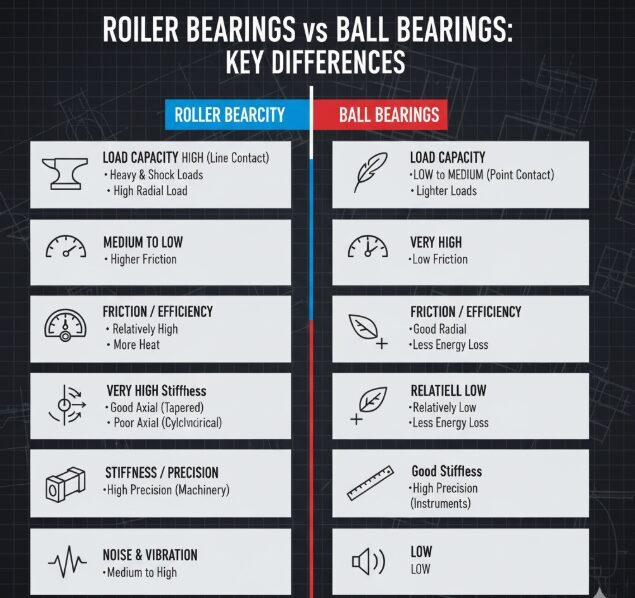
Roller Bearings vs Ball Bearings:What’s The Difference
Load Capacity
Point contact vs line contact:
This is the biggest difference between roller bearing vs ball bearing. Ball bearings, the rolling body is a sphere. The contact between the sphere and the raceway is theoretically “point contact”. Although the actual load will be elastic deformation, into a small elliptical contact surface, but the area is still very small.
The roller bearing, its rolling body is cylindrical, conical or drum roller. These rollers and raceway contact, that can be “line contact. Line contact can distribute the load to a larger area, so under the same size, the bearing capacity of the roller bearing is much higher than that of the ball bearing, especially when it is subjected to heavy load and impact load, its advantage is simply overwhelming. Therefore, if your equipment needs to bear a relatively large load, I will basically consider roller bearings directly.
Speed Capability
Friction:
Speed this thing, friction is the key. Because the ball bearing is point contact (or contact area is small), the friction resistance between the rolling body and the raceway is relatively small. This means that it generates less heat during high-speed operation and can better maintain the stability of the lubricating film.
The roller bearing, although the carrying capacity is strong, but because of the line contact, the friction resistance is relatively large. At high speeds, friction heat generation will be more, and the requirements for lubrication and heat dissipation will be higher. If the design is improper, it is easy to cause the bearing to overheat or even fail. So, generally speaking, for the need for extremely high speed occasions, I will give priority to ball bearings.
Friction and Energy Consumption
Efficiency:
This piece is actually closely related to speed ability. The coefficient of friction directly determines the energy consumption. Ball bearings typically have a lower coefficient of friction than roller bearings. This means that under the same working conditions, the ball bearing runs with lower energy consumption and higher system efficiency. Although the energy consumption of a single bearing may not feel anything, but in large equipment or the need for long-term continuous operation of the occasion, the accumulated energy consumption difference will be very considerable. Therefore, in applications with strict requirements for energy efficiency, I tend to choose ball bearings.
Axial vs Radial Load
Combinations:
Here we have to analyze the specific problems in detail.
- Radial loads: Roller bearings, particularly cylindrical roller bearings and needle roller bearings, excel in withstanding pure radial loads. Their rolling body arrangement dictates effective resistance to radial forces.
- Axial loads: Ball bearings, particularly deep groove ball bearings, are able to withstand a certain amount of both radial and bidirectional axial loads due to their channel design. Thrust ball bearings are even more specially designed to withstand pure axial loads. And the standard cylindrical roller bearing is relatively weak in bearing axial load, and usually needs to be matched with other bearings to bear axial force. The exception is the tapered roller bearing, which can withstand both large radial and unidirectional axial loads.
Universal Bearing:
In some complex conditions, such as a bearing to withstand a large radial force, but also to withstand considerable axial force, which requires us to choose very carefully. Sometimes, it may be necessary to use a combination of different types of bearings, or to choose special structural bearings that can be taken into account on their own, such as angular contact ball bearings or tapered roller bearings.
Stiffness and Precision
Deflection:
Stiffness is the ability to resist deformation. The higher the stiffness of the bearing, the smaller the elastic deformation when subjected to load. In this regard, roller bearings can provide higher rigidity due to their large contact area due to their line contact characteristics. This is essential for applications such as machine tool spindles and precision instruments that require extremely high operating accuracy and positioning accuracy.
Although ball bearings can also provide good stiffness, but compared with roller bearings, the deformation under heavy load will be slightly larger. Therefore, I usually prefer to consider roller bearings when extreme rigidity and ultra-high precision are required.
Noise and Vibration
Smoothness:
Noise and vibration are important indicators that affect the quality of equipment operation. Ball bearings typically have lower levels of noise and vibration during operation due to their point contact characteristics and the ease with which the balls roll smoothly in the raceways. This makes them preferred for applications that are sensitive to noise, such as household appliances, office equipment or medical equipment.
Roller bearings, especially those with a large number of rolling elements and larger sizes, may produce relatively higher noise and vibration under certain operating conditions due to line contact and possible slight sliding between the rollers and raceways. But this is not absolute. Advances in modern manufacturing processes have greatly improved the smoothness of roller bearings. However, if the primary consideration is low noise and low vibration, ball bearings are still more advantageous.
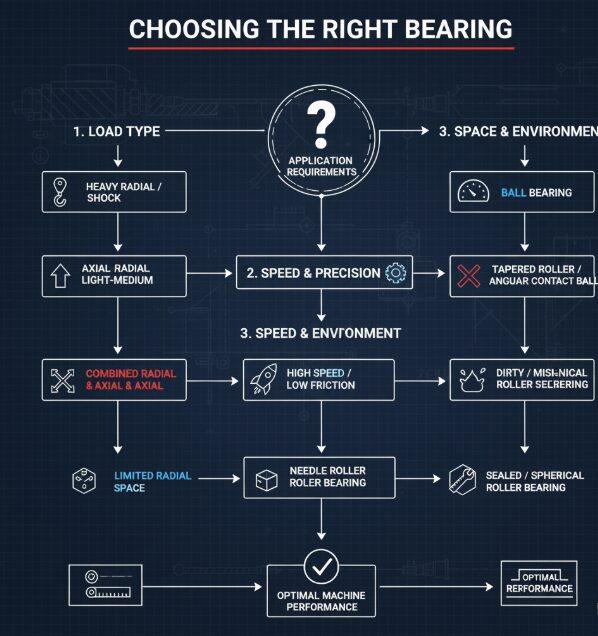
How to Choose the Right Bearing?
Based on Load Requirements
This is the first and most critical consideration.
- Light load and medium load: Ball Bearing is preferred. Why? Ball bearings use point contact, the friction is relatively small, the operation is smoother, and the accuracy is easier to guarantee. For those equipment that is not loaded but requires smooth operation and precision, such as small motors and office equipment, ball bearings are undoubtedly an economical and reliable choice. In some of the automation equipment I handle, many high-speed, light-load transmission parts are basically ball bearings.
- Heavy load, impact load: The Roller Bearing must be selected. When you are faced with large construction machinery, heavy transmission equipment or often need to withstand the impact of the working conditions, cylindrical roller bearings, spherical roller bearings on the debut. Their rolling body is line contact or surface contact, which can distribute the load more evenly in a wider area, and the compression resistance and impact resistance far exceed the ball bearing.
Based on Speed Requirements
Speed is also a decisive factor.
- High-speed applications: Ball Bearing has more advantages. The point contact characteristics of the ball bearing make it generate less friction heat during high-speed rotation, better heat dissipation performance, and relatively low temperature rise. Therefore, in the need for high speed occasions, such as high-speed spindle, precision instruments, ball bearings are the first choice. Of course, it is necessary to pay attention to lubrication and heat dissipation in order to truly realize its high-speed potential.
- Medium to low speed but large carrying applications: Roller Bearing. If your equipment needs to carry heavy loads and does not need to reach extremely high speeds, then roller bearings will be a more secure choice. It can provide the necessary carrying capacity, while maintaining good operating stability at medium and low speeds.
Based on Installation Space
- Space is limited: Needle Roller Bearing or some compact Ball Bearing. When the internal space of the equipment is small, I will first consider the Needle Roller Bearing. Its very small radial cross-section provides a relatively high load-bearing capacity with minimal installation space. In addition, some compact design of deep groove ball bearings, in the space is limited but the load is not large, I often included in the alternative list.
Based on Cost and Lifespan
Cost and life are always the two ends of the balance that engineers need to balance.
- For the same load capacity, the Roller Bearing may cost more, but it also has a longer life. This is basically a universal law. Because of its structural characteristics and material consumption, roller bearings are often more expensive than ball bearings with the same carrying capacity. But in the long run, especially under heavy load conditions, the longer service life of roller bearings can effectively reduce maintenance costs and downtime, so “one-time investment is large, but later worry-free” is my basic judgment. Of course, it depends on the brand and precision level.
FAQ: Roller Bearings vs Ball Bearings
1. What is the main difference between roller bearings and ball bearings?
The main difference between roller bearings vs ball bearings lies in their contact type and load capacity. Ball bearings use spherical balls for point contact, making them ideal for high-speed, low-friction applications. Roller bearings use cylindrical or tapered rollers for line contact, providing much higher load-carrying capacity and better shock resistance.
2. Which bearing is better: roller bearing or ball bearing?
Neither is universally “better”—it depends on the application. Ball bearings are best for high-speed, light-load, and precision operations. Roller bearings perform better under heavy loads, impact forces, or when high rigidity is required. In short: choose ball bearings for speed and efficiency, and roller bearings for strength and durability.
3. What are the different types of roller bearings?
There are several different types of roller bearings, including:
- Cylindrical roller bearings – for high radial loads
- Tapered roller bearings – for combined radial and axial loads
- Spherical roller bearings – for misalignment tolerance and heavy loads
- Needle roller bearings – compact and ideal for limited space applications
4. What is the difference between a needle roller bearing and a ball bearing?
A needle roller bearing vs ball bearing comparison highlights the difference in structure and load handling. Needle roller bearings use long, thin rollers that provide a very high radial load capacity in a compact design. Ball bearings, on the other hand, are better for higher speeds but lower loads. If space is tight and the load is mostly radial, a needle roller bearing is often the better choice.
5. Can roller bearings and ball bearings be used together?
Yes. In complex machinery, engineers often combine roller and bearing types to balance different forces. For example, a roller bearing may handle the heavy radial load, while a ball bearing manages axial load and helps reduce friction for smoother rotation. This bearing universal approach improves overall stability and lifespan.
6. How do I choose between roller bearings and ball bearings?
To choose the right bearing, consider:
- Load type: Radial → roller bearing; Axial → ball bearing
- Speed: High speed → ball bearing
- Shock/vibration: Roller bearing
- Space limitation: Needle roller bearing
- Precision: Ball bearing for low noise; roller bearing for high stiffness
By matching these conditions, you can select the best roller bearing vs ball bearing for your specific application.
Conclusion
Choosing between roller bearings vs ball bearings ultimately depends on your application’s load, speed, and space requirements. If your equipment demands high-speed rotation with low friction and minimal noise, ball bearings are the ideal option. However, for heavy-duty operations where strength, durability, and shock resistance are crucial, roller bearings—including needle roller bearings and other different types of bearings—offer far greater load capacity and reliability.
Understanding the difference between a roller bearing vs ball bearing helps you select the most efficient bearing roller for your system, improving performance and extending service life. Whether you need precision, speed, or durability, there’s always a roller and bearing solution suited to your mechanical needs.
If you’re still unsure which bearing is right for your application, consider your working conditions—load direction, rotation speed, and space constraints—and choose accordingly. Making the right decision between roller bearings vs ball bearings is the key to achieving optimal machine efficiency and long-term reliability.
About Author:Michael Harris-Mechanical Engineer

Michael Harris is a experienced mechanical engineer with over 10 years of experience in the design and maintenance of industrial machinery. He specializes in bearings, gear systems and precision mechanical components, and his projects range from heavy machinery to automotive systems and high-precision instruments. He is passionate about sharing his engineering knowledge and has written in-depth guides on topics such as roller and ball bearings, needle roller bearings, and different types of bearings to help professionals and enthusiasts make informed choices about their machinery and equipment.
