 SWBTEC


How To Check Swing Bearing On Excavator
To check an excavator’s swing bearing, perform a visual grease inspection, an operational noise test, and a precise dial indicator measurement. First, inspect the waste grease for “sequins” (silver metal flakes), which indicate internal bearing failure. Second, perform a “wobble test”: park on level ground, extend the arm, and use the boom to lift the tracks slightly. A helper should watch for visible vertical separation or a “chuckle” sound at the seal. Finally, for a definitive diagnosis, use a magnetic dial indicator between the undercarriage and superstructure to measure vertical play. If the movement exceeds the manufacturer’s limit—typically between 1.5mm and 3.0mm depending on machine tonnage—the bearing must be repaired or replaced.
Preliminary Inspection
Before using precision tools such as dial indicators, many problems can be found by sensory and visual inspection. This “zero tool” inspection is at the heart of preventive maintenance.
Abnormal Sound In Auscultation
When the machine is operating normally, listen carefully to the movement from the turning center. If you hear a grinding sound , a popping sound or a clicking sound during the swing cycle, it is definitely a signal of internal damage. In my experience, these sounds usually mean that the internal raceway or balls have worn out, or the internal clearance of the assembly is too large.
Grease And Contamination Analysis
The state of the grease is like the “medical report” of the slewing bearing “. Remove the inspection cover (usually under a bolt cover on the upper part of the turntable) and spot the grease inside to see:
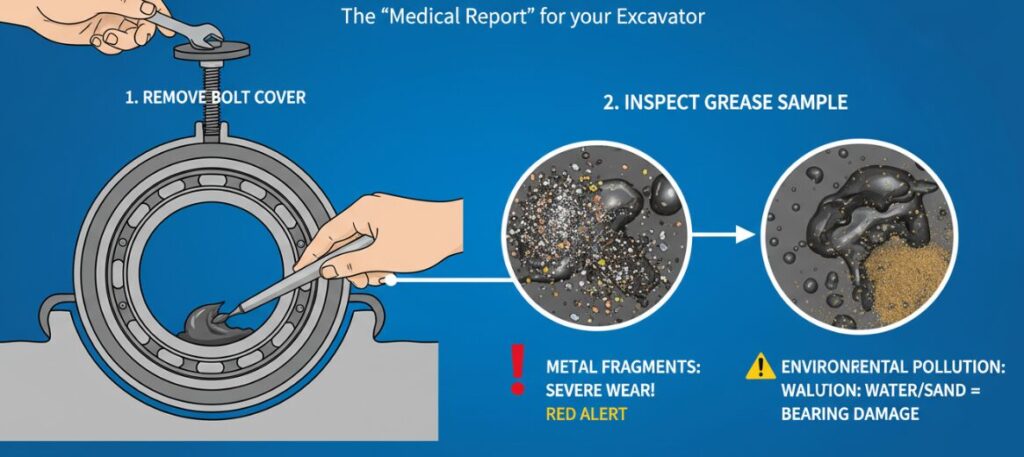
Metal fragments: If you find silver or copper-colored metal particles in the grease, it is a “red warning”, indicating severe internal wear or fatigue flaking.
Environmental pollution: see if there is any water or sand, these dirty things will quickly destroy the bearing surface like abrasives.
Check The Mounting Bolts
The slewing bearing is a bridge connecting the chassis and the upper structure, so the inspection of the installation bolts must be careful.
Look for loose or missing bolts.
Check for sheared bolt heads.
Note whether the bolt hole is elongated, which indicates that the support has been displaced under heavy load.
Physical Clearance Test (Dial Indicator Method)
To get an accurate diagnosis, it is necessary to perform what is often referred to in the industry as a “wobble test” (wobble test). This process uses a dial indicator to quantify the “play” or displacement within the support.
This is a video demonstrates how the dial indicator method work in checking swing bearing play:
Step 1: Safe Shutdown
To engage in heavy machinery, safety is always the first. Make sure the excavator is parked on level ground. Always insert the rotary locking pin to prevent accidental rotation and extinguish the engine before erecting the equipment.
Step 2: Set Up A Dial Indicator
The position of the measuring tool directly determines the accuracy of the reading and cannot be sloppy:
The magnetic base of the dial indicator is attached to the chassis (X-frame).
Adjust the needle probe so that it is on the outer ring of the slewing bearing (I. e. the side close to the upper structure).
Make sure that the probe is perpendicular to the surface so that the measured vertical displacement is accurate.
Single Row Ball Slewing Bearing
Single-row ball slewing bearings are divided into internal tooth, external tooth and toothless structure, which are suitable for a variety of transmission needs.
Double Row Ball Slewing Bearing
Double-row ball slewing bearings are specially designed for super-heavy load scenarios.
Slewing Bearing With External Gear
The external gear internal flange slewing bearing integrates the advantages of external gear transmission and internal flange mounting.
Slewing Bearing With Internal Gear
The internal tooth and external flange slewing bearing is characterized by the combination of internal tooth transmission.
Slewing Bearing Without Gear
Gearless double flange slewing bearing is light weight and compact.
Cross Roller Slewing Bearing
Single-row cross roller slewing bearing adopts roller cross layout, large contact area, can synchronously and efficiently withstand axial and radial loads and overturning moment,
Step 3: Measure Vertical Displacement (Lift Test)
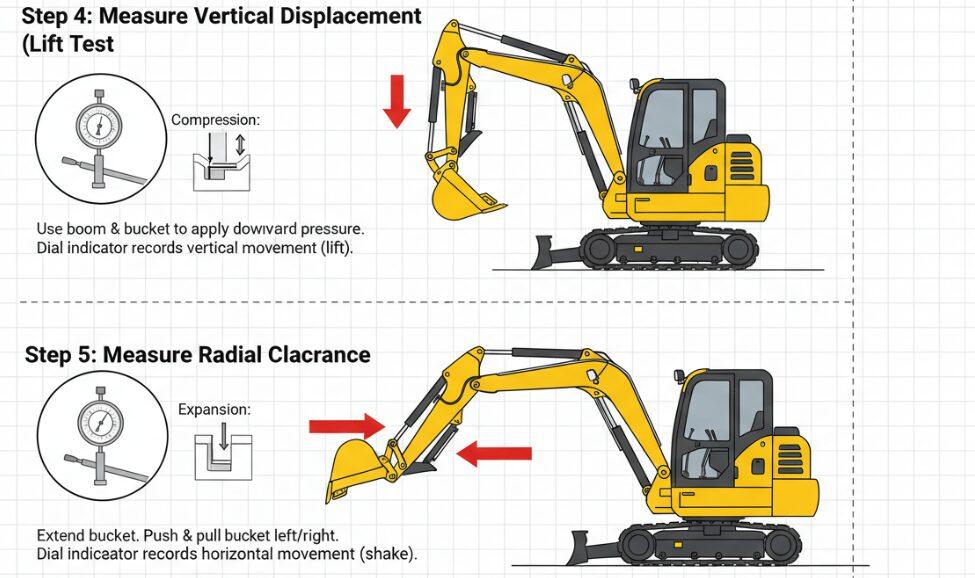
Use the boom and bucket to apply downward pressure to lift the track slightly off the ground.
Compression: When the machine is lifted, the weight is transferred and the support is compressed.
Expansion: When the machine falls or the boom forces upward to generate tension, the support gap will open.
At this time, the dial indicator will record this vertical displacement. Any movement beyond the manufacturer’s limits means you need to prepare a maintenance budget.
Step 4: Measure Radial Clearance
In addition to the vertical displacement, also check the horizontal “shaking”:
Extend the bucket to the neutral position.
Clear the dial gauge.
Push and pull the bucket to the left and right as far as possible.
Record the sum of the readings to see if the lateral clearance is exceeded.
Step 5: Data Interpretation
After you get the data, you have to go through that maintenance manual. Each type of excavator is different, and the allowable tolerance is also different.
Final Action
Excessive clearance
If the measured vertical or radial displacement is greater than the value specified in the manual, the support should be discarded. If left alone, excessive clearance will cause the ring gear to break the teeth, or even directly cut off the mounting bolts, which is a catastrophic failure.
Stickling And Torque Problems
If it is found that the rotation is not smooth during the inspection, or the rotation resistance is large or small, the support may be stuck. This is often caused by uneven wear or inadequate lubrication, and the torque resistance during operation will become very high.
Oil Tank Pollution
Check the swing gear sump. If there is water or heavy metal sheet, the seal has failed or the support material is disintegrating.
According to these diagnostic steps and strict tolerance of the standard manufacturer, you can accurately judge the health status of the slewing bearing and avoid suddenly “dropping the chain” when working on the construction site.
Author:Mark
“I am a heavy equipment maintenance specialist dedicated to helping operators prevent catastrophic machine failures. With extensive experience in excavator diagnostics, I specialize in practical inspection methods—ranging from visual grease analysis to precision dial indicator measurements.”
