 SWBTEC


How Does A Swing Ring Work
The working principle of a slewing ring is to support a heavy upper structure (such as the cab and boom of an excavator) for smooth, 360-degree rotation on a fixed lower chassis by means of rolling elements (usually steel balls or rollers) housed between two concentric steel rings (an inner and an outer ring).
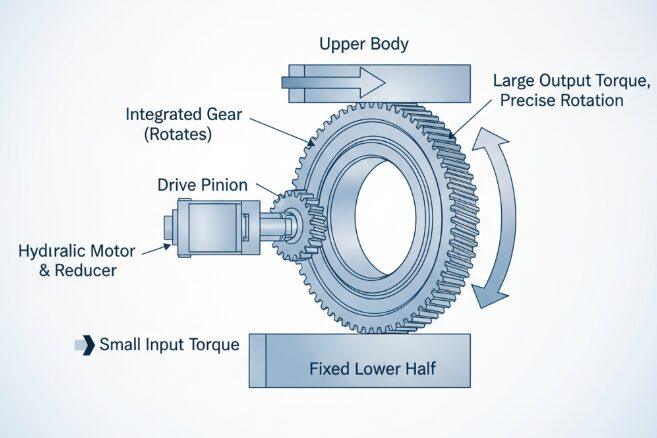
Its core function is twofold: The first is weight bearing. It must pass through precision-machined raceways and rolling bodies, and at the same time “eat” the vertical axis force, the horizontal radial force, and the most troublesome tipping moment (Tilting Moment). The second is transmission. One of the rings is usually directly integrated with a gear (internal or external teeth), which meshes with the drive pinion (Pinion) from the hydraulic motor. This gear transmission system can amplify the small input torque and drive the upper body to rotate accurately. Therefore, don’t simply think of it as a “large bearing.” It is a complex combination of structural support and power transmission, and it is also the only hub for connecting equipment to get on and off.
Core Components Of Slewing Bearings
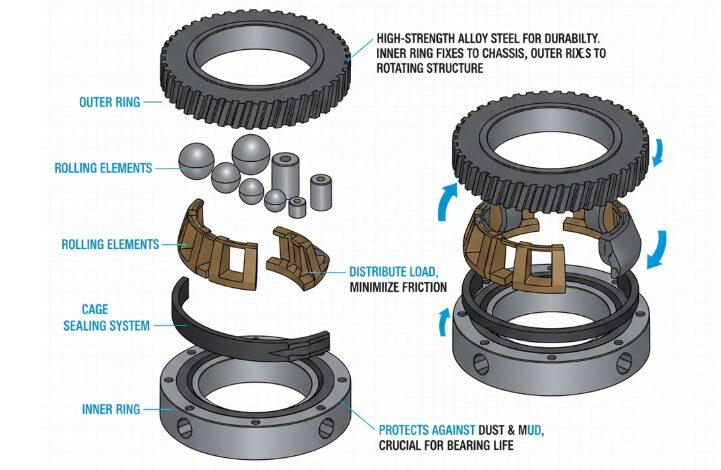
To really understand how it works, we need to disassemble its key components:
- Inner and Outer Rings: The entire bearing consists of an inner ring and an outer ring. In order to ensure durability and wear resistance, we usually choose high-strength alloy steel to manufacture. During installation, one ring is fixed to the lower chassis of the equipment, and the other ring is connected to the upper rotating structure. This constitutes the “foundation” of the entire rotating system.
- Rolling body: Clamped in the middle of the inner and outer rings is the core of smooth rotation – the rolling body. Whether it is a steel ball or a roller, they all roll in a precision-machined track. Their role is not only to move, but more importantly, to evenly distribute the huge weight and working load of the superstructure to the bottom structure, while minimizing the rotational friction.
- Cage and Sealing System: Cages are used to ensure proper spacing between the rolling elements and prevent them from “fighting”. But I have to put special emphasis on the sealing system – in the project site, dust and muddy water are everywhere, and the slewing bearing must be equipped with tight sealing strips. If the internal track into the dirt, the life of the bearing is almost the end.
Slewing Bearings Can Withstand Combined Loads
The most significant feature of the slewing bearing is that it can carry a variety of complex loads at the same time. This is essential for equipment such as excavators and cranes that generate huge tilting moments during operation.
- Axial Load: It is well understood that it is the vertical downward force, mainly the weight of the upper structure and the weight of the material in the grab bucket during operation.
- Radial Load: Horizontal force, usually from side impact or centrifugal force during rotation.
- Tilting Moment: When the excavator extends the long arm to dig, or the crane lifts heavy objects, the lever effect will produce a huge torque, trying to “overturn” the upper body. The slewing bearing must rely on the large diameter and high rigidity of the structural design to resist this moment, to ensure that the equipment does not roll over during operation.
SLEWING BEARING
Rigorous Internal Quality Control、Expert Engineering & Innovative Design Capabilities、20 Years of Expertise in Slewing Bearing Manufacturing、Expert Engineering & Innovative Design Capabilities.
Power Transmission Of Slewing Bearing
The slewing bearing is not only a static support structure; it is also a dynamic power transmission system.
- Integrated Gear: We directly machine precision gears on the circumference of the inner or outer ring.
- Drive Pinion: A pinion driven by a hydraulic motor or reducer, which directly meshes with the ring gear on the slewing bearing.
- Precision Rotation: When the pinion rotates, it drives the upper half of the entire slewing bearing (along with the upper body) to rotate relative to the fixed lower half. This gear system is actually a process of deceleration and torque increase – with a small input torque, it can drive behemoths weighing tens of tons or even hundreds of tons, and the speed and accuracy are completely controllable.
In the final analysis, the slewing bearing through a unique structural design, cleverly put the bearing “support function” and gear “transmission function” into one. It is not only the structural hub connecting the upper and lower parts of the equipment, but also the power core to realize flexible rotation. In modern heavy machinery, this component is truly irreplaceable.
Author:Colton
As a mechanical engineer specializing in industrial components, I’ve always been fascinated by the elegant design of the slewing ring. In my years in the field, I’ve gained a deep appreciation for how this single part masters both immense structural support and precise power transmission. I’m passionate about demystifying these critical mechanisms, and I wrote this guide to share my insights into the engineering that allows heavy machinery to move with such power and accuracy.
