 SWBTEC


Cross Roller Bearing Applications
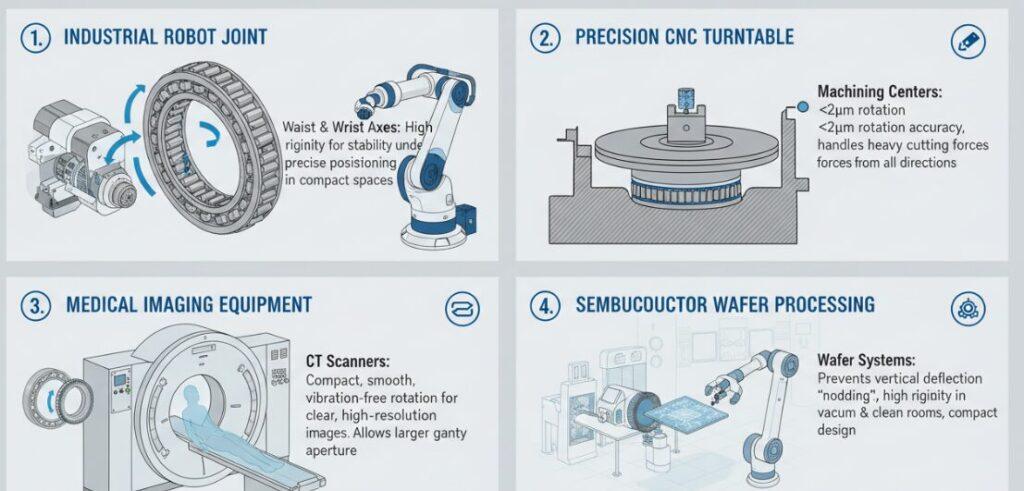
Cross roller bearing applications are primarily found in high-precision equipment where space is limited but rigidity is critical. They serve as the core component in industrial robot joints (waist and wrist axes), precision NC rotary tables, medical imaging devices (such as CT scanners), and semiconductor wafer handling systems. Engineers prefer these bearings for widespread use in automation, aerospace, and medical fields because they can handle radial, axial, and moment loads simultaneously within a compact footprint. This unique structure allows a single cross roller bearing to replace complex double angular contact ball bearing setups, ensuring rotational accuracy (often < 2μm) and high tilting rigidity.
Core Applications Of Cross Roller Bearings
Industrial Robot Joint
In the field of automation, the application of cross roller bearings is most vividly reflected in the joint parts of industrial robots. Especially the waist and wrist axis, these two fulcrums have the highest requirements for stability.
Waist Axes
As the base of the robot’s movement, the waist axis not only carries the weight of the entire robotic arm when rotating, but also responds to the dynamic inertia. The high overturning rigidity of the crossed roller bearings is crucial here, as it ensures that the robot remains stable even when the arm is fully extended and the torque reaches maximum.
Wrist Axes
The wrist part requires extremely high positioning accuracy to operate tools or grasp parts. Because these bearings can handle complex moment loads in a tight space, robot designers can significantly reduce the size of the wrist unit without sacrificing gripping force or rotational accuracy-which is especially critical when performing precision assembly or welding tasks.
Precision CNC Turntable
For machining centers, precision NC turntables are extremely dependent on the unique structure of this bearing. The most rigid indicator here is the rotation accuracy, which must usually be kept within 2 μm (microns).
The cross roller design can effectively prevent displacement under heavy cutting load. When the NC turntable holds the workpiece for machining, it will encounter cutting forces from all directions. The bearing’s ability to handle both radial and axial loads ensures that the position of the turntable relative to the machine tool does not move. In the actual processing, this directly determines whether you can make high-quality surface finish, and can hold those harsh tolerances.
Medical Imaging Equipment And CT Scanners
In the medical field, reliability and compactness are overriding considerations. The use of CT scanners is a typical example.
Inside the CT machine, the X-ray source and detector require smooth and precise rotation around the patient. But the reality is that the space inside the rack (Gantry) is very crowded. The use of a single crossed roller bearing is an excellent space-saving solution, which replaces the bulky traditional bearing components. This allows us to design a larger aperture (I. e., the opening through which the patient enters), while ensuring that the rotation process is smooth and vibration-free, which is essential for capturing clear, high-resolution medical images.
Semiconductor Wafer Processing System
The semiconductor industry’s requirements for cleanliness and precision are simply to the point of obsessive-compulsive disorder. In wafer processing systems, robots and transport arms are required to transfer fragile wafers between various process steps.
Here, the rigidity of the crossed roller bearing plays a decisive role, mainly to prevent any vertical deflection of the robot arm (that is, we often say “nodding” or sagging). You know, even micron-level vibration or positioning errors can scrap expensive wafers. In addition, this bearing’s ability to provide high rigidity in a compact form factor makes it ideal for operation in vacuum environments and clean rooms-where the smaller the equipment, the better it is to control airflow and pollution.
Advantages Of Crossed Roller Bearings
Simultaneous Handling Of Complex Composite Loads
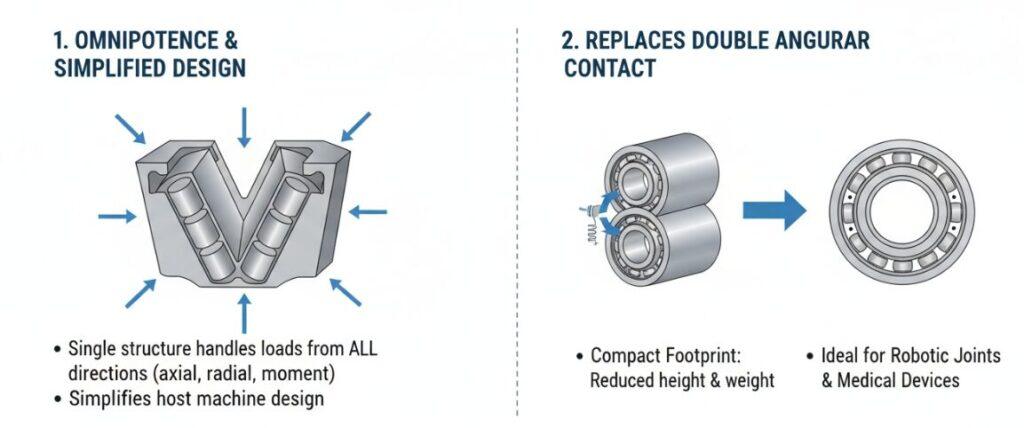
Its greatest advantage is “omnipotence”. Inside the crossed roller bearing, the cylindrical rollers are arranged in a 90 ° V-groove, and each roller is perpendicular to the adjacent roller. This single structure can withstand loads from all directions, greatly simplifying our host design work.
Replace Double Angular Contact Ball Bearings
In the past, dealing with complex composite loads usually requires the installation of two sets of angular contact ball bearings, but also carefully adjusted preload. Crossed roller bearings simplify this process directly, replacing the complex double bearing arrangement with one bearing. This brings two very practical benefits:
- Compact footprint: Reduced height and weight of components, which saves space at a premium for robotic joints and medical devices.
- High overturning rigidity: Here is a technical detail-the rigidity provided by the line contact of the roller is significantly better than the point contact of the ball bearing. Measured down, the rigidity of the equipment can usually be increased by three to four times.
Author: Jay
I am a Senior Application Engineer specializing in precision transmission systems. With a decade of experience in the bearing industry, I focus on optimizing cross roller bearing applications for industrial automation, robotics, and medical imaging devices to ensure maximum rigidity in compact designs.
