 SWBTEC


Cross Roller Bearing Advantages And Choices
Selection of cross roller bearings (Cross Roller Bearing) is a process of trade-off between structural performance and economic value. The engineering goal is clear: to resist complex loads in the smallest space, but also to ensure extremely high rigidity and precision.
But the challenge at the procurement level is how to find a reliable solution that simplifies system design while controlling total cost of ownership (TCO). How to build a bridge between strict technical indicators and smart investment?
The answer lies 1 a change in perspective: “high rigidity” is seen as a driving force to improve operational efficiency, while “compact design” is seen as a lever to cut structural costs. Below, I will take you through the 1 time to select the best cross roller bearing required knowledge.
Cross Roller Bearing Selection
The so-called cross roller bearing, the core lies in the internal roller is 90 ° vertical cross arrangement. This structure is very classic, so that a single bearing can handle radial, axial and turning moment loads at the same time. This is why in industrial robot joints, CNC turntable and precision medical equipment, it is always the “core big piece” that cannot be bypassed “.
Why Choose a Cross Roller Bearing?
Combining theory and field application, its benefits are not only “high performance”, but also directly reflected in simplifying design and saving money.
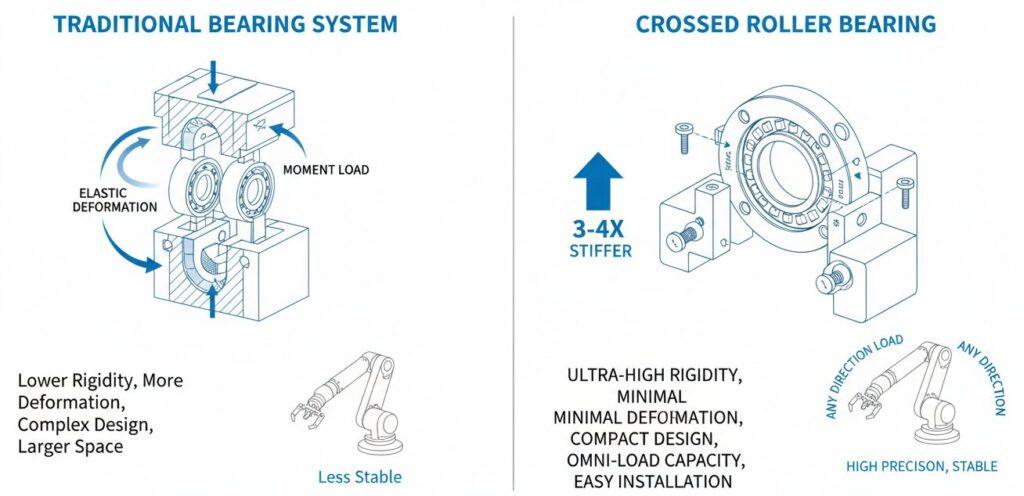
- Ultra-high rigidity and rotation accuracy: When encountering moment loads, traditional bearings are prone to elastic deformation. But the cross roller is line contact, plus preload (preload), the rigidity is usually the same size angular contact ball bearings 3 to 4 times. This means less deformation and extremely low vibration. When doing high-precision machining or automation tasks, this positioning accuracy is often decisive.
- Save space, simplify the design: this is I think the most fragrant advantage. A cross roller bearing can directly replace the combination of “radial bearing + thrust bearing. This eliminates the need to 1 a complex mechanical structure, the axial space is saved, the weight of the surrounding parts is also reduced, and the final manufacturing cost is naturally low.
- Almighty load capacity: Since it is called “Almighty”, it is because it can easily cope with forces from any direction. Therefore, the performance is particularly stable at the end of the robot arm where the load situation is very complicated.
- Installation fool: Many models (like RU and RA series) come with mounting holes on the inner and outer rings. This means you don’t need to specifically design bearing housings or flanges to lock the screws directly. This not only greatly reduces the assembly complexity and saves man-hours, but also avoids many low-level errors caused by inadequate installation.
Structure and model selection logic
Choosing the wrong model is the most common cause of performance rollover. There is only one key point here: is it the inner circle or the outer circle?
- Inner ring rotation (such as CNC turntable): select the outer ring division, the inner ring of the whole model (such as RB, CRBC series). This ensures that the rotating inner ring has the highest operating accuracy.
- Outer ring rotation (such as robot joint): select the model of inner ring division and outer ring as a whole (such as RE, CRBH series). In this way, the outer ring turns smoothly and has stable precision.
- The pursuit of extreme compact and easy installation: the overall structure model with mounting holes (such as RU series) is the first choice. Because its inner and outer rings are integral, the most rigid, and can be installed without additional parts, it is definitely the “version answer” of the compact design “.
Those installation details that must be paid attention
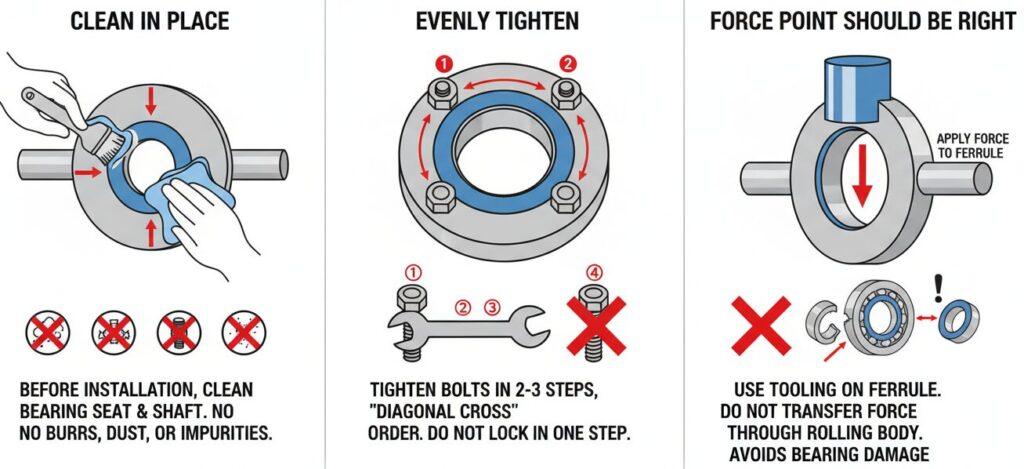
I must emphasize this point: according to my observation, more than 50% of the early failures of bearings are caused by improper installation. Even if you buy a top-grade bearing, it is useless if it is not installed properly. Be sure to remember:
- Clean in place: Before installation, the bearing seat and shaft must be cleaned, and there must be no burrs, dust or impurities.
- Evenly tighten: When locking the installation bolts, they must be tightened in 2-3 steps to the recommended torque in the order of “diagonal cross. Do not lock one step to prevent deformation of the ferrule.
- The force point should be right: when pressing, use the tooling to evenly apply the force to the ferrule to be installed. It is absolutely forbidden to transfer the impact force through the rolling body, which is the fastest way to destroy the bearing.
Procurement of Cross Roller Bearing
For the key function of cross roller bearings, “value” depends on the total cost of ownership (TCO), rather than just looking at the unit price.
Price vs. total cost of ownership
Although the initial quotation for high-quality bearings may be a little higher, you will find that it saves far more money than that difference by simplifying the design (saving flanges and bearing seats), reducing assembly labor, reducing maintenance frequency and prolonging the life of the equipment. When looking at quotations, it is the smartest financial decision to include these “invisible” cost savings.
How to judge whether the supplier is reliable?
- Technical support: reliable suppliers must have a strong engineering team behind sales. Try to ask them a specific selection technical question. Can give a professional, quick answer, more convincing than any beautiful brochure.
- Check the quality system: ask them for ISO 9001 certification, and require material certification and factory accuracy test report before placing an order.
- Evaluate deliverability: For standard models, ask about stock levels and average lead times. A stable supply chain is the key to ensuring that your production plan is not out of line.
With this strategy, you can not only buy high-quality bearings for the company, but also provide the entire project team with a set of reliable, efficient and cost-effective solutions.
About the Author:Bill
With over 12years in precision motion, I’ve spent my career on the front lines, helping engineers integrate cross roller bearings into some of the most demanding applications imaginable. From the multi-axis joints of industrial robots to the heart of CNC rotary tables and medical CT scanners, I’ve seen firsthand how the right bearing selection can elevate a design. My goal isn’t just to recite catalog data; it’s to share the practical, field-tested knowledge that I’ve seen make the difference between a project that simply works and a project that truly excels. I write to help fellow engineers avoid common pitfalls and make smarter, more confident design decisions.
