 SWBTEC


Crane Slewing Ring Performance And Selection
To keep your lifting equipment at peak performance, the first step is always precision selection. You must ensure that the slewing bearing design you choose-whether it is a single-roll type for light duty conditions or a cross-roll type for high-precision heavy loads-perfectly matches the crane’s load rating, operating speed and environmental exposure. In my experience, if you don’t carefully check the parameters in the manufacturer’s manual, this “mismatch” is often the culprit of premature decline in equipment performance. After selecting the model, the installation accuracy directly determines how long it can last. Emphasis should be placed on the flatness of the mounting surface and the torque control of the connecting bolts. If the uneven surface or the wrong preload once the introduction of stress concentration, early metal fatigue is not far from you.
Crane slew ring interpretation
1.1 Slew Ring Fundamentals and Selection
There are many types of crane slewing bearings, such as single volleyball, double volleyball, cross roller and three row column. Each design has its temper and adapts to the scene. For example, the single-ball type has a simple structure and can cope with light and medium loads. However, if it is a large precision lifting equipment that pursues high rigidity, I usually recommend the cross-roller type, because their carrying capacity and rigidity are indeed better.
The correct selection is the premise to ensure the long life of the slewing bearing. You must consider the crane’s rated load, operating speed, frequency of use, as well as environmental conditions (such as temperature, humidity, there is no corrosive media these), as well as the specific requirements for rigidity and accuracy. Be sure to refer to the manufacturer’s selection manual and calculation method. I have seen too many deviations caused by the selection of “forehead clapping” at the scene. As a result, the slewing bearing failed before it was used, or its performance was greatly reduced.
1.2 Installation and Commissioning
The installation quality of the slewing bearing has a decisive influence on its service life.
1 detailed installation instructions are absolutely indispensable, including checking the flatness of the foundation (or mounting surface), selecting the right grade of connecting bolts, and precisely controlling the tightening torque. Unregulated installation-such as stress concentration caused by uneven installation surfaces, or excessive/small bolt preload-will induce early fatigue or deformation of the slewing bearing.
Before putting into operation for the first time, it is also necessary to do a comprehensive inspection and debugging, such as confirming the rotation clearance, rotation resistance and lubrication state, which can effectively kill potential problems in the cradle.
1.3 Maintenance and Upkeep
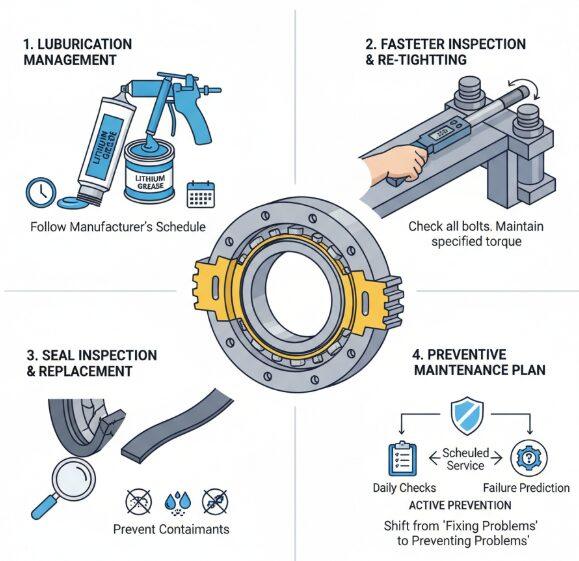
Want to extend the service life of the crane slewing bearing, effective maintenance is the cornerstone. This mainly includes the following points:
Lubrication management: select suitable lubricants (such as lithium grease, molybdenum disulfide, etc.) according to the working conditions and environment of the equipment, and strictly abide by the lubrication cycle and method recommended by the manufacturer. To be honest, insufficient lubrication or the wrong grease is one of the most common reasons for the failure of slewing bearings I have seen.
Inspection and re-tightening of fasteners: regularly check the tightening of all connecting bolts and re-tighten them according to the specified torque. Vibration and impact will loosen the bolts, which will affect the load distribution uniformity of the slewing bearing.
Seal inspection and replacement: check whether the sealing strip is aging or damaged to prevent dust, moisture and corrosive substances from slipping into the slewing bearing.
Preventive maintenance plan: develop and strictly implement a detailed preventive maintenance plan, combined with daily inspection, regular maintenance and failure prediction, the “problem repair” into “active prevention”.
1.4 Fault Diagnosis and Troubleshooting
During the operation of the crane, the slewing bearing may have “symptoms” such as abnormal noise, poor operation, excessive clearance or abnormal vibration “. It is recommended that you establish a standardized troubleshooting process:
Abnormal noise: may be caused by poor lubrication, raceway wear, foreign matter entering or loose fasteners.
Poor running/sticking: may be related to poor gear meshing, sealing strip sticking, internal damage or overload.
Excessive swing clearance: This usually means that the raceway or rolling body is severely worn and requires professional evaluation.
Through professional detection tools (such as stethoscope, vibration analyzer) plus empirical judgment, combined with the historical operation data of the equipment, the cause of the fault can usually be effectively located. In some cases, it may be necessary to replace parts or seek professional repair service.
1.5 Practical Tips for Enhancing Slew Ring Performance and Lifespan
In addition to basic maintenance, there are several advanced skills I think it is necessary to mention, can help you further tap the potential of slewing bearings:
Avoid overloading: strictly observe the rated load of the crane. Overloading is definitely the number one killer of premature fatigue and failure of slewing bearings.
Corrosion protection: In humid, dusty or highly corrosive environments, special attention should be paid to the anti-corrosion measures of the slewing ring, such as the use of anti-corrosion coatings and high-quality seals.
Predictive maintenance: Use sensors for real-time monitoring (such as temperature, vibration, oil analysis), and predict potential failures through data analysis, so that maintenance work is more accurate.
Selecting the Best Slew Ring
2.1 Supplier Evaluation and Selection
Manufacturing capacity: Assess their production equipment, technical strength and process flow to ensure that they can produce products that meet your requirements.
Quality management system: find out whether they have international quality certification (such as ISO), as well as specific quality control processes and testing standards.
After-sales service and technical support: High-quality after-sales and timely technical support can significantly reduce your operational risks and maintenance costs.
Industry reputation and case studies: look at other customer feedback and success stories to measure the supplier’s market reputation and product reliability.
Establishing long-term partnerships with suppliers who have a good track record and can provide customized solutions usually results in more stable supply, better prices and stronger technical backing.
2.2 Cost-Benefit Analysis
You need to calculate a general ledger and conduct a comprehensive cost-benefit analysis, including:
Initial purchase cost: the naked price of the product.
Installation costs: whether special tools or technicians are required.
Transport and tariffs: especially when it comes to cross-border procurement.
Operation and maintenance costs: including lubricant consumption, daily inspection and replacement of wearing parts.
Potential downtime costs: If the product quality is not good enough to cause a failure, the resulting loss of production will far exceed the purchase cost.
Although the initial investment of high-quality slewing bearings may be slightly higher, but with its longer life, lower failure rate and less maintenance needs, in the long run, the money saved and the return on investment is absolutely cost-effective.
About the Author: Brown
I am Brown, bringing over 15 years of extensive experience in the heavy lifting machinery sector. My background as a Senior Engineer and Technical Consultant for prominent crane manufacturers has allowed me to develop deep expertise across slew ring design, manufacturing, application, installation, maintenance, and strategic procurement. I’ve had the privilege of contributing to optimizing slew ring performance and selection in numerous international projects, and my goal is to provide you with authoritative, practical, and integrated solutions that empower both technical and commercial professionals to achieve superior equipment performance, extended operational life, and maximized ROI.
