 SWBTEC


Crane Slew Ring’s Principle And Maintenance Guide
Why slewing bearing are so important

What role does slewing bearing play in cranes?
- Bearing: The weight of the entire superstructure and lifting objects needs to be supported.
- Torque transmission: the power of the crane rotation and the resulting torque must be transmitted through it.
- To achieve relative rotation: that is, to allow the upper structure of the crane to rotate freely around the lower structure.
Slewing ring bearing how to affect the crane work
The performance of the slewing bearing is directly related to the efficiency, safety and stability of the crane. A high-quality slewing bearing can ensure the smooth and accurate rotation of the crane, reduce shaking, improve the hoisting accuracy and improve the efficiency of the operation.
Basic knowledge of slewing bearings
The specific position of slewing ring on crane
Slewing bearings are usually installed between the base of the crane and the upper rotating platform, like a huge bearing to closely connect the upper and lower parts.
Structure of slewing bearing
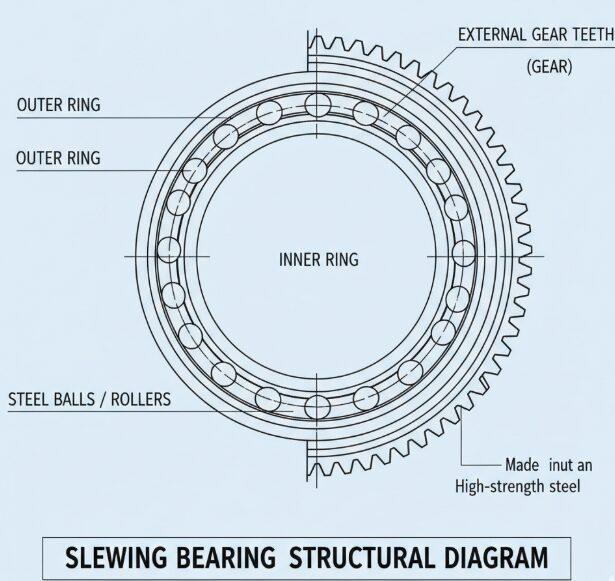
- Inner and outer rings: The main structure of the slewing bearing, usually made of high-strength steel, formed by precision machining raceway.
- Steel ball/roller: the rolling element of the slewing bearing, located between the inner and outer rings of the raceway, bears and transmits the load, while ensuring the smoothness of the rotation.
- Gear: Most crane slewing bearings have gears. Slewing ring gear can be installed on the outer ring (external teeth) or inner ring (internal teeth), through meshing with the gear of the drive mechanism to achieve the slewing drive of the crane.
Working principle
When the crane needs to rotate, when the driving device drives the gear to rotate, the inner ring or the outer ring will rotate, and the rolling elements will roll between the inner and outer rings, so as to realize the rotation of the upper structure relative to the lower structure.
In the process of rotation, the rolling body effectively converts the friction force into rolling friction, which greatly reduces the energy loss.
Several Common Types of Slewing Bearing and Applicable Equipment
- Single row four-point contact ball slewing bearing: This kind of bearing has compact structure and moderate carrying capacity. It is generally used as a small and medium-sized crane slewing bearing and excavator slew ring.
- Double-row reducing ball slewing bearing: Double-row bearing has higher carrying capacity and anti-overturning capacity than single-row bearing, and is often used in large cranes, port machinery, etc.
- Three-row cylindrical roller slewing bearing: the bearing capacity of the three-row bearing is the strongest ball bearing slewing ring, which is suitable for super heavy cranes, offshore platforms and other equipment that need to bear huge loads.
- Crossed cylindrical roller slewing bearing: This bearing has high rotation accuracy and rigidity, and is suitable for precision measuring equipment, and other occasions that require high rotation accuracy.
Routine inspection and maintenance
Intuitive judgment
- Vision: Regularly check whether there are cracks, deformation, loose or missing bolts on the outside of the slewing bearing, whether the seals are intact, and whether there are abnormal oil stains or leaks.
- Hearing: when the crane is rotating, listen carefully to see if there is any abnormal noise, such as friction sound, stuck sound, impact sound, etc. These may be a signal of a problem inside the slewing bearing.
- Smell: If you smell burnt smell, you need to be vigilant. This is usually a sign of overheating of the bearing, which may be insufficient internal lubrication or severe bearing wear.
- Tactile: If safety permits, you can touch the shell of the slewing ring with your hand to feel whether there is abnormal vibration or overheating.
Regular lubrication maintenance
Regularly and quantitatively adding grease to the slewing bearing can effectively reduce friction and extend its service life.
It is recommended to lubricate every once in a while (refer to the product manual for the specific cycle). When lubricating, ensure that the grease is evenly injected into the raceway until fresh grease escapes from the sealing ring.
Early signs of slewing bearing failure
- Abnormal sound: This is one of the most common early signs. In addition to the sound of friction and impact, such as regular “click”, “squeak”, and even the harsh sound of metal friction, you must be vigilant. These sounds often indicate that the raceways or rolling elements may have been damaged.
- Operation exception: If the crane is stuck, frustrated, shaking is obviously increased, the rotation speed is uneven, or the operation feels more difficult than usual, it indicates that the slewing bearing may have problems.
- Abnormal appearance: In addition to grease leakage, bolt loosening, seal damage these visible losses, if it is found that the gear of the slewing bearing is worn and cracked, or there are obvious pits and cracks in the inner and outer rings, it indicates that the slewing bearing has a serious problem.
FAQ
How long is the life of the slewing bearing?
The life of the slewing bearing is affected by many factors, including load size, frequency of use, maintenance, ambient temperature and so on. If overloaded, improper maintenance, life will be greatly shortened.
Slewing bearing can repair?
Some minor damages can be repaired, but if the raceway is severely worn or cracked, it is recommended to replace the slewing bearing with a new one to ensure safety.
How to judge the slewing bearing needs to be replaced?
When the above signs of failure, especially abnormal operation, abnormal noise continues to appear and become more and more serious, or the performance index of the slewing bearing is found to have exceeded the allowable range through professional testing (such as clearance testing), it is basically time to consider replacement.
Can you replace the slewing ring by yourself?
Not recommended. The replacement of slewing bearings is a highly specialized task that requires specialized tools and technicians. Improper replacement operation may cause more serious damage and even cause safety accidents.
Can I use second-hand slewing bearings?
Not recommended. Used bearings often have the naked eye can not detect the fatigue damage, raceway wear or clearance is too large and other issues, these will lead to its performance and life greatly reduced. For the safe operation of the equipment and long-term economic benefits, it is recommended to choose a new and quality assurance slewing bearing.
