
 SWBTEC


Slew Bearing Crane
The anxiety of front-line maintenance and after-sales personnel when facing the failure of crane slewing bearing. Once the machine stops, real money is lost every hour. The core logic of dealing with such problems is very simple and crude: reduce downtime through accurate diagnosis, and then quickly get high-quality replacement parts.
In order to completely solve the problems of abnormal noise, excessive clearance or astringent rotation, you must crack these four professional steps:
Step 1. Depth Diagnosis
When the crane rotates, there is a sense of frustration or metal friction. The most taboo is to guess by feeling. I have always insisted on “data speak”, and the “Tilt Test” is the gold standard for diagnosing internal raceway wear.
The specific approach is to mount a dial indicator between the inner and outer rings, and use the crane’s own boom action to apply overturning moment to measure the axial clearance. For most medium and large cranes, the limit given by the OEM is usually between 1.5mm and 3mm. If your measurement exceeds this range, it means that the internal roller or raceway surface has been worn quite severely. This situation will directly shake the structural stability of the entire lifting unit. Immediate replacement is the only safety plan, and there is no way to go.
Step 2. Precision Gear Matching
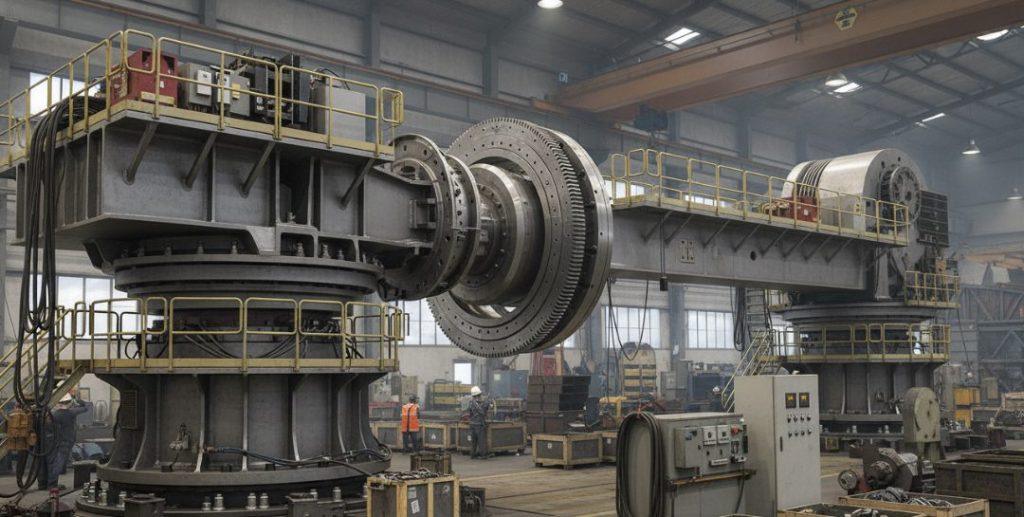
Many people easily overlook that the slewing bearing of the crane is not just a load-bearing turntable, it is essentially a core transmission part. In order to ensure that the power of the swing drive can be smoothly transmitted, you must accurately identify the gear configuration:
- Internal teeth: This design can protect the tooth surface from debris interference, and the structure is more compact.
- External teeth: Common on large cranes, the main one is easy to lubricate and maintain.
- Toothless: Usually used in some specific hydraulic drive configurations.
You have to review the modulus and the number of teeth. Even if the modulus is only a little difference, it will also lead to poor meshing, thus accelerating the wear of the tooth surface, and finally even directly damaging the rotary motor, which will cost a sea of repair.
Step 3. Material Integrity
The huge axial load and overturning moment when the crane is working, the requirements for metal materials are almost harsh. 42CrMo forgings is the best choice at present, and its toughness and fatigue strength are best balanced.
But the material alone is not enough, the raceway-that is, the place where the stress is most concentrated-must be induction hardened. This process ensures that the “core” of the part is strong enough to absorb impact, and the “surface” is hard enough to resist wear. When looking for SlewBearingTec custom-made replacement parts from this manufacturer, I will repeatedly confirm whether the raceway hardness matches the specific lifting tonnage requirement.
Single Row Ball Slewing Bearing
Single-row ball slewing bearings are divided into internal tooth, external tooth and toothless structure, which are suitable for a variety of transmission needs.
Double Row Ball Slewing Bearing
Double-row ball slewing bearings are specially designed for super-heavy load scenarios.
Slewing Bearing With External Gear
The external gear internal flange slewing bearing integrates the advantages of external gear transmission and internal flange mounting.
Slewing Bearing With Internal Gear
The internal tooth and external flange slewing bearing is characterized by the combination of internal tooth transmission.
Slewing Bearing Without Gear
Gearless double flange slewing bearing is light weight and compact.
Cross Roller Slewing Bearing
Single-row cross roller slewing bearing adopts roller cross layout, large contact area, can synchronously and efficiently withstand axial and radial loads and overturning moment,
Step 4. Ensure “Drop-In Fit”
The most expensive part of crane maintenance is not the bearing itself, but the waiting time for shutdown. In order to avoid the nightmare of parts being transported to the site but not being bored and having to be reamed and reamed on site, you must provide extremely accurate installation hole size.
Professional manufacturers usually require you to provide the following core parameters:
- Inner Diameter and Outer Diameter: Ensures that the bearing can fit into the existing base and frame.
- Bolt hole center circle diameter: determines whether the bolt can be aligned.
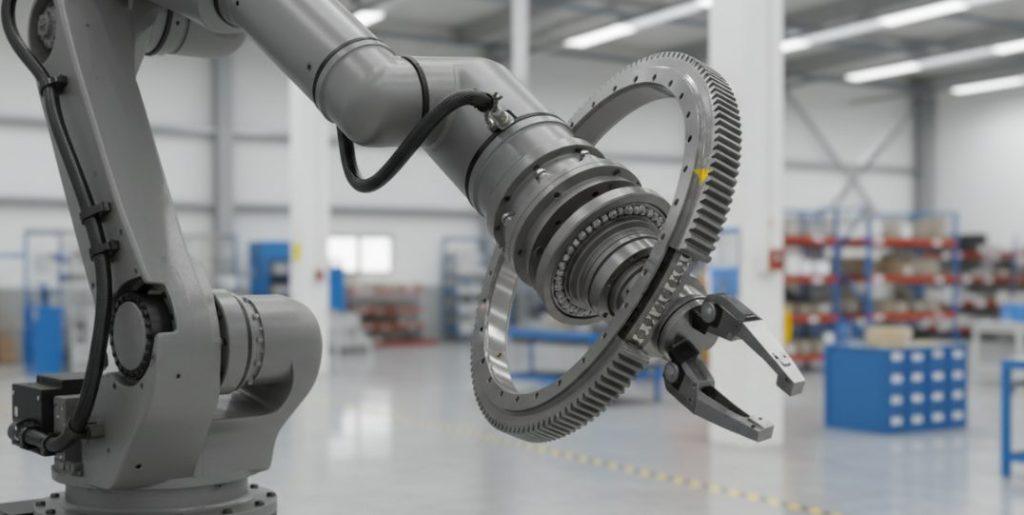
- Number of holes and aperture: to ensure that high-strength bolts can be perfectly engaged with the crane structure.
As long as these technical indicators are aligned, the so-called “drop-in fit” can be achieved. Your team can return the crane to the battlefield by simply tearing down the old and replacing it with a new one. Many times the actual service life of such high-quality replacement parts is longer than that of original parts.
Author: Robert Chen
“I’m a mechanical engineer with over 13 years of hands-on experience in the heavy machinery transmission field. Having spent over a decade troubleshooting complex equipment failures on the front line, I deeply understand the high cost of downtime. I specialize in the precision diagnosis and structural optimization of crane slewing bearings, focusing on high-performance materials like 42CrMo and induction hardening. “
