 SWBTEC


Decoding Crane Slewing Bearings: An Engineer’s Guide
Basic Knowledge And Type Of Slewing Bearing
Definition and Core Functions
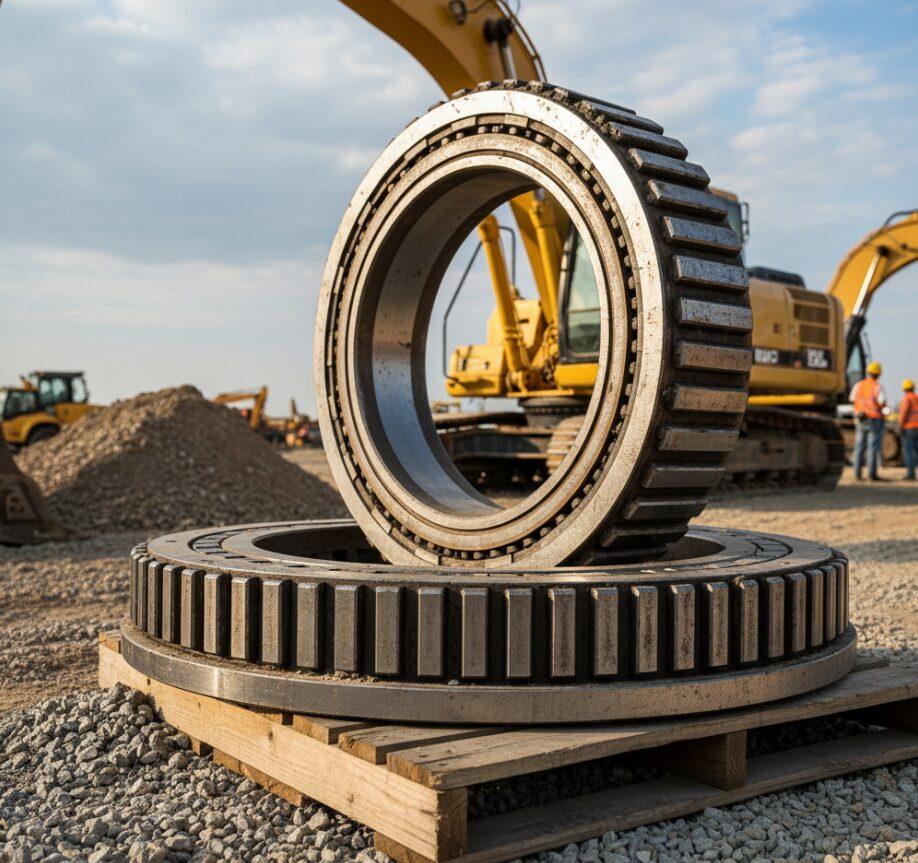
In simple terms, slewing bearing is a special bearing that can bear axial force, radial force, overturning moment and other loads at the same time. In the crane, its core function is to allow the upper structure (such as boom, cab, counterweight) to rotate 360 degrees relative to the lower chassis.
If you think about it, if there is no slewing bearing, the crane can only work in one direction, how inefficient it is! Therefore, it is the cornerstone of the crane to achieve multi-functional operations.
structure and working principle
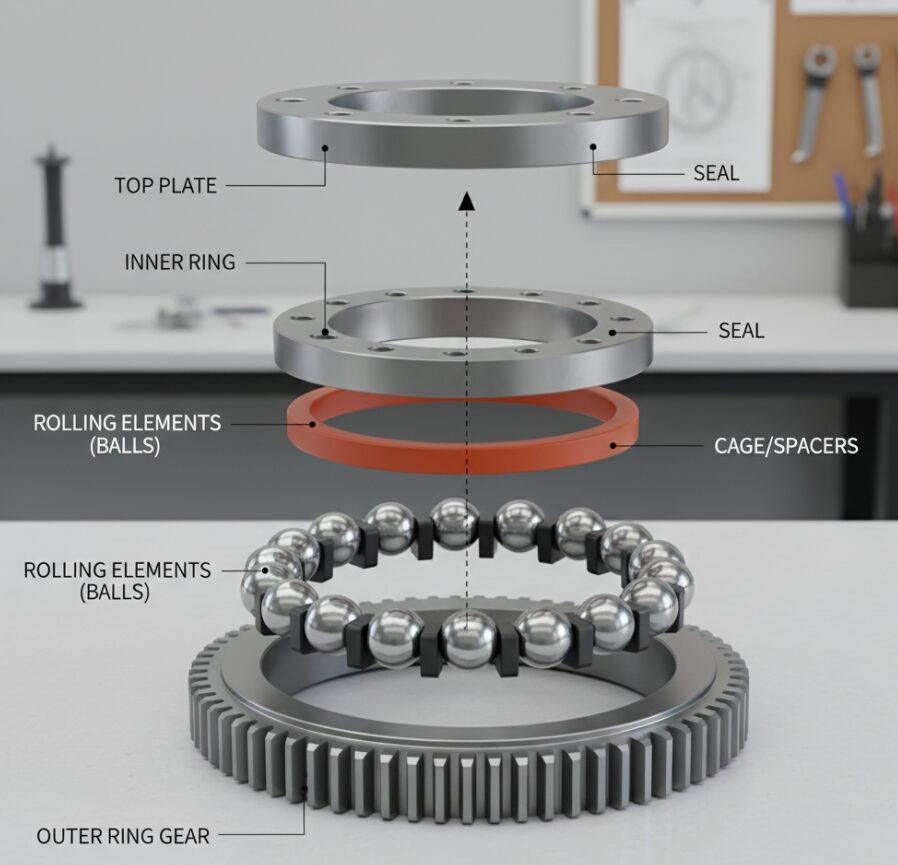
The structure of the slewing bearing is actually quite exquisite, mainly including inner and outer rings, rolling bodies (may be steel balls, or rollers), isolation blocks, sealing rings, and some will also integrate gears.
- Inner and outer rings: This is the main body of the slewing bearing, which is usually fixed on the upper and lower structures of the crane.
- Rolling elements: they are the “bridge” between the inner and outer rings, bear the load and realize rolling friction.
- Isolation block: to prevent the friction between the rolling body, to ensure smooth operation.
- Sealing ring: very important! It can effectively prevent dust, moisture and other impurities from entering the interior, while preventing the loss of grease and extending the support life.
- Gear: Many slewing bearings on the outer or inner ring will be machined out of the gear, used to drive the motor pinion meshing, to achieve rotation.
The working principle, to put it bluntly, is to roll between the inner and outer ring raceways through the rolling elements to transfer various loads of the upper structure (the vertical downward lifting force is the axial force; the force generated by the lateral swing of the boom is the radial force; The farther the lifting weight is from the center, the greater the overturning moment generated) is transmitted to the lower structure. At the same time, through the gear drive, the precise rotation of the upper structure of the crane is realized.
Main types of and their applications
According to the arrangement and number of rolling elements, slewing bearings can be divided into the following types:
- Single row slewing bearing: This is the most common 1 with moderate carrying capacity. Its structure is relatively simple and the cost is relatively low, so it is widely used in small and medium-sized cranes, excavators and other equipment. I think that for those equipment whose working environment is not so bad and the load is not particularly large, the single-volleyball type is the 1 choice with high cost performance.
- Double volleyball slewing bearing: Compared with single volleyball, its carrying capacity is stronger, especially in the overturning torque. It is usually used on medium and large cranes with higher requirements for stability.
- Cross roller slewing bearing is characterized by a 90-degree cross arrangement of rollers, which can bear large axial force, radial force and overturning moment at the same time. The carrying capacity is the strongest of several types, so you can definitely see it on the “big guys” such as heavy cranes, port machinery, and shield machines. I personally think that under extreme conditions, the reliability of the cross roller type is beyond doubt.
- Three-row roller slewing bearing: This structure can be regarded as a reinforced version of the cross roller type. It bears axial force, radial force and overturning moment respectively through three rows of rollers, and its bearing capacity is extremely strong. It is mainly used for lifting equipment that is super heavy and requires extreme stability, such as some offshore platform cranes.
Material Selection and Heat Treatment
The material selection and heat treatment process of the slewing bearing directly determine how strong its “bones” and “muscles” are.
Commonly used materials are mainly high-quality alloy structural steel, such as 42CrMo, 50Mn and so on. The strength, toughness and wear resistance of these materials are better.
The heat treatment process has a great influence on the performance of the slewing bearing. The surface of the raceway is usually quenched to obtain higher hardness and wear resistance to cope with the high-strength rolling friction of the rolling elements. The core part maintains a certain toughness to resist impact loads.
It can be said that material selection and heat treatment are like injecting vitality into the slewing bearing, allowing it to work stably and reliably under various harsh conditions. I have seen some cases of early failure due to inadequate materials or heat treatment, and the consequences can be serious, directly affecting the safe operation of the crane.
Selection Considerations: To Ensure The Best Match
In my career, I have seen too many accidents and failures caused by improper selection of slewing bearings. Therefore, whenever I receive a new project, the selection of slewing bearings is always one of my top priorities. This is by no means as simple as looking up the manual, it requires a comprehensive consideration of many factors to ensure that we choose the “best match”.
Load calculation and analysis
This is the core of the entire selection process. Just like choosing shoes for a person, you have to know how much he weighs and what sports he usually does. For slewing bearings, we must accurately calculate all the loads it needs to bear. I usually start with the following:
- Maximum weight and working radius: the most basic parameters, it directly determines the size of the slewing moment. I will carefully check the working condition diagram of the crane to find out the worst load combination.
- Wind load: the influence of wind is not small, especially for large cranes, the moment generated by the strong wind on the boom is huge and must be included in the calculation.
- Impact load: shaking when lifting heavy objects and impact when braking will instantly increase the load. I will set a reasonable impact factor based on experience and specifications.
- Other loads: the weight of the crane itself, such as eccentric load, etc., need to be carefully analyzed.
These load calculations are not just a matter of beating your head and usually require the use of professional structural analysis software and reference to industry standards. After the calculation results come out, I will also choose a suitable safety factor.
Generally speaking, the choice of safety factor will be more conservative. After all, it is related to personal safety. It is better to be higher than lower. A high safety factor means greater redundancy and the ability to cope with unexpected situations, such as occasional overloads (of course, this is strictly prohibited, but we have to prepare for the possibility).
Work environment factors
The complexity of the working environment of the crane directly affects the life and performance of the slewing bearing. When I select the type, the weight of environmental factors is even no less than the load itself.
- Temperature: high temperature will affect the performance of the grease, resulting in aging seals; low temperature may make the steel brittle, grease viscosity is too large. Extremely cold regions even need to consider low-temperature special steel.
- Humidity and dust: The humid and dusty environment is the enemy of the slewing ring. Moisture will cause corrosion, and dust will enter the bearing and accelerate wear. At this time, it is particularly important to choose products with better sealing performance, and may even need to customize the protective cover.
- Corrosive medium: If the crane works in the port, chemical plant and other environments with salt spray, acid and alkali corrosion, it is necessary to consider the use of special anti-corrosion coating or stainless steel slewing bearings.
Life expectancy and reliability requirements
The customer’s requirements for the service life and reliability of the crane are the key to my decision on the grade of the slewing bearing. If the customer wants the equipment to run continuously at high intensity for more than ten years, then I cannot recommend a product that can only be used for three to five years.
- Service life: This is usually measured by fatigue life calculations. I will choose the type of slewing bearing that meets the corresponding life requirements according to the customer’s expectations. Single-row, double-row, three-row rollers, their carrying capacity and life characteristics are different.
- Reliability: In some critical applications, such as nuclear power plant cranes, reliability is overwhelming. At this time, I may choose a special slewing bearing with higher precision, higher material grade, or even with redundant design, and the quality control requirements of the supplier will be very high.
Cost and Supplier Evaluation
Cost is certainly an important consideration, but it is by no means the only one. In my experience, just looking at the price often leads to more trouble.
- Comprehensive cost: I will pay more attention to “full life cycle cost”, that is, in addition to the purchase price, but also consider installation costs, maintenance costs, as well as potential failure repair costs and downtime losses. Sometimes, the initial investment is higher, and the later can save a lot of money.
- Quality: Needless to say. Slewing bearing is the “heart” of the crane, the quality is not good, everything is free to talk about. I will ask the supplier to provide detailed quality certification and test report.
- Technical support and after-sales service: These two points are often overlooked, but they are very important. Can you get professional technical guidance in time if you encounter problems in the process of use? Can spare parts and repair services respond quickly after a failure? A responsible supplier would do well in this regard.
- Reliable suppliers: I must emphasize this! There are too many fake and shoddy slewing bearings on the market. They may look exactly the same as genuine goods, but the internal materials, heat treatment, and processing accuracy are not up to standard. Once used, light life sharply reduced, heavy catastrophic failure. I would rather spend more time examining the supplier’s qualifications, production lines and reputation than take the risk. After all, engineering quality and safety is my bottom line.
Installation And Commissioning: The Cornerstone To Ensure Trouble-Free Operation
We all know that no matter how good the equipment is, if it is not installed well, it will be useless. Slewing bearing is especially so, its installation and debugging is directly related to the operation accuracy, safety and service life of the crane.
Preparations
Before starting the installation, the preparation work must not be sloppy. It’s like building a house and laying the foundation. The foundation is unstable and the superstructure is useless no matter how beautiful it is.
- Check the installation surface: First, I will carefully check the flatness and cleanliness of the upper and lower installation surfaces of the crane. Uneven surface will lead to uneven force on the slewing bearing and accelerate wear; while dirt may be mixed into the bearing, causing early damage. We usually clean the surface thoroughly with a scraper, sandpaper and other tools, and check the flatness with a feeler gauge to ensure that the error is within the allowable range. Sometimes, you will find some small burrs or welding slag, don’t underestimate them, have to remove them one by one.
- Tools and equipment preparation: If a worker wants to do a good job, he must first sharper his tools. Suitable lifting tools, torque wrenches, spirit levels, feelers, lubrication guns, etc. are all necessary. We will also check in advance whether these tools are in good condition and whether the accuracy is up to standard, especially the torque wrench, which must be calibrated before it can be used.
Precise installation steps
The next step is to install the core link of the slewing bearing. This process requires fine operation, one step can not be wrong.
- Hoisting and positioning: Hoist the slewing bearing carefully in place to ensure that its center is aligned with the center of the host. This requires the cooperation of experienced hoisting masters, and sometimes it may need to be fine-tuned several times. After positioning, we will use temporary bolts to initially fix it to prevent it from moving.
- Pre-tightening bolts: This step is crucial. We usually pre-tighten all the bolts according to the drawing requirements, but not tighten them at one time. This process needs to be carried out in stages, usually to 30% of the specified torque, then 50%, and finally to 100. More importantly, it is necessary to use diagonal fastening. For example, if there are 8 bolts, we will not follow 1 turns, but cross and twist 1-5,2-6,3-7,4-8. Why would you do that? Because this can ensure that the slewing bearing force is uniform to the maximum extent and avoid deformation caused by local stress concentration. I have seen many cases of abnormal noise or even cracking of slewing bearings after running for a period of time due to incorrect bolt tightening. The lesson is very profound.
- Final tightening torque: After the pre-tightening is completed, it is tightened according to the final torque requirements. This requires the use of a calibrated torque wrench to ensure that the tightening torque of each bolt is at the standard value. Again, the importance of diagonals and phasing is emphasized. This is a textbook level operation and a guideline that our engineers must strictly follow.
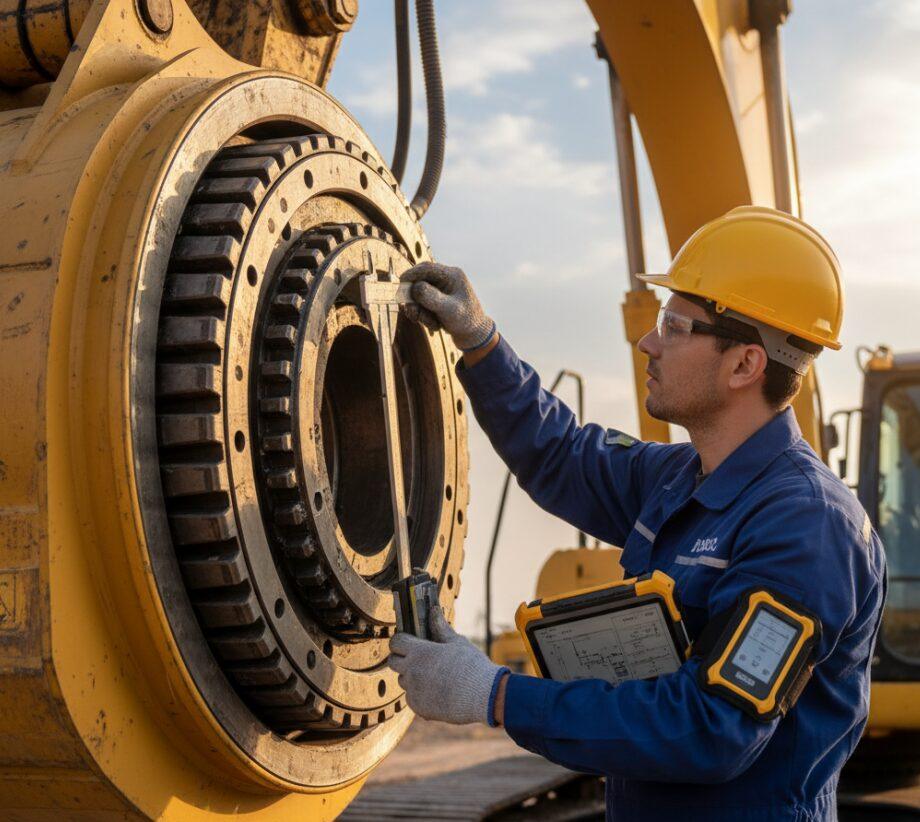
- Gear meshing clearance adjustment: the adjustment of gear meshing clearance is also a key step if the slewing bearing has gears. We need to ensure that the gear meshes evenly, without jamming, and the clearance is within the specified range. The gap is too large and easy to produce impact and noise, too small may lead to gear jam or increased wear. This usually needs to be achieved by adjusting the installation position of the rotary reducer, and we will use the feeler gauge to measure repeatedly until the best condition is reached.
Lubrication and Sealing
Lubrication and sealing is the secret of the long life of the slewing bearing.
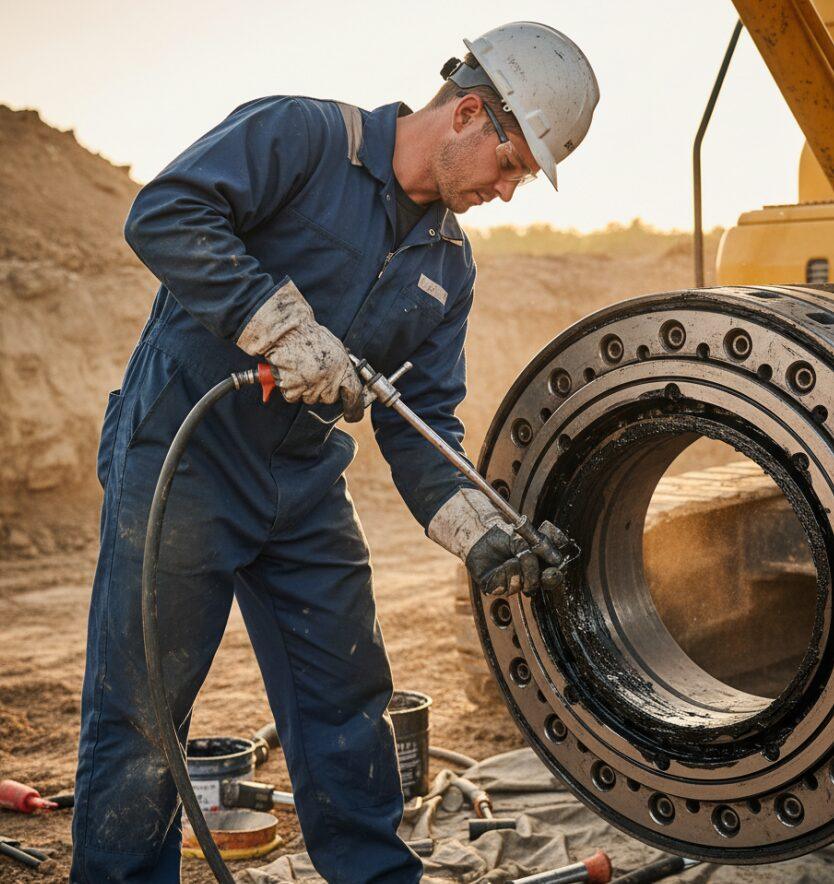
- Choose the right lubricant: the choice of the type of grease is a big question, according to the crane’s working environment temperature, load size, speed and other factors to decide. For example, cranes working in low temperature environments need to choose grease with good low temperature performance; heavy-duty cranes need to choose better extreme pressure performance. We usually refer to the recommend of the slewing bearing manufacturer and combine practical experience to choose.
- First lubrication and regular lubrication: After the installation is completed, be sure to carry out the first lubrication and add the grease to the specified amount. I remember once, a little apprentice forgot to lubricate for the first time. As a result, the equipment did not run long before he heard the harsh friction sound, which almost caused a big accident. In addition, regular lubrication maintenance is also essential. We will use the frequency and environment, develop a detailed lubrication cycle and filling amount, and strictly implement.
- Sealing ring importance: the role of the sealing ring is to prevent the loss of grease and external dust, moisture. During installation, check whether the sealing ring is in good condition and whether there is any damage. I often say that the sealing ring is like the “skin” of the rotary bearing. If the skin is damaged, the internal organs will be easily damaged.
Initial operation inspection
After all installation and commissioning, it cannot be put into use immediately, and the initial operation inspection is required.
- Abnormal sound inspection: let the crane run with no load, and listen carefully to whether there is abnormal sound at the slewing bearing, such as friction sound, impact sound, etc. Any abnormal noise may be a sign of a problem.
- Temperature check: check the operating temperature of the slewing bearing with a thermometer to observe whether there is overheating. If the local temperature is too high, it may mean poor lubrication or installation deviation.
- Rotation stability: the crane is observed in the process of rotation is stable, whether there is stuck, jitter. Smooth rotation is a direct manifestation of the correct installation of the slewing bearing.
Maintenance And Fault Diagnosis: The Key To Extend The Life Of Slewing Bearings
We often say, “three points by product, seven points by maintenance”. This sentence is reflected in the slewing bearing body incisively and vividly. I have handled many cases. Most of the time, the occurrence of faults is not a product quality problem, but a lack or improper daily maintenance.
Routine inspection and regular maintenance:
Let me say that daily spot check and regular maintenance are the best way to “renew life” for slewing bearings.
- Bolt tightening torque check (anti-loosening): This is absolutely the top priority! The slewing bearing is fixed on the upper and lower structures by bolts. If the bolts are loose, it will not only cause abnormal noise, but also cause the bearing to fall off, which is a safety accident. I usually suggest that the operator should visually check before operation every day, and the key bolt area should be checked regularly with a torque wrench. Don’t underestimate this step, it can avoid a lot of big trouble.
- Grease replenishment (cycle, dosage): lubrication is the “blood” of the slewing bearing “. The type, filling cycle and dosage of grease have strict requirements. I usually make recommendations based on the working environment and frequency of the crane. For example, in dusty or humid environments, the lubrication cycle may be shortened. When filling, be sure to fill the grease evenly into the raceway and gear meshing, until the sealing ring has fresh grease overflow, which indicates that the lubrication is in place.
- Sealing state inspection: The sealing ring is the “skin” of the slewing ring, which can prevent dust and moisture from entering the interior, and can also avoid the loss of grease. If the sealing ring is found to be aging or damaged, it must be replaced in time. A small sealing ring can play a big role, don’t take it seriously.
- Abnormal noise, vibration, temperature rise monitoring, these are the “health” of the slewing bearing barometer. When working on a crane, I often approach the turning area to hear if there is any abnormal friction or knocking. Touch your hand and feel whether the temperature is too high. Of course, professional vibration meter and infrared thermometer will give more accurate data, which is an important basis for judging early failure.
Common failure mode and cause analysis:
The failure mode of slewing bearing is relatively concentrated, but the reasons may be varied.
- Wear (gears, raceways), fatigue spalling, cracking, deformation are common mechanical damages. Gear wear is mostly related to poor lubrication or improper meshing clearance; raceway fatigue spalling is usually caused by overload, impact load or material fatigue; cracking and deformation may result from severe overload, installation stress or manufacturing defects.
- Poor lubrication, improper installation, overload, environmental factors are the main “behind the scenes” that cause the above failures “. Poor lubrication is like human ischemia, and its function will be greatly reduced; improper installation will produce additional stress concentration; long-term overload will make any component “unbearable”; and harsh environments (such as corrosive gases, high temperature and high humidity) will Accelerate its aging and damage.
