
 SWBTEC


Slewing Ring Bearing Applications: Core Uses Unlocked
Slewing ring bearings are the primary structural link in heavy machinery, designed to handle simultaneous axial, radial, and moment loads while enabling precise 360-degree rotation. You will find these critical components in the swing mechanisms of hydraulic excavators, the yaw and pitch drives of wind turbines, and the rotating platforms of mobile cranes. Selecting the right bearing depends on the specific force distribution—whether the application prioritizes tilting moment resistance or high-speed rotational accuracy.
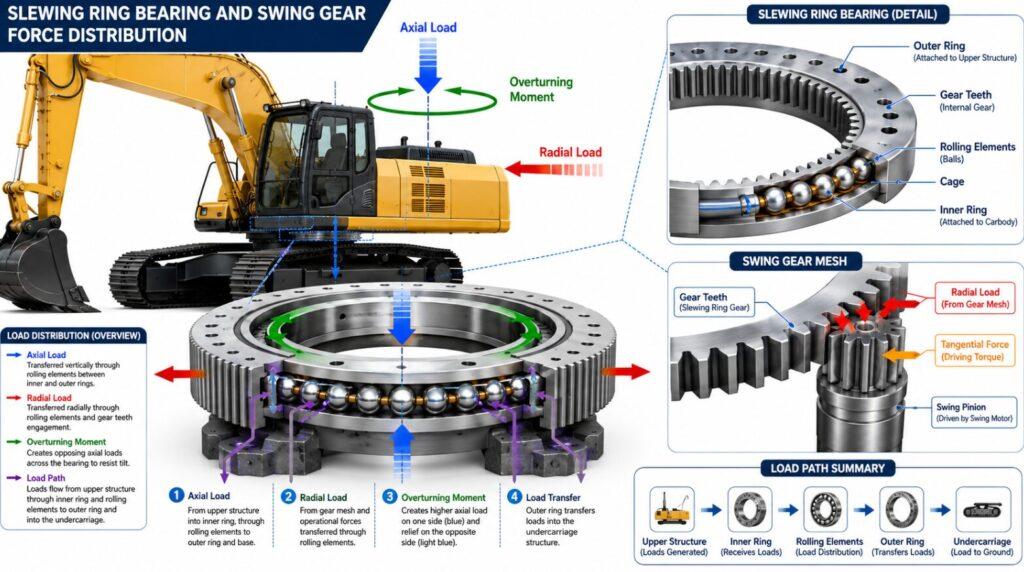
While simple rotation is the goal, the engineering reality is complex. Misjudging the environmental stress or the load frequency leads to premature bearing failure and catastrophic downtime. This guide breaks down the core uses and the technical nuances that separate a long-lasting installation from a maintenance nightmare.
Matching Design To Application
The internal geometry of a slewing ring must align with the dominant force of the application. Not all “uses” are created equal, and applying a standard ball bearing where a triple-row roller bearing is required is a common procurement error.
Axial-Heavy Applications
In crane applications, the bearing acts as the pivot for the entire boom and counterweight. The primary challenge here is the massive axial load combined with a significant tilting moment. Single-row four-point contact ball bearings are often the standard, offering a balance of cost and capacity for intermittent rotation.
| Bearing Type | Load Capacity Characteristics | Rotation Behavior | Typical Application | Suitability in Crane Systems |
|---|---|---|---|---|
| Single-row four-point contact ball bearing | Moderate axial + radial load capacity with good moment handling for its size | Intermittent rotation, smooth slewing | Standard slewing systems, medium-duty cranes | Common choice for cost-effective crane slewing rings |
| Double-row four-point contact ball bearing | Higher axial load capacity and improved moment resistance compared to single-row | Intermittent rotation with improved stability | Larger cranes, heavier slewing platforms | Used when higher stability is required under load |
| Crossed roller bearing | Very high rigidity, excellent moment and axial load capacity | Precise, low-clearance rotation | Precision positioning systems, robotics, high-accuracy machinery | Used in high-precision crane slewing or special-duty applications |
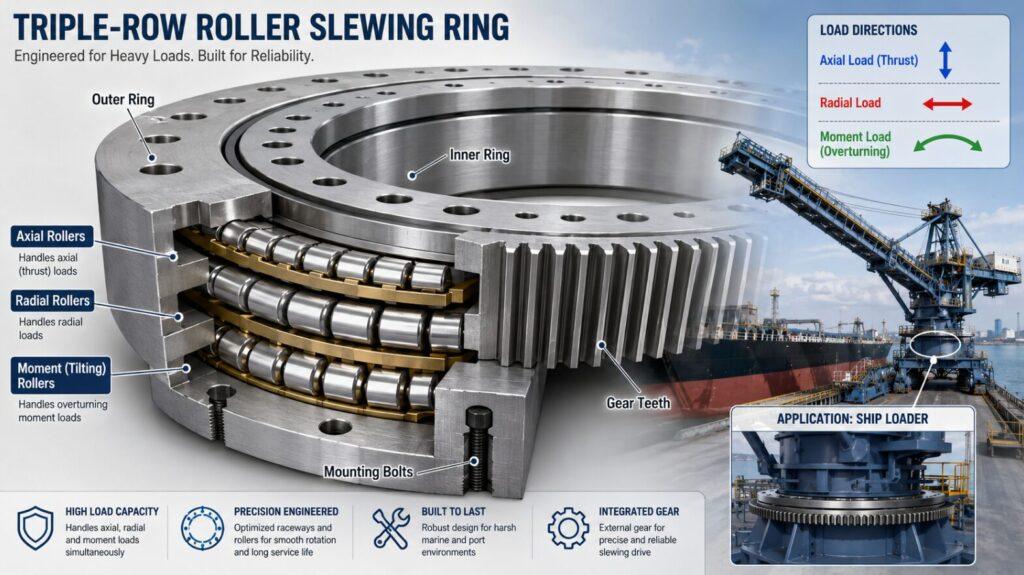
| Three-row roller slewing bearing | Extremely high axial, radial, and tilting moment capacity | Slow intermittent rotation under heavy load | Large port cranes, offshore cranes, wind turbine installation cranes | Preferred for ultra-heavy lifting applications |
| Slewing ring with gear-integrated design | High load capacity depending on roller configuration | Drives integrated rotation via gear system | Tower cranes, excavators, large industrial cranes | Widely used in construction machinery for combined drive + support |
Moment-Dominant Applications
Excavators subject the slewing ring to violent, repetitive shock loads and high tilting moments every time the bucket hits the ground. For these high-cycle environments, induction-hardened raceways are non-negotiable. The gear teeth (internal or external) must withstand the shear forces of rapid acceleration and braking.
Critical Slewing Bearing Applications In Heavy Industry
Understanding the specific demands of each sector is key to selecting the right part number.
Renewable Energy: Wind Turbine Yaw And Pitch
In a wind turbine, the slewing bearing uses are split into two functions: yaw bearings (rotating the nacelle into the wind) and pitch bearings. These bearings rarely rotate fully; instead, they oscillate. This creates a risk of “micro-pitting.” Expert engineers now specify specialized surface coatings to prevent corrosion in offshore environments.
Material Handling: Port Cranes And Ship Loaders
Port applications require massive diameters—often exceeding 5 meters. The focus here is on corrosion resistance and sealing integrity. Because these bearings are exposed to saltwater and grit, a multi-stage sealing system is the difference between a 10-year lifespan and a 2-year failure.
Why Applications Fail In The Field
Most slewing ring bearing applications don’t fail due to “wearing out”; they fail due to installation or maintenance oversights.
The Bolt Pre-load Trap
The slewing ring is only as strong as the bolts holding it to the structure. We often see technicians reuse old bolts or fail to follow a star-pattern torque sequence. This causes the ring to deform slightly, leading to “tight spots” and rapid raceway fatigue. Always use a calibrated torque wrench and Grade 10.9 or 12.9 fasteners.
Lubrication Starvation in Vertical Mounting
When a bearing is mounted on a vertical axis (like a carousel), gravity pulls the grease to the bottom. The top portion of the raceway can run dry within weeks. To solve this, experts utilize multiple grease nipples positioned at different heights and implement automated lubrication systems to ensure a constant film.
FAQs
Q: Can I use a slewing ring bearing for high-speed continuous rotation?
A: Generally, no. Slewing bearings are designed for slow-speed, high-torque applications (typically < 30 RPM). For high-speed needs, traditional deep-groove or angular contact bearings are more suitable.
Q: What is the most common cause of noise in a new slewing bearing application?
A: Usually, it is improper gear backlash adjustment. If the pinion is pressed too tightly against the slewing ring gear, it creates a grinding noise and excessive heat.
Q: How do I choose between internal and external gearing for my application?
A: External gearing is easier to access for maintenance and allows for larger pinions. Internal gearing is more compact and protects the teeth from debris, which is why it’s preferred in excavators.
Q: Are slewing bearings interchangeable between brands?
A: Rarely. While the mounting hole patterns might match, the internal load ratings, gear modules, and hardening depths vary significantly between manufacturers like SKF, Rothe Erde, or specialized B2B brands.
Q: How does temperature affect slewing bearing uses?
A: Extreme cold requires specialized low-temperature steel to avoid brittleness, while high-heat applications (steel mills) require heat-stabilized rings and high-temp synthetic grease.
