 SWBTEC


Slew Drive Gearbox: What To Check Before Ordering
A rotating platform needs to move its load, support it and remain in position when required. A slew drive gearbox can combine several of those functions, but the name alone does not tell you which components are included. One quotation may cover an enclosed slewing drive. Another may cover only the reducer connected to its input.
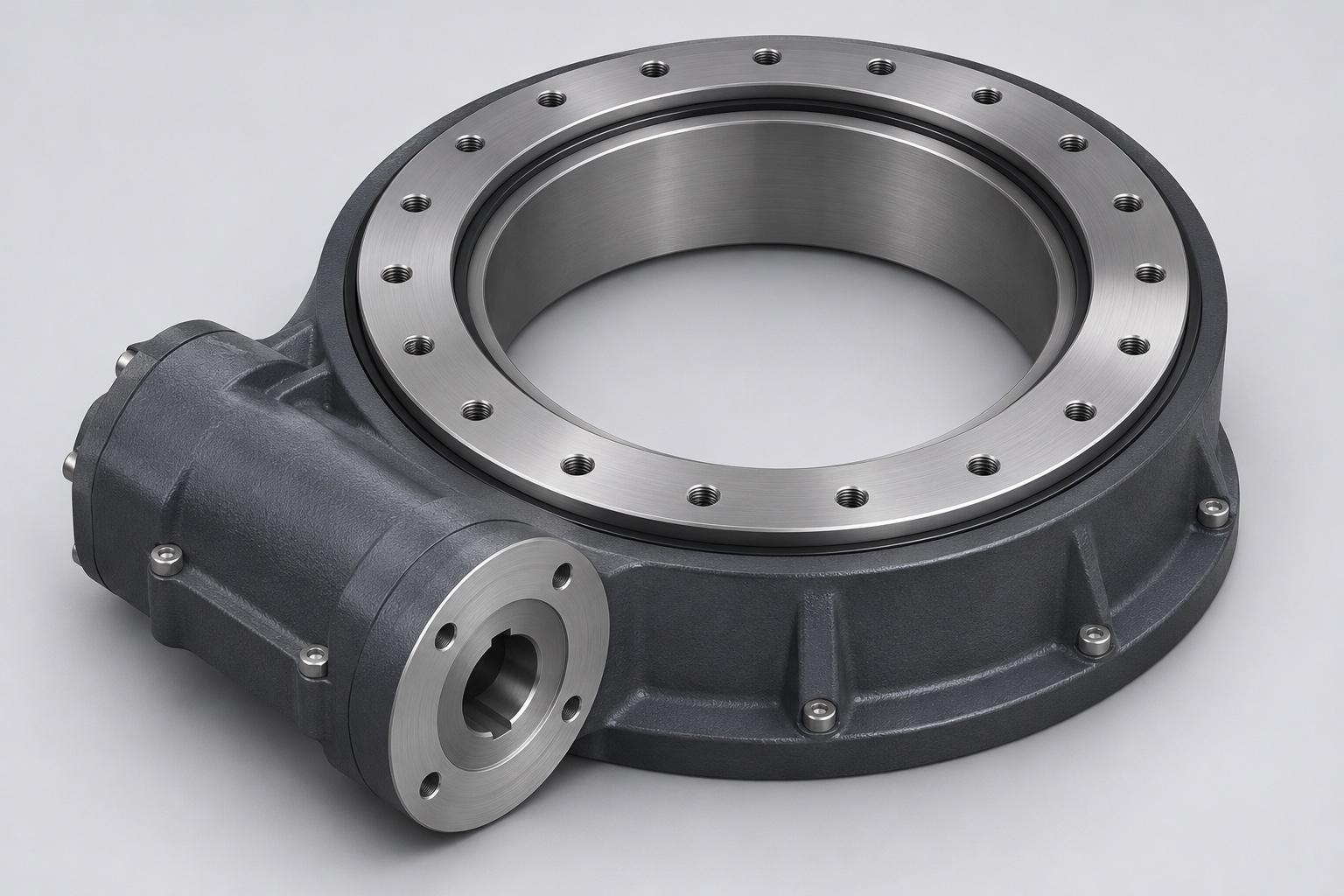
Before comparing prices or torque figures, establish the assembly boundary. That decision determines which loads the supplier must check, which interfaces must match and which parts your equipment team still needs to provide.
What Does A Slew Drive Gearbox Include?
An integrated slewing drive combines a slewing bearing, a worm or pinion transmission, a housing and an input interface. The bearing supports axial load, radial load and overturning moment, while the transmission delivers torque to the rotating structure. Its suitability depends on the actual combination of these loads.
An input gearbox has a narrower role. It changes speed and torque between the motor and the downstream mechanism. It should not be treated as the component that supports the platform simply because it appears in the same drive assembly.
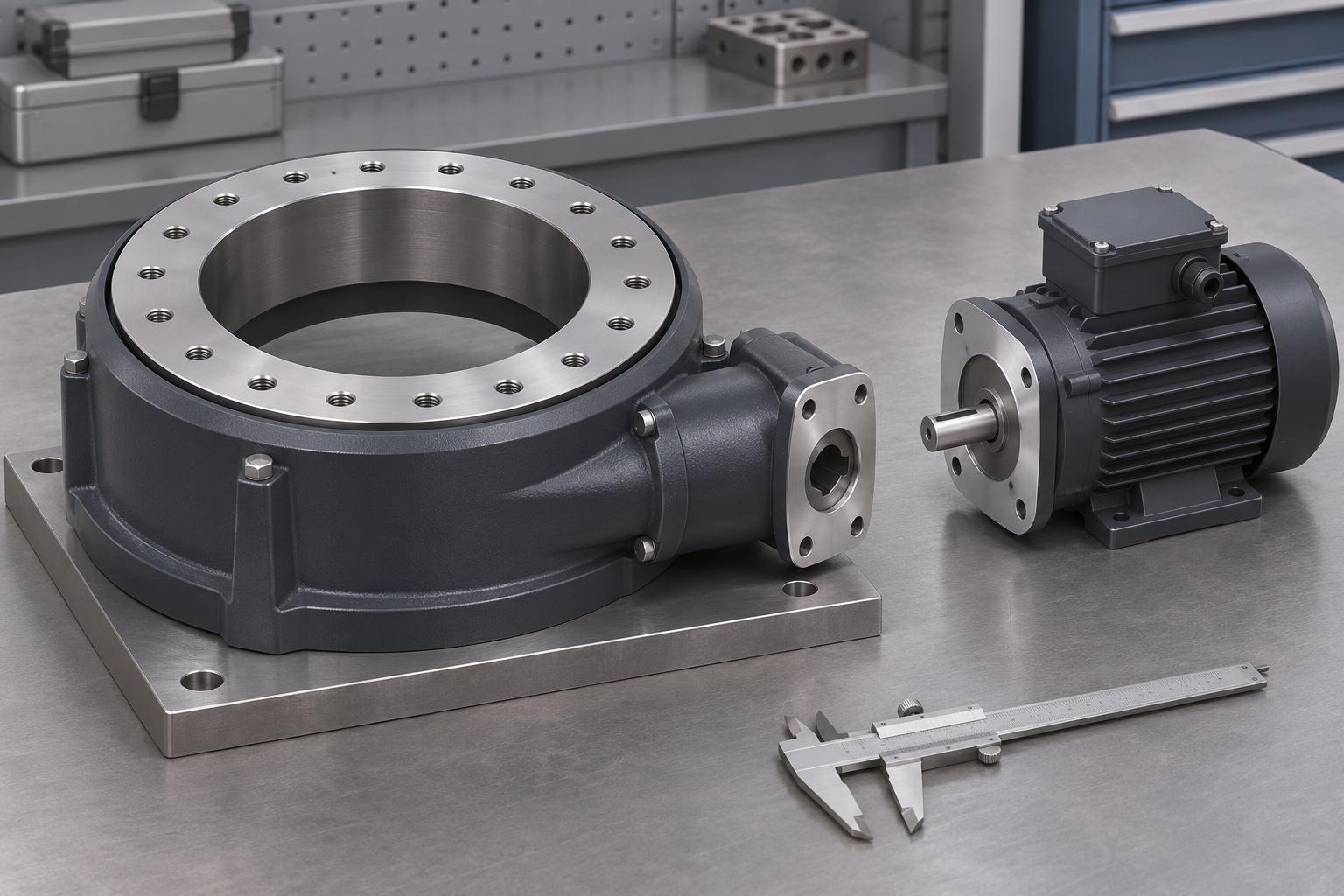
Ask for an assembly drawing and a supply list. Identify the bearing, transmission, housing, input reducer and motor separately. Confirm whether a brake, encoder, fasteners and lubricant are included. A clear drawing is more useful here than two quotations that use the same product name.
Follow The Power Path
In a worm slewing drive, the input turns a worm that engages the wheel teeth associated with the slewing bearing. This arrangement can provide substantial reduction in a compact package. Efficiency, starting behavior and heat generation still need checking against the operating cycle.
A pinion-driven arrangement sends power through a pinion into a slewing ring gear, often with an upstream reducer. Its bearing, gearing, reducer and brake require separate checks. Replacing one transmission type with another therefore involves more than matching nominal output torque.
Slewbearingtec’s product range includes worm slewing drives as well as standalone slewing bearings. When requesting a quotation, specify whether you need the integrated drive or the bearing for a larger drive system.
Describe The Operating Cycle Before Choosing A Rating
Consider two platforms that carry the same load. One turns briefly and then rests; the other rotates throughout its working shift. Their peak torque requirement may look similar, while their continuous power and thermal requirements differ.
Record output speed, acceleration, stopping frequency, direction changes, running time and rest periods. For oscillating equipment, include the working angle and reversal frequency. These details let the supplier evaluate the duty rather than infer it from a motor rating.
Keep output torque, peak torque, holding torque and permitted backdriving torque distinct. They describe different operating conditions and cannot be substituted for each other. A short-duration peak rating does not establish continuous operating capability.
Submit axial force, radial force and overturning moment for each relevant condition, including which loads occur together. The maximum value of each load may occur at a different time. A useful load table preserves those relationships instead of presenting unrelated maxima as a single operating case.
Do Not Use Gear Ratio As A Performance Shortcut
Gear ratio describes the relationship between input and output motion. It does not independently establish efficiency, load capacity, backlash or positioning accuracy.
For motor matching, provide the available input speed and torque together with the required output motion. Starting, accelerating, reversing and overcoming friction all affect the drive requirement. The input connection also needs checking for flange dimensions, shaft or coupling details, rotation direction and clearance.
If positioning matters, state the permissible backlash and repeatability, along with the load and operating conditions under which they apply. The reducer, transmission, bearing, mounting structure and control system all contribute to the final result. An encoder specification alone does not describe platform accuracy.
Define Holding And Braking Separately
A worm mechanism should not be assumed to provide reliable self-locking in every condition. Lead angle, lubrication, vibration, wear and reverse loading can affect backdriving behavior.
Describe what the platform must do when power or hydraulic pressure is lost. If it must hold a load, establish the worst external torque and the allowed movement, then agree on the appropriate brake or locking arrangement. Ask how the holding function will be verified for the complete assembly.
This also clarifies quotation scope. A mechanical drive body and a drive supplied with a motor brake are different configurations, even when their basic housings look similar.
Check The Mounting Arrangement And Service Access
The drive depends on the structure around it. Mounting-face flatness, support stiffness and bolt preload affect how the assembly carries load. Tightening bolts harder cannot correct an unsuitable mounting surface.
Identify the fixed side and the rotating side on the drawing. Check the bore, mounting-hole pattern, locating features and surrounding clearances. Include space for the motor, brake, cables or hoses, lubrication fittings and installation tools. A unit that fits its nominal envelope may still be difficult to install or maintain.
Confirm the output-axis orientation as well. A horizontal or inclined installation can change lubrication distribution and sealing conditions. Suitability for one orientation should not be assumed to cover another.
An enclosed housing helps retain lubricant and reduce exposure of the transmission, but it does not establish immersion resistance or maintenance-free service. Describe dust, water, temperature, corrosion and cleaning conditions so that protection and maintenance requirements can be agreed for the selected configuration.
Request A Lubrication Plan For The Actual Drive
The rolling contact, worm or gear mesh and input bearings may have different lubrication requirements. Do not assume that one grease fitting services every contact inside the assembly.
Ask which points require lubrication, which lubricant is approved and how the schedule changes with duty and environment. Also confirm how seals and internal parts can be inspected. A maintenance interval for a standalone slewing bearing should not automatically become the interval for an entire gearbox assembly.
For an installed unit, unexpected noise, impact or a sudden rise in driving resistance warrants stopping and investigating. Lubricant condition, mounting deformation, connection preload and transmission adjustment are relevant checks; adding more lubricant without identifying the cause may leave the underlying problem unresolved.
What To Send With Your Enquiry
A practical enquiry gives the supplier a drawing, a load table and a description of the operating cycle. Together they should establish the mounting orientation, rotating side, available space, input source, output motion, holding requirement and environmental exposure.
Request model-specific load and torque data with their operating limits, a controlled interface drawing and a component supply list. For replacement work, include the original part identification and interface information. Similar outside dimensions do not establish interchangeability.
When approaching Slewbearingtec, make the unresolved items explicit: whether “slew drive gearbox” means the complete mechanical drive, an input reducer or a package with a motor and brake. Resolving that scope first makes the technical comparison clearer and gives both teams a concrete basis for selecting the assembly.
