 SWBTEC


Ring Bearing: How to Tell If You Need a Slewing Bearing
An equipment drawing may call a part a “ring bearing” without saying what is inside it or what loads it carries. The name describes a shape more readily than a specific bearing design. For a rotating platform, two parts with similar diameters may serve very different purposes. Start with the cross-section and the load path before choosing a replacement.
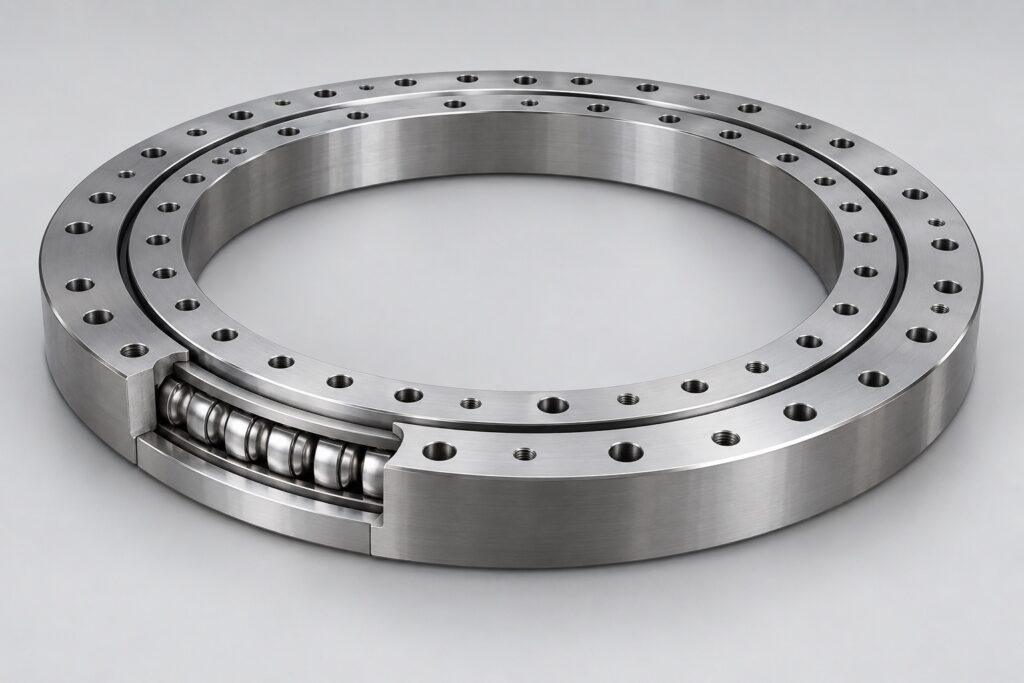
Identify the Bearing Structure
A slewing bearing typically has an inner ring, an outer ring, raceways, and rolling elements. The rings connect two parts of a machine that rotate relative to one another. Balls or rollers carry load through the raceways; the choice and arrangement affect how that load is distributed. Mounting holes, seals, lubrication points, and gear teeth depend on the particular design.
A circular outline—even one with bolt holes—does not establish that a part is a slewing bearing. Check the controlled cross-section. Are there raceways and rolling elements between the rings? How does each ring attach to the machine? Which ring is fixed, and which rotates? If a drawing provides only inner diameter, outer diameter, and height, request the missing structural and interface details. A separate gear ring or another annular component cannot be treated as a bearing merely because it fits the same space.
Check Combined Loads, Not Diameter Alone
A slewing bearing often supports axial and radial forces and an overturning moment at one location while allowing relative rotation or oscillation. Its ability to carry combined loads still has limits. The overturning moment from an off-center load must be evaluated with the axial and radial loads acting at the same time. The supporting structure and connecting bolts are part of that load path.
Consider a platform with an unchanged total weight. Moving the load toward its outer edge changes the moment acting on the bearing. An inquiry should therefore identify the bearing’s position in the equipment, load directions and application points for each operating condition, the rotation or oscillation pattern, and any start-stop or impact events. “Large ring bearing” and an outer diameter alone are insufficient to establish structural suitability or load capacity.
Distinguish a Slewing Bearing From Other Ring-Shaped Parts
Cross-roller bearings, thin-section bearings, and turntable bearings can also have a ring-shaped form. A precision machine-tool turntable may place particular emphasis on rotational accuracy, stiffness, preload, and friction. An industrial slewing platform may demand a different balance of load capacity, mounting conditions, and drive layout. Direct bolt mounting is possible in more than one product type, so bolt holes alone do not prove interchangeability.
If an external pinion drives the assembly, determine whether the bearing has internal teeth, external teeth, or no teeth. A geared bearing may integrate teeth into its inner or outer ring. A gearless bearing requires the machine to provide a separate drive arrangement. Gear placement affects the layout, while the raceways, gears, and bolted joints each need their own checks.
Slewbearingtec offers internally geared, externally geared, and gearless slewing bearings, along with ball and roller designs. The appropriate configuration depends on the machine’s operating conditions and interfaces; the name “ring bearing” cannot select one by itself.
Verify a Replacement Against the Machine
For an existing assembly, begin with the original part number, equipment location, and current drawing revision. Compare inner and outer diameters, overall height, mounting holes, locating features, gear parameters, the rotating ring, clearance or preload, seals, and lubrication connections. A part that fits the available space may still differ in raceway capacity, bolt connection, or gear mesh.
Finally, review the candidate as part of the complete machine. Confirm that its permitted load combinations cover the actual conditions, that the mounting faces meet the required stiffness and flatness, and that the drive and protection can be installed as intended. Where these inputs are missing, obtain the cross-section, operating loads, and mounting interface before deciding whether a particular ring bearing should be selected as a slewing bearing.
