 SWBTEC


Get Slewing Bearing Catalogue & Slewing Ring Bearing Catalog
You can instantly download our comprehensive slewing bearing catalogue (EU/DIN standards) and the complete slewing ring bearing catalog (US/ANSI standards) in high-resolution PDF format from the direct links below. Downloading the raw dimensional tables is only the first step; matching the static load limit curves listed in these documents against your machinery’s actual dynamic duty cycle prevents catastrophic offshore and mining equipment failures. The technical data repositories and analytical frameworks below provide the exact metallurgical parameters, cross-reference matrices, and load rating calculations required to specify the correct rotational components for your engineering projects.
Download Library: PDF & Interactive Data Repositories
Technical procurement teams require instant access to un-gated dimensional data. We segment our technical documents by internal structural design to help you quickly locate the exact outer diameter (OD), gear module, and mounting hole pitch circle diameter (PCD).

The S.P.E.C. Selection Blueprint for Catalog Data
Procurement directors fail when they treat printed catalog load curves as absolute operational guarantees rather than baseline reference points. Applying the S.P.E.C. blueprint ensures your engineering team interprets the dimensional tables correctly before issuing a purchase order.
Static Load Boundaries vs. Bolt Limits
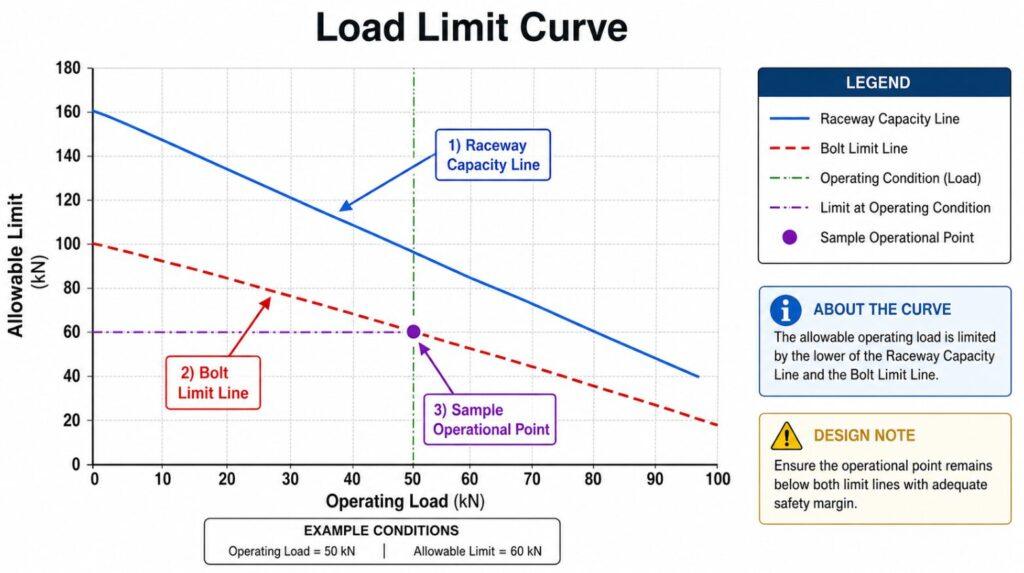
Slewing ring bearing catalog charts display two distinct limit curves: the raceway load capacity and the fastener tensile limit. You must select a bearing where your maximum equivalent axial load and overturning moment intersect well below the weakest of these two curves. Selecting a bearing based solely on raceway capacity while ignoring Grade 10.9 or 12.9 bolt limits guarantees flange separation under peak tipping moments.
Pinion Compatibility and Gear Data
Mismatched gear modules destroy pinion drives. A professional slewing bearing catalogue details specific gear data including the module (m), number of teeth (z), addendum modification coefficient, and exact backlash tolerances. You must align these catalog parameters strictly with your hydraulic motor’s pinion specifications to prevent premature tooth wear.
Equivalent Dynamic Indexing
Static PDF tables cannot account for your machine’s vibration frequency. You must apply an application factor (fs) ranging from 1.2 for smooth operation to 3.0 for heavy impact crushers. Multiply your actual working load by this factor before matching it against the static capacity chart listed in the catalog.
Cross-Reference Mapping
Global supply chains rely on accurate part substitutions. Our catalog includes a dedicated cross-reference matrix, allowing you to map legacy European part numbers directly to their identical dimensional equivalents in Asian or American manufacturing standards.
Procurement Pitfalls: Misreading the Technical Catalog
Engineers destroy project budgets by misinterpreting technical tables during the vendor evaluation phase. Avoid these specific technical missteps when reading any manufacturer’s documentation.
Ignoring the Hardened Zone Gap
Standard catalogs specify a “soft spot” or unhardened zone on the raceway, usually marked with an ‘S’ or a plug hole. Procurement teams often forget to relay this information to the assembly floor. You must position this unhardened zone in the minimum load area (the zero-stress neutral axis) during installation, or the raceway will suffer immediate plastic deformation.
Misjudging Core Hardness Values
Buyers frequently search the catalog for the highest possible hardness numbers, assuming higher means better. A raceway surface requires 58-62 HRC, but the catalog must indicate a core hardness of 260-290 HB. A bearing with an excessively hard core becomes brittle and will shatter under the extreme shock loads typical in tunnel boring machines.
2026 Industry Trend: Interactive Dynamic Cataloging
Static PDF brochures fail to address real-time engineering variables. We have transitioned our standard slewing bearing catalogue into a cloud-based dynamic calculation tool. You input your specific axial loads, radial forces, overturning moments, and rotational speeds directly into the interface. The system bypasses static tables and instantly calculates the adjusted L10 fatigue life and actual raceway deflection, generating a custom specification sheet tailored exactly to your duty cycle.
Real-World Data: The $1.2M Cross-Reference Mismatch
A European port authority required replacement parts for six ship-to-shore cranes. The procurement team used an outdated, generic slewing ring bearing catalog from a third-party distributor and matched the outer dimensions perfectly. They failed to notice the catalog’s small print regarding gear tooth hardening depth.
The replacement bearings featured surface-only induction hardening (2mm depth), while the original crane specs required deep-contour hardening (6mm depth). Within 1,800 operating hours, the gear teeth sheared off entirely. By switching to our comprehensive slewing bearing catalogue—which explicitly lists effective case depth (ECD) for every gear profile—they identified the correct heavy-duty replacement, avoiding a repeat of the $1.2 million downtime disaster.
People Also Ask (FAQ)
What is the difference between a slewing bearing catalogue and a slewing ring bearing catalog?
The difference is purely regional terminology. “Catalogue” is the standard British/European English spelling preferred in DIN/ISO markets, while “Catalog” is the American English spelling used in ANSI markets. “Slewing bearing” and “slewing ring” refer to the exact same rotational component. Our data repository covers both search requirements.
How do I read the load limit curve in your catalog?
Locate your maximum equivalent axial load on the vertical axis and your maximum overturning moment on the horizontal axis. Plot the intersection point of these two values. If the point falls below the solid line (raceway limit) and the dashed line (bolt limit), the bearing is dimensionally safe for your application.
Does the technical catalog provide exact gear module data?
Yes. Every product page within the catalog lists the specific gear module, number of teeth, pitch circle diameter (PCD), and required backlash tolerance for internal, external, and ungeared configurations.
Can I cross-reference a competitor’s part number using this document?
Yes. The final section of our PDF catalog features a comprehensive cross-reference index. You can search for major competitor series numbers and instantly find the dimensionally equivalent replacement model in our product line.
Are custom CAD models included with the catalog download?
The PDF catalog provides 2D cross-sectional drawings and raw dimensional data. For 3D integration, every part number listed in the catalog links directly to our CAD library, where you can download native STEP and IGES files.
How do I adjust the catalog’s static capacity for high-impact applications?
You must apply an application shock factor (fs). For smooth rotary applications, multiply your working load by 1.0. For high-impact machinery like excavators or shredders, multiply your working load by 1.5 to 2.5 before checking the catalog’s limit curves.
