 SWBTEC


Durable Customized 3-Row Cylindrical Roller Slewing Bearing
For heavy-duty conditions such as shield machine (TBM) and port crane that require extreme rigidity and load isolation, customized three-row cylindrical roller slewing bearing is undoubtedly the ultimate choice. The axial force, radial force and overturning moment are completely disassembled and carried by three independent rows of rollers. This design directly circumvents the most troublesome “point contact” stress concentration problem in ball bearings. Under extremely harsh working conditions, it can even increase the service life of the equipment by 300.
Most of the time, people only focus on the basic size parameters when purchasing, but to be honest, whether this kind of heavy-duty bearing is resistant to manufacturing or not, the bottom card is all on the precise control of induction hardening depth and the flatness of the installation surface-it is these often neglected details that determine whether a large project with tens of millions of dollars is successfully completed on schedule or caught in the nightmare of endless shutdown.
The Underlying Logic Of Load Decoupling
The reason why the three-row cylindrical roller slewing bearing can stand at the top of the pyramid of slewing technology is that it can “simplify the complex compound load” and transform it into pure linear force. You can see by comparing single-row or double-row ball bearings that they often have to resist compound stress. However, the three-row design is not so good. Its upper and lower two rows of horizontal rollers are specially used to deal with axial load, while the middle row of vertical rollers firmly bites the radial force. This kind of structural “each duty” ensures that the bearing can burst into extremely high rigidity when dealing with the overturning moment, thus effectively avoiding the “pitting” phenomenon that occurs frequently in high torque equipment.
| Bearing Type | Static Load Capacity | Dynamic Rigidity | Life Expectancy | Torsional Stiffness | Structural Behavior Summary |
|---|---|---|---|---|---|
| Single-row ball bearing | Moderate | Moderate | Medium | Low–Moderate | Combined stress handling; axial, radial, and moment loads shared in one contact path |
| Double-row ball bearing | High | Improved over single-row | Medium–High | Moderate | Better load distribution; improved stability under tilting moment |
| Three-row cylindrical roller bearing | Very high | Very high | Long | Very high | Loads are decoupled into dedicated rows: axial and radial forces are separated, maximizing stiffness and minimizing deformation under extreme moment loads |
When you choose a customized three-row roller slewing bearing, you are not only buying a component, but also investing in a stable structural guarantee for the whole equipment. In the case of port cranes, the overturning moment caused by sea breeze is often irregular and extremely tricky, and the safety redundancy provided by this decoupling architecture is not comparable to that of ordinary ball bearings.
The “Iron Triangle” Of Customized Long Life”
Truly reliable customization is not as simple as changing the outer diameter on the drawings, but to find the perfect balance between rigidity, surface metallurgy and lubrication system. We have seen too many cases of purchasing and stepping on the pit. The problem is that we only value “can we put it in”, but we don’t put our mind on “performance engineering.
Rigid control
For high-precision equipment such as shield machines, we will keep the internal clearance stuck in micron tolerances. Why do you want to be so serious? It is to prevent the roller from “slipping” during the severe vibration phase. After all, in the industry, slipping is the number one killer that causes premature wear of the raceway.
surface metallurgy
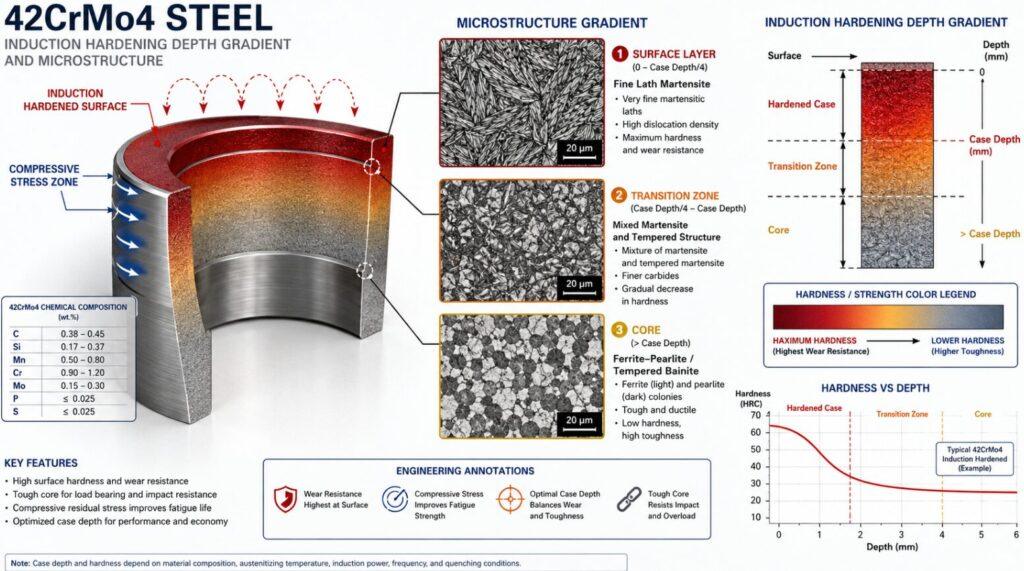
In the face of customized solutions, the standard quenching process is often difficult to do. We will re-deduce the effective case depth (ECD) based on the maximum Hertz contact stress of your project. Typically, custom three-row roller slewing bearings require a strictly controlled ECD between 4 and 6mm to ensure that the shear stress on the secondary surface does not evolve into deep material spalling.
Lubrication ingenuity
We have integrated a dedicated grease flow channel inside the bearing to accurately “feed” the high-pressure area of the upper axial row. If the equipment is to face the harsh marine environment, we will also add a special lip seal ring, with stainless steel spray coating, the sea water and salt spray dead outside.
Avoid The “Hidden Minefield” Of The Heavy Industry”
The actual combat experience after many years of crawling and rolling on the front line has proved that 80% of the so-called “bearing is broken” is actually a flaw in the mounting surface and bolt pre-tightening force. As a technical consultant, I have watched many projects go wrong because engineers treated the bearing as an isolated rigid dead piece, but forgot that it worked in the entire dynamic system.
Bolt slack trap
The reaction force generated by the operation of the heavy-duty bearing is extremely frightening. If the flatness error of the mounting surface exceeds 0.2mm per meter, when you tighten the bolt, the bearing ring will be distorted. This 1 is deformed, the force on the roller will be uneven immediately, and abnormal noises will follow one after another, which will inevitably be scrapped within a few months. Therefore, listen to my 1 advice: be sure to specify the use of high-strength fasteners of grade 10.9 or 12.9, and force a torque re-inspection after 100 hours before the equipment runs full.
Don’t ignore the low temperature impact energy (KV value)
If your project is in polar or high altitude areas, don’t always stare at the hardness. The impact toughness (KV value) of steel is the key to life. The conventional 42CrMo is easily brittle there. In view of this special working condition, we will specially adjust the heat treatment process to make the material maintain excellent ductility in the extreme cold of minus 40 degrees, and ensure that the raceway will not crack when it is suddenly impacted.
Renewing Life For TBM In Highly Abrasive Geology
A while ago, we took over a subway project with extremely strong geological abrasiveness and high water pressure. At that time, the standard bearings used had to “lie down” every 1.5 kilometers “. For this hard bone, we specially designed the 1 customized three-row roller slewing bearing, which not only has a triple redundant sealing system, but also increases the diameter of the vertical radial roller by 15%.
The final result was very good: the shield machine dug up the remaining 4.2 kilometers in one go, and the bearing never failed to shut down. At the end of the project, the 1 of dismantling the machine showed that the wear of the raceway was 40% lower than expected, directly saving the general contractor more than 120 million US dollars in potential downtime and replacement costs.
FAQs
Q1: How can three-row roller bearings reduce the overall size of the equipment?
A: Because the roller is “line contact”, and the steel ball is “point contact”. In the same space, the line contact can carry much larger loads. This means that without sacrificing the bearing capacity, you can reduce the outer diameter of the bearing, and the whole equipment will naturally be more compact and lighter.
Q2: How do I judge that the customized three-row roller slewing bearing should be replaced?
A: Dead staring at these 3 key signals: first, the metal debris touched in the grease increased significantly; Second, the vibration of the equipment in the frequency band of 2kHz to 5kHz suddenly increases. Third, the axial clearance exceeds 50% of the factory initial value. In these situations, spare parts must be prepared quickly.
Q3: Can gears be customized to resist higher torque?
A: No problem at all. Whether it is internal or external teeth, we can do tooth surface induction hardening (the highest hardness can be pulled to HRC 55-60), but also specifically optimize the tooth structure, so as to minimize the backlash in precision positioning applications.
Q4: why this kind of bearing favorite with 42CrMo4 this material?
A: Because 42CrMo4 achieves an excellent balance between “core toughness” and “surface hardenability. It not only allows the bearing to not crack when eating high-strength impact, but also ensures that the raceway has sufficient hardness to resist wear.
Q5: How long does it usually take for this customized three-row roller bearing to be delivered?
A: Because this stuff involves extremely complicated 5 surface processing, and the quenching accuracy requirements are extremely harsh, the delivery time is usually about 10 to 14 weeks. If there are special customization requirements for materials, time must be more generous.
