 SWBTEC


Slewing Bearing Factory
For OEM procurement and engineers, selecting a slewing bearing plant is more than simply comparing prices-it is essentially a guarantee for the structural stability and operational life of your heavy equipment. A truly qualified factory must provide a complete set of manufacturing ecosystems, which I usually summarize in the following core dimensions.
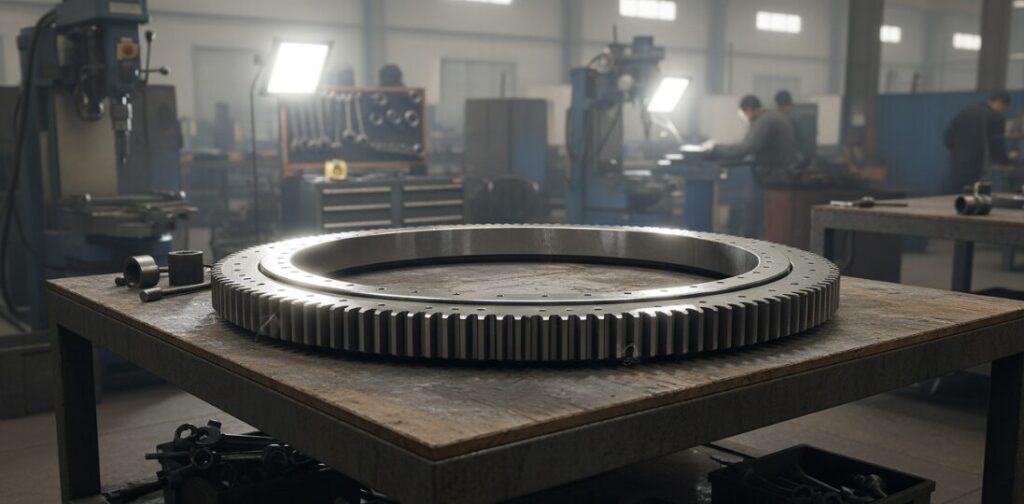
Verify The Integrity Of The Material
In any world-class slewing bearing factory, quality starts from the moment of raw materials. For heavy-duty applications, the use of high-grade forged steel is the bottom line and there is no room for negotiation.
42CrMo and 50Mn game: The factory must be proficient in how to select materials according to working conditions. 50Mn performs well in conventional applications, but if you are facing a high stress environment, the excellent tempering performance of 42CrMo is the first choice, which can provide more stable structural strength.
Full process traceability: In our factory, every ferrule must have its “birth certificate”. From the steel mill’s heat number to the final forging record, this traceability is the only means to prevent catastrophic failure due to internal impurities or chemical composition errors.
Precision Heat Treatment
The life of the slewing bearing is actually shaped at the moment when the raceway is quenched. The level of a factory is measured by their control over induction hardening technology.
Ideal HRC hardness depth: The real technology is in the “hardening layer depth”. Our process strictly controls the hardness transition zone to prevent the raceway from cracking under severe axial or radial loads. Only deep enough to hold up millions of cycles of wear.
Hardness uniformity: A little knowledgeable people know that if the heat treatment equipment is not strong, the circumference is prone to “soft spots”. In actual working conditions, these soft points are often the culprit of premature bearing failure.
Strict Quality Testing
A reliable factory must deeply embed non-destructive testing (NDT) into every stage of the production line.
Ultrasonic Inspection (UT): We use UT to scan the forged steel for cracks, slag inclusions or shrinkage that are invisible to the naked eye.
Magnetic Particle Inspection (MT): This is essential for the detection of micro-cracks on the surface and near the surface after quenching.
Zero defect policy: For OEM engineers, these tests are actually the hardest insurance policy. Choking the defect in the cradle before leaving the factory is not only to protect the safety of the end user, but also to protect your brand’s reputation from the drag of after-sales costs.
Single Row Ball Slewing Bearing
Single-row ball slewing bearings are divided into internal tooth, external tooth and toothless structure, which are suitable for a variety of transmission needs.
Double Row Ball Slewing Bearing
Double-row ball slewing bearings are specially designed for super-heavy load scenarios.
Slewing Bearing With External Gear
The external gear internal flange slewing bearing integrates the advantages of external gear transmission and internal flange mounting.
Slewing Bearing With Internal Gear
The internal tooth and external flange slewing bearing is characterized by the combination of internal tooth transmission.
Slewing Bearing Without Gear
Gearless double flange slewing bearing is light weight and compact.
Cross Roller Slewing Bearing
Single-row cross roller slewing bearing adopts roller cross layout, large contact area, can synchronously and efficiently withstand axial and radial loads and overturning moment,
Advanced CNC Machining
Whether the slewing bearing performs well or not depends on whether it can “fit” with your machine. There are no shortcuts in this area, and factories must be willing to spend money on precision CNC equipment.
Tolerance control: Whether it is the installation hole or raceway diameter, micron-level accuracy is necessary. Only in this way can the rotation be silky and reduce unnecessary friction power consumption.
Precise gear processing: For slewing bearings with teeth, tooth profile accuracy is the lifeline. We use advanced CNC gear hobbing and gear shaper to ensure that it can perfectly mesh with your drive pinion, the noise is reduced, and the life of the entire transmission system is naturally lengthened.
The Value Of Engineering Customization
Standard model manuals are just a starting point, and complex engineering projects often need to be “tailored”. A first-class factory like SWBTEC should be an extension of the customer’s R & D team.
ISO 9001 systematic operation: This international standard management system ensures that from the first prototype to mass production, quality is consistent and does not fall short.
Targeted load scheme: We don’t just sell bearings, we will analyze your actual force situation (axial, radial and overturning moment) in depth, and give an optimal design that balances cost and performance. This kind of customization is the most direct way to reduce downtime and improve the return on investment (ROI) of equipment.
Why Choose To Work With SWBTEC?
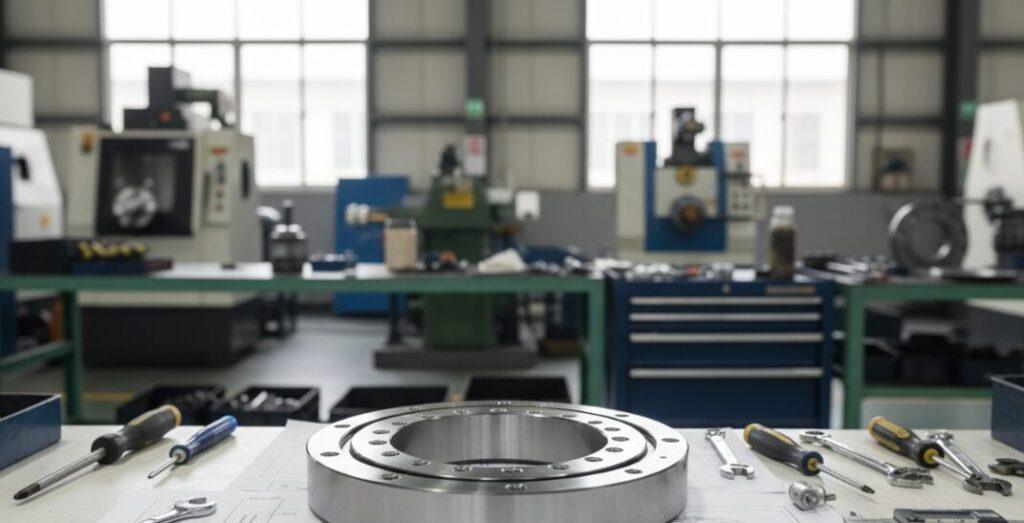
Choosing the right manufacturer is a strategic investment. At SWBTEC, we combine material reliability, precision engineering and near-paranoid inspection to power the world’s most demanding machinery.
If you encounter any technical bottlenecks in your current project, or are not sure about the selection, contact our technical team at any time and let’s talk about the specific parameters directly.
Author: Alex Chen
“Hi, I’m a Technical Project Manager at SWBTEC. Over the years, I have spearheaded numerous heavy-duty bearing projects, bridging the gap between complex engineering requirements and high-precision manufacturing. My expertise lies in material science and non-destructive testing, and I am passionate about helping OEM engineers optimize equipment performance through customized, ‘zero-defect’ structural solutions. I believe that a bearing is not just a part, but the heart of machine reliability.”
