
 SWBTEC


How To Check A Slew Ring
The most reliable indicator of internal raceway wear is the measurement of axial play. The process involves mounting a magnetic base dial indicator on the stationary ring, positioning the probe on the rotating ring, and zeroing the gauge; you then apply a maximum tilting load (e.g., by lifting a heavy load at maximum radius) and record the movement. If the axial play has increased by 1.5mm to 3.0mm (0.060″ to 0.120″) beyond the original “as-new” baseline, the bearing is likely near the end of its fatigue life and requires replacement. To ensure a comprehensive inspection, this must be combined with a grease analysis (checking for bright metallic flakes or “grit” that indicates spalling), a bolt torque verification (ensuring no fasteners have stretched or loosened), and a rotational noise check (listening for clicking or grinding that signals broken separators or raceway pitting).
Measurement Of Axial Clearance
The core means to determine the health status of the slewing bearing is the flip gap test. This measurement can visually reflect the degree of wear of the internal raceway.
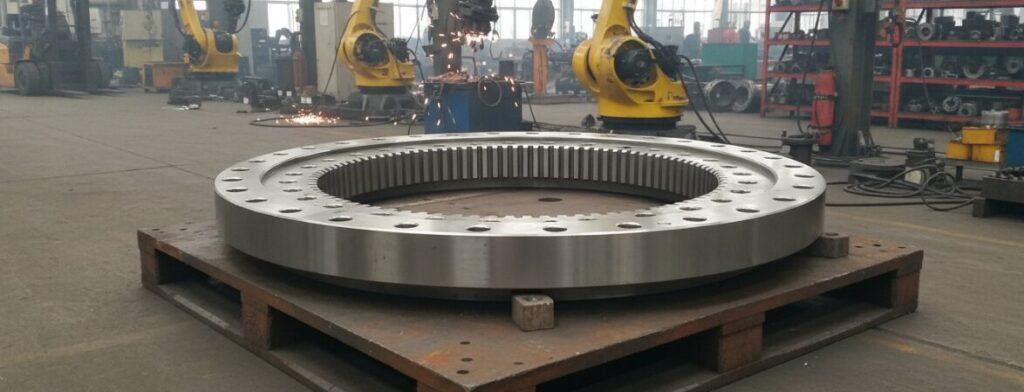
Specific Operation Steps:
- Preparation: Clean the installation surface. Fix the magnetic stand on the retaining ring (usually the inner ring in most crane applications).
- Positioning: Press the dial gauge probe against the surface of the rotating ring.
- Reset: Make sure the machine is in the neutral position and reset the dial to zero.
- Loading: Apply the maximum tipping load. For an excavator or crane, this usually means lifting heavy objects at the largest possible radius, thereby generating the greatest leverage force on the bearing.
- Record: Record the reading when the bearing “tilts” under load.
Results Interpretation:
It is crucial to compare the test results with the original “baseline value” when the machine was first put into production. If the deviation reaches 1.5mm to 3.0mm, it means that the fatigue is already very serious. In my opinion, the internal raceway must have been damaged at this step. It is suggested to replace it immediately and don’t regret it after a big accident.
Grease Analysis And Pollution Detection
Grease is like a “blood test report” for a slewing bearing. Analysis of the old oil discharged can often be found long before the mechanical failure of the bearing.
- Metal chips: For inspection, take a sample of the old grease squeezed out of the sealing ring. If you see shiny metal sheets inside, this is a typical sign of “peeling”-the raceway surface is falling off in pieces.
- Grit and texture: Twist the grease with your fingers. If there is an obvious “gritty feeling”, it means that there are pollutants or hardened metal particles, which will accelerate wear like sandpaper.
Single Row Ball Slewing Bearing
Single-row ball slewing bearings are divided into internal tooth, external tooth and toothless structure, which are suitable for a variety of transmission needs.
Double Row Ball Slewing Bearing
Double-row ball slewing bearings are specially designed for super-heavy load scenarios.
Slewing Bearing With External Gear
The external gear internal flange slewing bearing integrates the advantages of external gear transmission and internal flange mounting.
Slewing Bearing With Internal Gear
The internal tooth and external flange slewing bearing is characterized by the combination of internal tooth transmission.
Slewing Bearing Without Gear
Gearless double flange slewing bearing is light weight and compact.
Cross Roller Slewing Bearing
Single-row cross roller slewing bearing adopts roller cross layout, large contact area, can synchronously and efficiently withstand axial and radial loads and overturning moment,
Bolt Torque Calibration
The safety of the slewing ring depends on those fasteners. However, in environments of high vibration and heavy cyclic loads, bolts are prone to problems.
- Stretching: Over time, the bolt may “stretch” beyond its elastic limit and lose its clamping force.
- Loose: Check for fasteners that are withdrawn due to vibration.
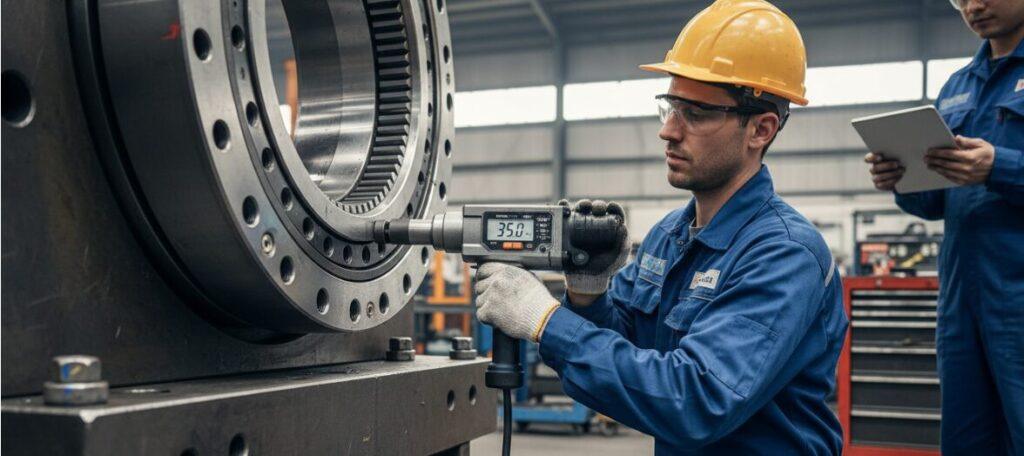
- Operation suggestion: a calibrated torque wrench must be used regularly to confirm that all bolts meet the pre-tightening force specified by the manufacturer. Once the bolt is loose or stretched, the load distribution will become uneven, and the bearing will soon be scrapped.
Rotation Noise And Vibration Inspection
A healthy slewing bearing should turn smoothly and quietly. “Moving your ears” during operation is actually one of the simplest and most effective diagnostic tools.
Clicking sound: If you hear a repeated clicking sound, it usually means that the spacer between the ball head or roller is broken.
Grinding sound or crunch: This sound often indicates pitting of the raceway, or a serious lack of lubrication.
Vibration: If you feel abnormal vibration through the machine chassis when rotating, it means that the internal rolling body is no longer running on a smooth path.
Author: Marcus Thorne
“Hi, I’m a heavy machinery maintenance engineer with over 14 years of experience in rotating equipment. Throughout my career, I have specialized in the diagnostics and lifespan extension of slewing bearings. I believe that rigorous, data-driven maintenance is the key to operational safety and efficiency.”
