
 SWBTEC


How Do I Choose A Slewing Bearing
When selecting a slewing bearing, first determine the load (axial, radial, moment), speed and accuracy requirements required for the application, and then select the appropriate bearing type (ball/roller) and design (geared/non-geared) based on these requirements to ensure that it fits the installation space, can cope with environmental factors and meets the budget. Use the selection tool that contains the usage factor to find the appropriate match. To ensure a successful and durable installation, be sure to check the support structure, bolts and lubrication requirements.
Step1: Clear Core Application Requirements
The underlying cornerstone of selection logic is your understanding of equipment operating conditions.
- Accurate calculation of the load curve: slewing bearings rarely bear only a single direction of force. You must accurately calculate the maximum axial load, the radial load, and most importantly-the overturning moment. The overturning moment is often the key to the success or failure of the selection. It is the leverage effect caused by the deviation of the load from the center. If this is ignored, the bearing will soon appear structural fatigue in actual operation.
- Speed and Rotational Frequency: Determine the maximum operating speed (RPM) and rotational frequency. High-speed applications will produce heat accumulation, which is completely different from low-speed, heavy-duty crane conditions, which have more stringent requirements on internal clearance and lubrication strategies.
- Accuracy requirements: find out exactly how high precision you need. If it’s a medical scanner or a satellite dish, you have to knock “backlash” and runout accuracy; but if it’s a construction machine, load carrying capacity is obviously more important than extreme rotational accuracy.
Step2: Consider The Environment And Operating Conditions
The “outside world” of the bearing directly determines its life.
- Environmental factors: You have to consider extreme temperatures, high humidity, dust exposure, and even corrosive environments (such as salt spray in marine applications).
- Protection scheme (sealing and shielding): it is very important to choose the right protection. The 2RS seal ring performs well in resisting water vapor and impurities, while the ZZ dust cover is more practical in occasions where the environment is better and only grease needs to be retained.
- Lubrication management: Determine the lubricant type and filling method in advance. Lubrication is not in place is the number one killer of early bearing wear, which is particularly evident under heavy load conditions.
Step3: Select Bearing Type And Design
With data support, it is now possible to narrow down the scope of physical design.
- Load type (ball vs. roller): Usually, the ball bearing friction is small, suitable for light load, high speed occasions; and the roller bearing is more rigid, through a larger contact area to share the pressure, suitable for dealing with those “hard bone” like heavy duty tasks.
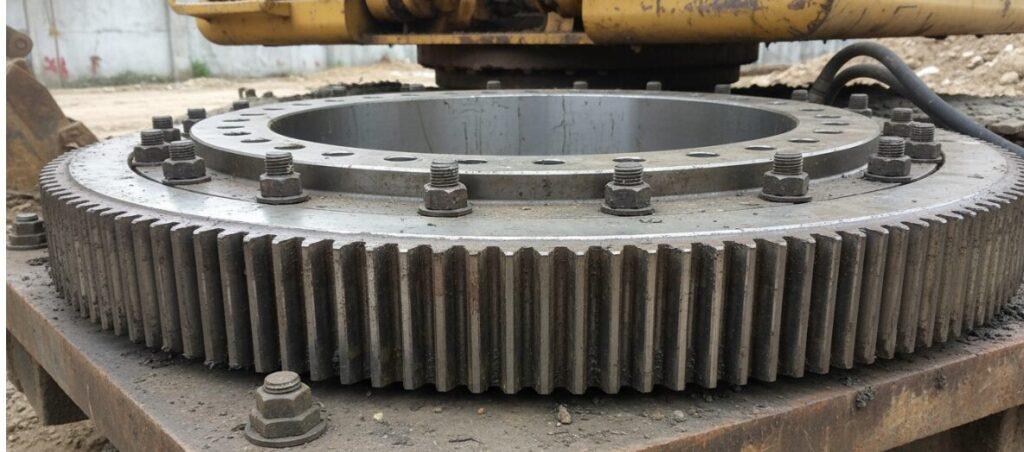
- Gear configuration: Decide whether your application requires internal teeth, external teeth or toothless design. The toothed slewing bearing can simplify the drive system, directly engage the pinion with the bearing, and save a lot of trouble in structural design.
- Section style: According to the pressure of the structure space, explore rectangular section or high load-bearing section to meet the needs of high-stress tasks.
Single Row Ball Slewing Bearing
Single-row ball slewing bearings are divided into internal tooth, external tooth and toothless structure, which are suitable for a variety of transmission needs.
Double Row Ball Slewing Bearing
Double-row ball slewing bearings are specially designed for super-heavy load scenarios.
Slewing Bearing With External Gear
The external gear internal flange slewing bearing integrates the advantages of external gear transmission and internal flange mounting.
Slewing Bearing With Internal Gear
The internal tooth and external flange slewing bearing is characterized by the combination of internal tooth transmission.
Slewing Bearing Without Gear
Gearless double flange slewing bearing is light weight and compact.
Cross Roller Slewing Bearing
Single-row cross roller slewing bearing adopts roller cross layout, large contact area, can synchronously and efficiently withstand axial and radial loads and overturning moment,
Step4: Evaluation Of Installation And Support Structures
The performance of the slewing bearing depends to a large extent on where it lies.
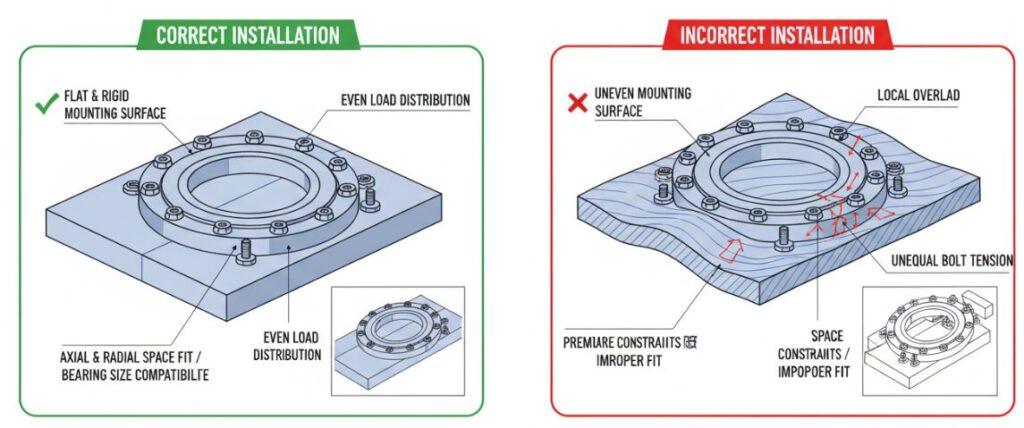
- Space constraints: to ensure that the bearing size and equipment axial, radial space fit.
- Integrity of the support structure: the mounting surface must be sufficiently flat and rigid. If the base surface is uneven, it will lead to uneven load distribution, which will lead to local overload, and the bearing will break down much faster than you think.
- Install bolts: The correct bolt size, grade (e. g. 10.9 or 12.9), and quantity must be selected. Make sure that the bolts are evenly spaced so that the load is evenly distributed over the entire circumference.
Step5: Use Of Selection Tools And Service Coefficients
In order to leave enough safety margin, professional mathematical modeling and coefficient correction are essential.
- Service Factor: A service factor multiplied by a calculated load to deal with static extremes or sudden shocks.
- Bearing curve: compare the calculated load with the coefficient with the bearing curve provided by the manufacturer. It is safe to fall in the “green zone”. If it falls in the red zone, it is a clear overload alarm.
- Minimum load: This is an easily overlooked detail-in high-speed applications, it must be ensured that the bearing maintains a minimum load (usually 1-2% of the dynamic rating), otherwise the roller will “slip”, and the damage caused by sliding friction is devastating.
Step6: Cost And Reliability
The final step is to find a balance between technical performance and economic reality.
- Total Cost of Ownership (TCO): Don’t just look at the initial purchase price. You have to weigh up-front investment against long-term maintenance costs, potential downtime risks, and bearing life expectancy. Sometimes, more expensive bearings are more economical.
- Manufacturer’s reputation: Choose suppliers with quality standards and reliable after-sales support. In key industrial applications, the technical documentation and testing certificates that manufacturers can provide are often the last line of defense for the success of your project.
Author: Marcus Thorne
” With over a decade of experience in mechanical engineering and industrial component sourcing, I specialize in helping businesses optimize their heavy-duty machinery. Throughout my career, I’ve navigated the complexities of load calculations and precision requirements to select the perfect slewing bearings for diverse applications.”
