 SWBTEC


Slewing Ring Bearing Applications And Maintenance
Slewing bearing (Slewing Ring Bearings) is not only a simple rotating part; it is the core of the mechanical system to carry the load and realize the rotation. From the muddy excavators on the construction site to the sophisticated medical CT machines in the clean room, to the wind turbines at sea, the span is very large. To truly understand the application of slewing bearings, it is not simply to flip through the catalog to select a model.
According to a large number of cases I have dealt with, the core is how to accurately match the load capacity (axial force, radial force, especially overturning moment), internal structure, and transmission system of the bearing with the specific needs of your equipment—whether you are designing a 300-ton mining excavator or a high-precision medical scanner.
Of course, selection is only the first step. It is also critical that you know the corresponding maintenance, lubrication, and testing standards for different application scenarios. This is directly related to whether the equipment can run full working hours and whether the safety meets the standard. Next, let’s discuss some of the most critical application scenarios, the “foolproof” selection logic, and some basic rules for on-site maintenance.
Core Applications of Slewing Bearings
Before selecting the model, I usually ask the customer a question: where is this thing used? The living environment of the bearing on the wind turbine and the bearing on the filling machine is simply very different.
1. Heavy Construction and Mining Machinery (Heavy Construction & Mining)
This should be the most common application area; excavators, truck cranes, and shield machines (TBM) are included.
Core requirements: Huge overturning moment carrying capacity and extreme durability.
Engineering perspective: The conditions here are very harsh. Excavator in the excavation or crane lifting offset weight, bearing to withstand continuous impact load and severe vibration. In this case, three-row roller slewing bearings (Three-row roller bearings) are often my first choice, because their load capacity is almost unmatched in the industry and they are very resistant to construction.
2. Renewable Energy (Renewable Energy)
Mainly wind turbines and large solar trackers.
Core requirements: High reliability and long service life (usually more than 20 years).
Engineering perspective: This is crucial—the pitch and yaw bearings of wind turbines are often located in remote areas or at high altitudes. The lifting cost of a bearing change is simply sky-high, so we attach great importance to sealing (protection against bad weather) and stability under fluctuating loads.

3. Industrial Automation and Robotics (Industrial Automation & Robotics)
Including palletizing robots, car assembly lines, and precision rotary indexing tables.
Core requirements: High rotation accuracy, repeated positioning accuracy, and speed. Space is often limited.
Engineering perspective: In this compact design, crossed roller bearings (Crossed roller bearings) are frequent customers. They offer extremely high rigidity and precision in a small installation space.
4. High-tech and Medical Equipment (High-Technology & Medical)
Examples include medical CT/MRI scanners, satellite communication antennas, and radar stations.
Core requirements: Absolute rotation smoothness and accuracy, must be “zero clearance”. The noise should be low and the torque should be stable.
Engineering perspective: This occasion can not be discussed, must use with pre-tightening (Preloaded) high precision slewing bearing. Any movement is unacceptable.
5. Marine & Offshore
Deck cranes, mooring systems, offshore platforms.
Core requirements: Excellent corrosion resistance and sealing ability.
Engineering perspective: Sea water, moisture, and storms are the killer of bearings. If you don’t use special coatings, stainless steel materials, or reinforced sealing structures, the bearings will quickly become useless.
How to Select the Appropriate Slewing Bearing
Selection is not guessing; it is a step-by-step calculation process.
Step 1: Quantify All Loads
This is the foundation. You have to figure out the exact external force the device is exerting:
- Axial load (Fa): Vertical downward force.
- Radial load (Fr): Lateral force in the horizontal direction.
- Overturning moment (M): This is the most critical indicator of slewing bearings. Simply put, it is the force that tries to “flip” the bearing.
Recommendation: Always check the Load Curve Chart provided by the manufacturer. If your combined load falls outside the curve, you’ll have to change it to a larger one.
Step 2: Match the Bearing Structure
Each internal structure has its temper and cost advantages:
- Single row four-point contact ball bearings: Cost-effective, panacea. Suitable for tower cranes, food processing equipment, and medium-load general occasions.
- Single row cross roller bearings: High precision, good rigidity, especially resistant to torque. The first choice for robots and medical scanners.
- Double row ball bearing: Axial bearing capacity is strong. Commonly used in large tonnage marine cranes.
- Three-row roller bearings: Load-bearing ceilings. Shield machine this not only axial, radial, and huge moment of extreme conditions, it is none other.
Step 3: Determine Gear Requirements (Define Gearing Requirements)
Most applications require a gear drive:
- Internal teeth (Internal Gear): The structure is more compact, and the gear is protected by the housing, which is not easy to enter dirt.
- External teeth (External Gear): Easy to maintain and easier to install the pinion.
- Non-Geared: This is selected if the rotation is not driven by the bearing itself.
Step 4: Accuracy and Clearance (Specify Precision and Clearance)
How accurate do you need to turn your equipment?
- Construction machinery with standard clearance is enough, dirt resistance.
- Robots and machine tools must be used with zero clearance (preloaded) bearings to eliminate any possible shaking.
Step 5: Plan for the Operating Environment
Most of the time, it is not the heavy load that damages the bearing, but the environment.
- Seal: Standard with nitrile rubber; high-temperature environment must be specified with fluorine rubber (Viton).
- Anti-corrosion: Marine or chemical environment, must require special coating (such as galvanized) or stainless steel.
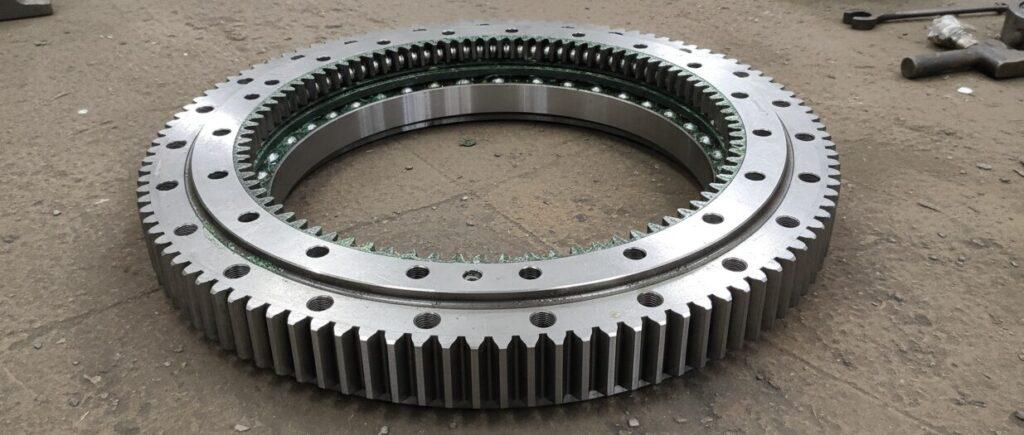
Slewing Ring Bearing Repair Guide
Most of the failure cases I have seen on the spot are not due to poor bearing quality but because they are not installed or kept properly.
1. The Installation Surface Must Be Smooth and Rigid Enough
This is the number one cause of premature failure. If the mounting surface is uneven, the bearing ring will be twisted after tightening the bolts, resulting in stress concentration points (Pinch points) in the raceway, and the wear rate will increase exponentially.
Practical operation suggestion: Before installation, be sure to use feeler gauge (Feeler gauge) to check the flatness. Don’t be lazy.
2. Bolts Must Be Tightened with Torque Wrench
All mounting bolts must be tightened according to the torque value specified by the manufacturer.
Practical operation suggestion: Use a calibrated torque wrench and tighten in a star or cross sequence. This ensures a uniform clamping force. The harm of uneven torque is the same as that of uneven mounting surface.
3. Strictly Implement the Lubrication Plan
Grease is the blood of the bearing. Use the correct EP2 extreme pressure lithium-based grease and “clean-out lubrication” regularly (usually every 50-100 hours).
Practical advice: When filling oil, keep playing until you see the new oil squeezing out the old oil and dirt from the sealing ring. This is not only lubrication but also in the detoxification.
Troubleshooting Quick Guide:
| Symptom | Most Likely Cause | Immediate Action |
| Grinding/Popping Noise | Lack of lubrication, raceway damage, or contamination. | STOP operation. Immediately re-lubricate and rotate slowly. If noise persists, schedule an inspection. |
| Jerky Rotation/Binding | Loose mounting bolts, gear obstruction, or severe internal damage. | STOP operation. Check bolt torque and inspect gear mesh for debris. |
| Grease Leaking Excessively | Damaged seal. | Plan for seal replacement. In the interim, increase lubrication frequency to purge contaminants. |
About the Author Box
My name is Box, and for over 11 years, I’ve worked as a Senior Application Engineer specializing in slewing ring bearings. My career has been spent in two places: at the design table with project engineers, ensuring the perfect bearing is selected for a new application, and out in the field with technicians, troubleshooting complex failures on everything from massive mining excavators to high-precision robotic arms. I believe the costliest failures often stem from the simplest oversights.
