 SWBTEC


Excavator Slew Ring Repair, Diagnosis, and Maintenance Handbook
How to repair the slewing bearing of an excavator
Repair Procedure
Positioning and marking: This is the first step, but many people will forget. Before removal, the position of the fixing bolt of the slewing bearing and the soft belt/hard point mark made by the manufacturer on the slewing ring gear must be clearly marked. Ensure that the new parts can be installed accurately back to the original position to avoid uneven force caused by installation deviation.
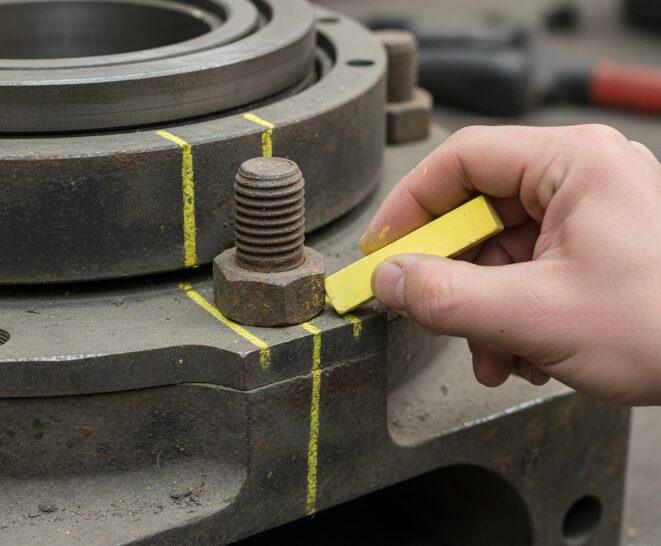
Safety locking and pressure relief: it is necessary to ensure that the upper frame and the lower frame are firmly fixed and the hydraulic system is completely relieved.
Safety support and hoisting: Crane of sufficient tonnage or solid hydraulic support tools must be used to stabilize the upper car body and completely remove the load of the slewing bearing.
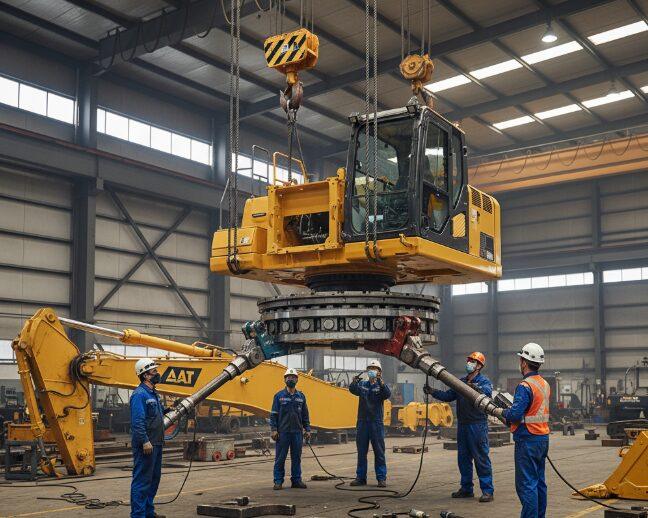
Disassemble the boarding connector: Remove all oil pipes, wires, rotary motor and all accessories connecting the boarding and alighting.
Removal of bolts: The fixing bolts must be loosened and removed step by step according to the diagonal or circular sequence provided by the manufacturer. Do not remove all bolts at once.
Remove the old bearing: clean the site, remove the fixing bolts connecting the old slewing bearing, and hang it down.
Cleaning and inspection: After the old support is safely lifted, the mounting surfaces of the upper and lower frames must be thoroughly cleaned to ensure flatness, no burrs, and no welding slag.
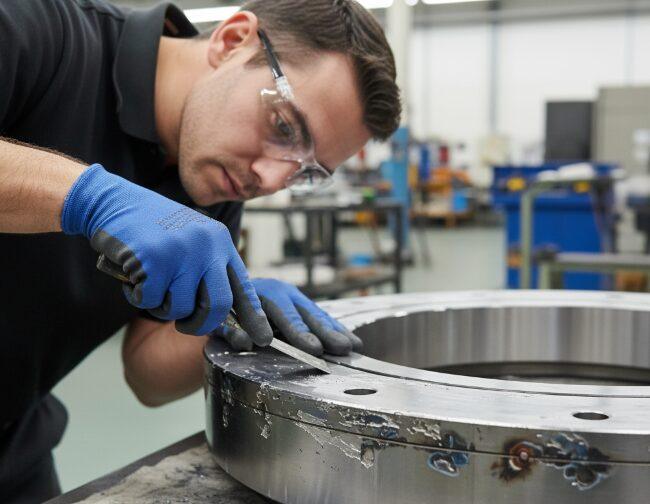
Install new bearings and torque: Install new or repaired slewing bearings. All bolts must be tightened in stages in strict accordance with the torque and sequence specified by the manufacturer.
Torque re-tightening: A calibrated torque wrench must be used to tighten all bolts 3 to 4 times in strict accordance with the manufacturer’s specified torque values and symmetrical cross sequence.
Reset and test: carefully reset the upper frame and connect all pipelines. After the connection is completed, carry out no-load and on-load rotation tests to check whether the rotation is smooth and whether there is abnormal noise.
How to judge whether the excavator slew ring needs to be repaired
Direct observation
Look.
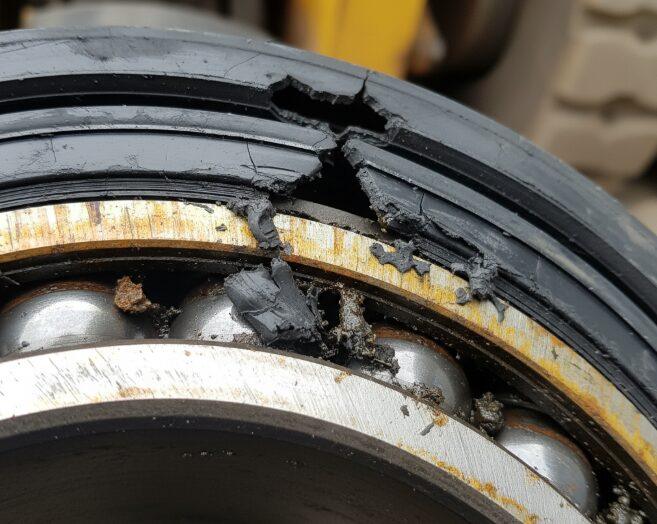
- Seal ring status: check the seal ring (oil seal) for damage, aging, bulging or a large amount of grease extrusion. If the grease is black or there are metal chips, the bearing has a big problem.
- Rotary clearance: Observe whether there is an abnormal clearance or relative movement between the inner ring and the outer ring of the support. In the small range of rotation, if you see the support has obvious shaking, you must immediately check the tool.
- Bolt condition: whether the bolt head shows signs of loosening, paint peeling or fracture. Bolt loosening is one of the culprits leading to the damage of the excavator slewing ring bearing.
Listen.
- Unusual sound: When starting the rotation, if you hear a continuous rustling sound (ball or roller wear), a click sound (raceway chipping or foreign objects), or a noticeable metal friction sound, this means that the internal structure has been damaged.
- Positioning abnormal noise: sometimes when rotating in a fixed position, the noise is particularly loud, which indicates that the wear of the raceway in this specific area has formed a pit.
Touch.
After running for a period of time, stop the machine. Touch the outer ring of the slewing ring bearing by hand. If the temperature rises abnormally (far exceeding the normal working temperature), it indicates that the internal raceway friction is serious, which may be lack of lubrication or raceway deformation.
Tool check
Although it can be directly observed based on experience, tool inspection is the only scientific criterion for judging whether the bearing needs maintenance.
Related tools
Magnetic gauge seat, dial indicator (dial indicator is more accurate), crowbar (large, used to assist in jacking), bolt torque wrench.
Operation process
- Set the dial indicator: fix the dial indicator on the slewing platform, and the measuring head contacts the mounting surface of the lower frame (usually directly above or near the slewing bearing).
- Apply axial load: operate the excavator, extend the boom and stick, and then use the bucket to lift the ground to apply the maximum axial load to the slewing bearing.
- Record data: record the reading change of the dial indicator under no load state and maximum load state respectively. This difference is the axial clearance.
- Radial inspection: The dial indicator can be placed horizontally to measure the relative displacement of the inner ring and the outer ring to obtain the radial clearance (horizontal shaking).
Judgment standard
This standard usually refers to the maintenance manual of the equipment manufacturer. However, in my experience, if the measured axial clearance exceeds 1.5 times the manufacturer’s specified value, or the radial clearance exceeds 0.5mm, it is recommended to repair or replace the bearing immediately.
Post-Repair Precautions
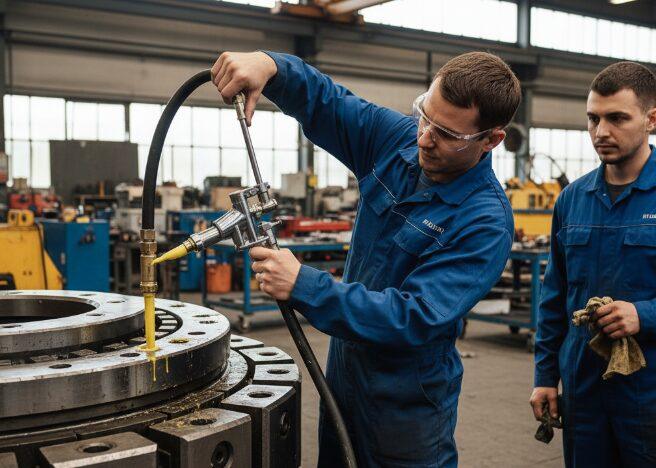
Regular cleaning: keep the ring gear clean and avoid accumulation of sand and mud on the ring gear. These contaminants into the grease will become abrasive, accelerate the wear of gears and raceways.
Lubrication maintenance: This is the focus of daily work. It is recommended to use the grease recommended by the manufacturer and lubricate it at the specified frequency. Lubrication, be sure to let the excavator slow rotation for a week, to ensure that the raceway and tooth surface can be evenly filled with oil, see the oil seal with fresh grease gently overflow.
Keep clean: keep the supporting ring gear and oil filling area clean to prevent dust, muddy water and foreign matter from entering the raceway through the sealing ring.
