SWBTEC


Schwenkantriebslager: Wie man die richtige Baugruppe spezifiziert
A rotating platform needs a load-carrying connection and a way to move it. The phrase Großwälzlager can describe the bearing inside a drive, or it can be used loosely for the complete slewing drive. That difference matters when you compare quotations or replace a unit: one supplier may be offering a ring bearing, while another is offering a housed drive assembly.
The quickest way to resolve the ambiguity is to define what the machine must carry, how it must move, and exactly which components will arrive in the box.
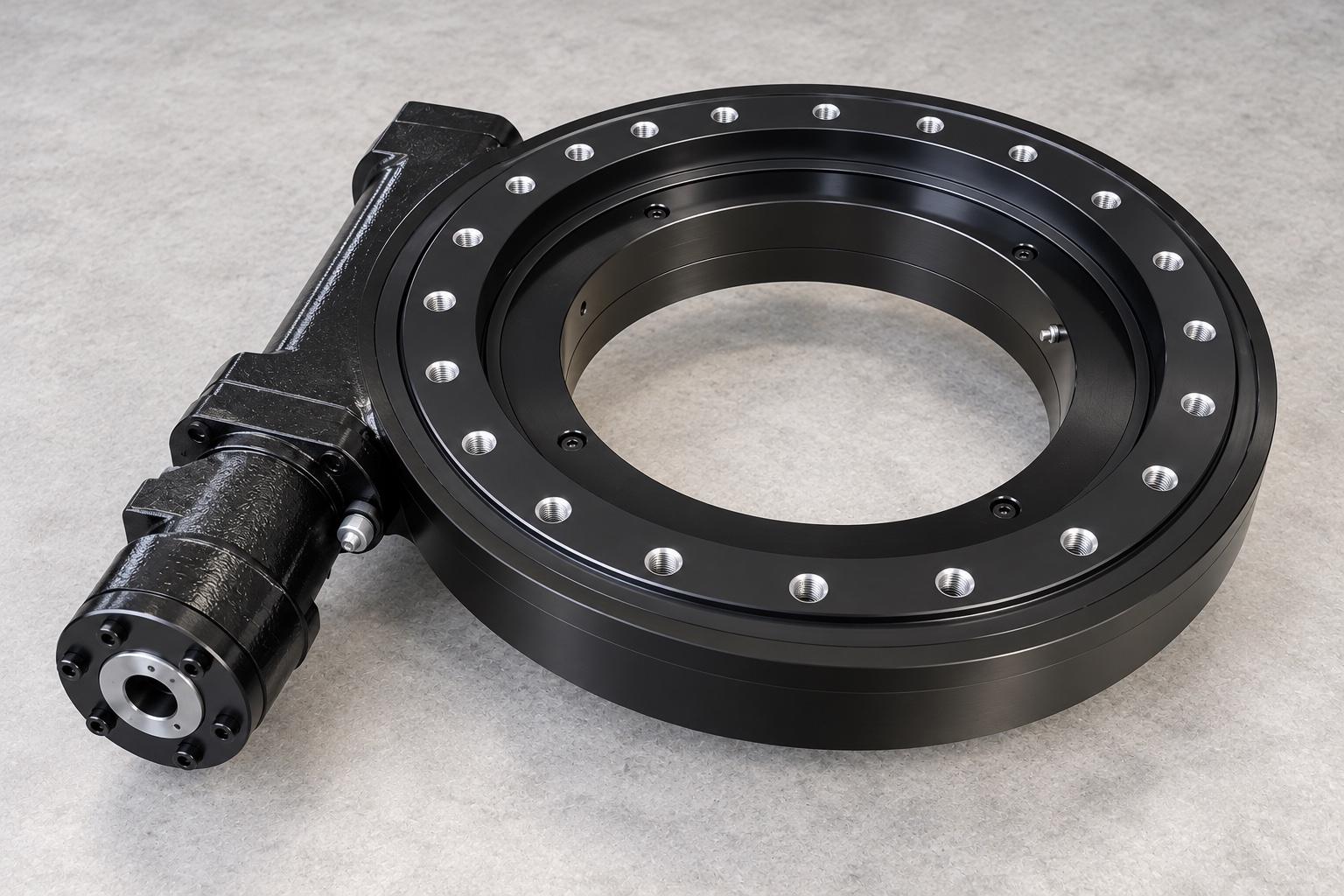
Bearing, Drive, Or Complete Assembly?
The bearing section joins the fixed and rotating parts of the machine. Its rings and rolling elements carry axial force, radial force, and overturning moment while allowing relative rotation. A geared slewing bearing may have teeth that accept an external pinion, but those teeth do not make it a complete drive.
A slewing drive adds a torque-transmitting mechanism, a housing, and an input interface to the bearing function. In a worm-drive arrangement, the worm turns a toothed member associated with the bearing. The package can simplify integration, yet the motor, hydraulic input, brake, encoder, and fasteners still depend on the agreed scope of supply.
Ask for an assembly drawing and a component list. Mark the fixed side, rotating side, bearing, gearing, housing, input connection, and optional equipment. If this is a replacement, use the original drawing and part details to check the complete interface rather than relying on a similar product name.
Beginnen Sie mit Lasten, die gemeinsam auftreten
The bearing cannot be selected from platform weight alone. An off-center payload creates an overturning moment; sideways force adds radial load. Starting, stopping, or reversing may change the combination at the same instant. Record each meaningful operating condition as a set of simultaneous axial force, radial force, and moment values, with their directions.
Use those same conditions when checking the bearing, mounting bolts, and support structure. A ring that appears suitable in isolation may not perform as expected on a flexible or uneven base. Ask the supplier which load cases and mounting assumptions were used for the proposed assembly.
Describe Motion And Holding Separately
Next, describe the output motion: travel angle or continuous rotation, speed, starts and stops, reversals, running time, and rest time. Normal running torque, brief peak torque, and the external torque present while stopped are different requirements. A reduction ratio does not, by itself, prove usable torque, efficiency, positioning accuracy, or holding ability.
Be especially clear if the platform must stay in position after power is removed. A worm gear should not automatically be treated as a safety brake. Backdriving behavior depends on the specific drive and its operating conditions. Define the maximum external holding load, acceptable movement, and fault condition, then verify the brake or other holding method in the complete machine design.
Check The Interface Before Ordering
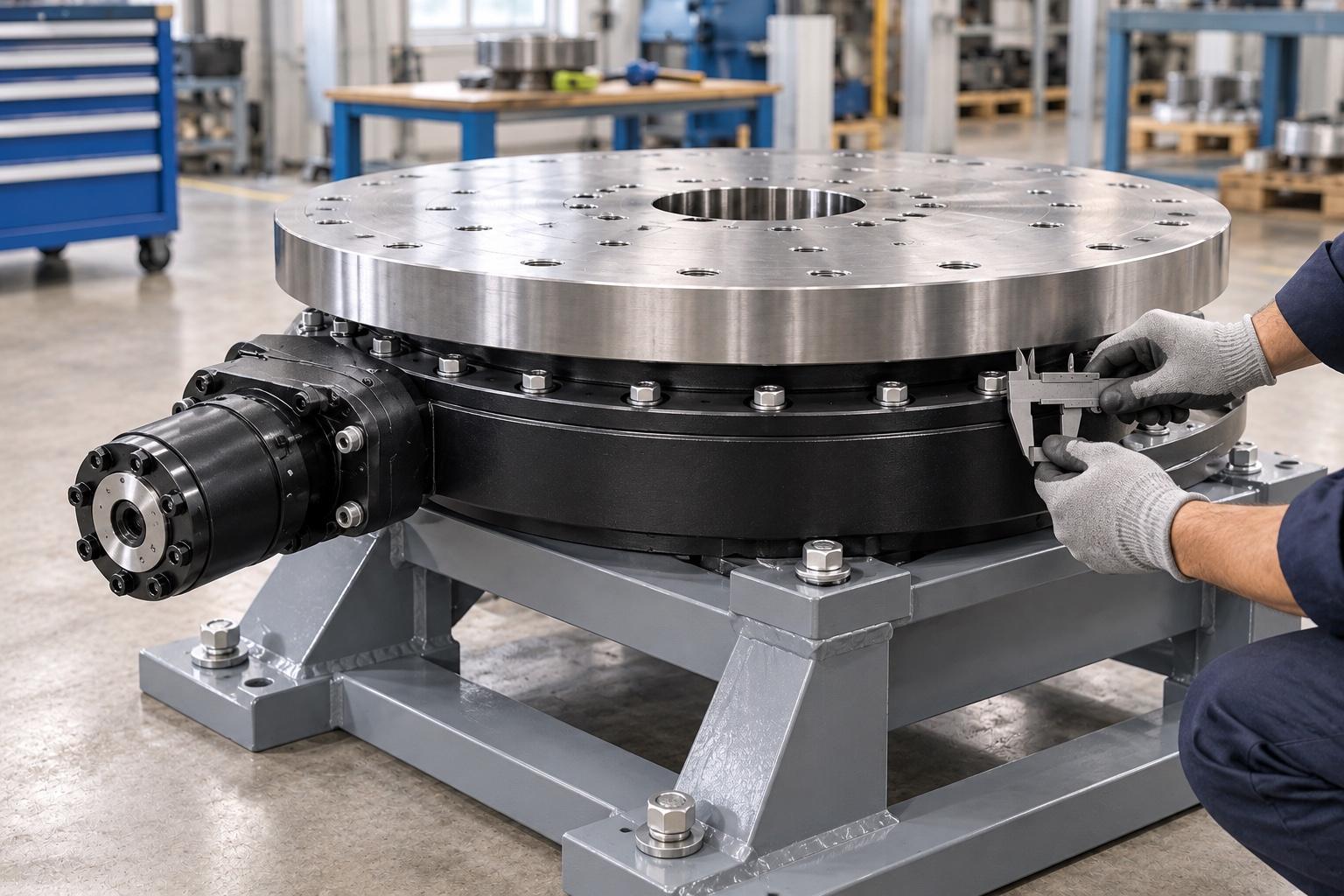
The mounting drawing should show both bolt patterns, the central opening, overall envelope, input orientation, and which side rotates. Leave practical space for the motor or hydraulic connection, wiring or hoses, lubrication points, inspection, and tools. A unit that fits inside the nominal diameter can still collide with nearby structures or be difficult to service.
Mounting faces and structure stiffness deserve the same attention as the drive itself. Local gaps or deflection can change how forces reach the raceway and bolts. State whether the axis is horizontal, vertical, or inclined so the proposed unit can be checked for its actual load direction, sealing, and lubrication arrangement.
A Clearer Request For A Proposal
Send Slewbearingtec the simultaneous load cases, motion cycle, running and peak torque, stopping or holding requirement, interface drawing, mounting orientation, environment, and desired supply scope. Request a controlled assembly drawing and the assumptions used to check the bearing, transmission, bolts, and lubrication. This makes quotations comparable and gives the installation team a practical basis for review.