SWBTEC


Rollendrehverbindungslager: Wie man die richtige Bauart wählt
A roller slewing bearing has to do more than turn. In a crane, excavator, or rotary platform, it connects two large structures while carrying loads that change direction and magnitude as the machine works. A bearing that fits the available diameter can still be wrong for the job if its internal roller arrangement, bolt connection, or mounting surface does not suit the actual duty.
The useful starting point is to describe the machine and its loads, then choose a roller arrangement. That order makes it easier to compare candidates on a common basis and to spot details that a product name leaves out.
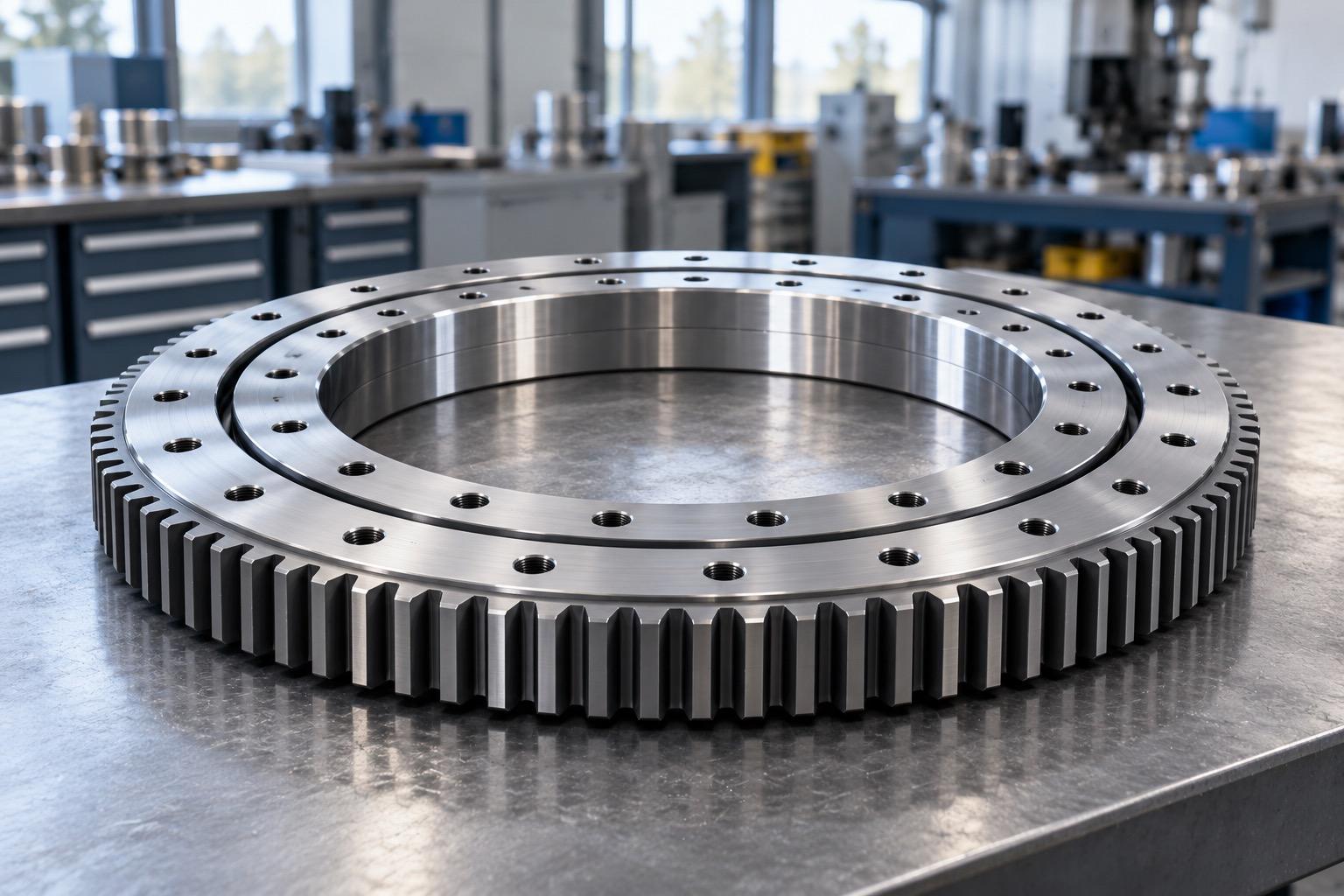
What The Name Does And Does Not Tell You
“Roller slewing bearing” is a broad product description, not a single internal design. It may refer to a crossed roller slewing bearing, a three-row roller design, or another roller arrangement. A product photo or outside diameter alone cannot identify the load path inside the bearing.
In a crossed roller design, adjacent cylindrical rollers are arranged at alternating angles within one raceway system. The arrangement can carry axial load in both directions, radial load, and overturning moment at one bearing position. It is often considered when compact construction, rotational accuracy, or tilting stiffness matters. The result still depends on the raceway geometry, roller dimensions, clearance or preload, and the structure to which the bearing is bolted.
A three-row cylindrical roller slewing bearing separates the work across roller groups. Two axial roller raceways handle axial forces in opposite directions and contribute to resisting overturning moment; a radial roller group mainly handles radial force. This can be a candidate for high combined loads, provided the surrounding structure is stiff enough to support the intended load distribution. More rows do not compensate for a flexible or uneven mounting frame.
Slewbearingtec's range includes crossed roller products and three-row roller slewing bearings. Its three-row models include 130, 131, 132, 133, and 134 series combinations. A series name helps narrow the discussion, but the controlled drawing and calculation for the specific model determine whether it fits an application.
Beginnen Sie mit Lasten, die gemeinsam auftreten
For each operating condition, record axial force, radial force, and overturning moment as a set. These quantities do not necessarily reach their maxima at the same time. Combining unrelated peak values may describe a condition the machine never sees, while checking each maximum separately can miss a real, demanding combination.
The motion pattern matters as well. A platform that rotates continuously has different lubrication, heat, and life considerations from one that makes short, repeated swings. Record speed or swing angle, frequency, operating time, starts, stops, reversals, and any shock events. Note the mounting orientation, temperature, dust, water exposure, and access for lubrication. These details can change the sensible choice even when two bearings have similar headline load ratings.
Once candidate models are identified, compare the actual load points with the raceway capacity information supplied for each model. Check the bolted connection under the same conditions. A raceway result by itself does not establish that the complete installation is suitable. Life estimates also need the duty cycle and load spectrum; a static check and a life check answer different questions.
Check The Interface Before Comparing Prices
A replacement or new design needs more than matching inside and outside diameters. Confirm overall height, center opening, mounting-hole count and pitch circle, locating features, which ring rotates, and the available space around the bearing. If the bearing is geared, specify whether the teeth are on the inner or outer ring and check the mating pinion and its position. A gearless arrangement needs its separate drive method defined.
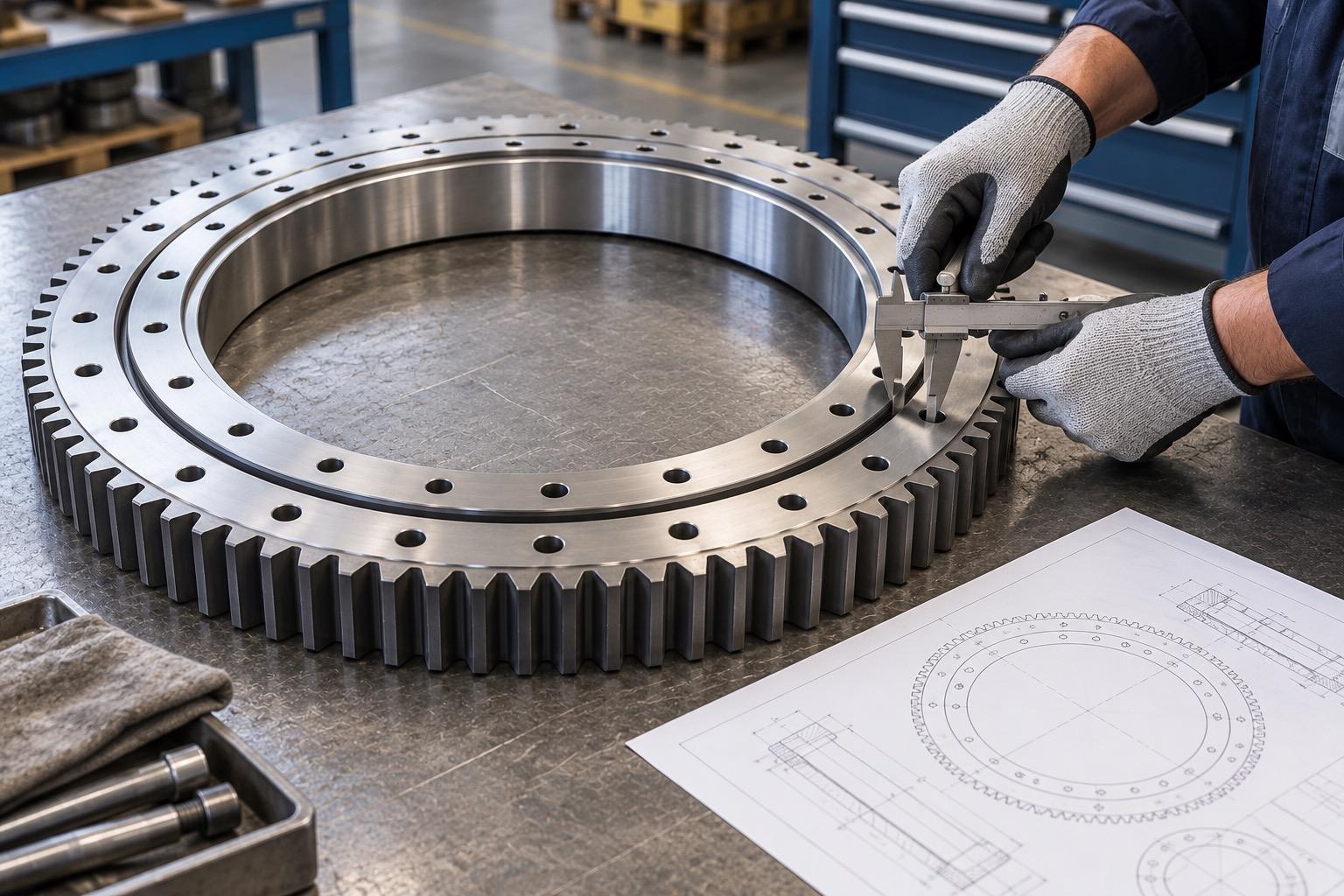
The mounting structure deserves equal attention. The contact surfaces must be clean and sufficiently flat, and the structure must provide the stiffness assumed in the bearing assessment. Local distortion can shift load toward a limited part of a raceway. Bolt grade, layout, and controlled, even preload belong in the installation plan rather than being left to the bearing designation.
For a crossed roller design, ask how clearance or preload is specified and what installed rotational accuracy is required. Preload can increase stiffness, but it also affects friction and sensitivity to mounting errors. For a three-row design, axial and radial clearances should be considered separately. These are model-specific questions; a universal clearance value would be misleading.
What To Request From A Supplier
Ask for the drawing of the exact proposed model, its mounting and gear details, and the calculation basis for the stated operating conditions. The review should show the limiting load cases, raceway and bolt checks, and any assumptions about mounting stiffness. If precision or low running resistance matters, request the applicable runout, clearance or preload, and friction conditions rather than relying on a general “high precision” label.
Inspection records can help confirm that the delivered part matches its specification. Useful items may include overall height, ring diameters, mounting-hole geometry, axial and radial clearance, runout, raceway hardness, and smooth rotation. A record for one serial number does not prove that every other model or production batch has the same measured results.
Can A Roller Design Replace A Ball Slewing Ring?
Sometimes a roller design is worth evaluating when stiffness or combined-load demands change. It is still a design change, not a drop-in upgrade. Recheck the load cases, raceway and bolt limits, height, holes, gearing, clearance, precision, and service requirements. A ball design and a roller design should be compared under the same duty and mounting assumptions; neither is automatically the better choice from its rolling-element name alone.
A sound roller slewing bearing choice is the one that survives these checks as an installed system. Define the real duty, compare suitable internal structures, confirm the interface, and review the model-specific evidence before ordering.