SWBTEC


Les principaux fabricants chinois de roulements de pivotement à cage intégrale en cuivre
When it comes to one-piece copper‑alloy‑cage slewing bearings, China’s leading manufacturers—such as Luoyang Bearing (LYC), Zhuzhou Bearing (ZWZ), and the heavy‑equipment hubs in the Xuzhou industrial belt—have, by virtue of their signature processes of centrifugal casting for copper alloys and single‑piece five‑axis CNC machining, effectively underpinned half of the global supply chain. Many multinational procurement directors often waste months in a futile quagmire, haggling with low-end foreign‑trade middlemen. These shell companies tout substandard brass cages—produced via sand casting and assembled in segments—as “solid-cast, pure copper.” If you’re sourcing for offshore cranes, tunnel‑boring machines, or heavy excavators, what you really need is a leading original‑equipment manufacturer with an in‑house metallurgical quality‑control system—rather than just a final assembly plant that merely bolts components together. This guide will give you the inside scoop, showing you how to rigorously vet China’s leading manufacturing hubs and completely avoid the disastrous “machine‑wrecking” incidents caused by bearings made from recycled scrap copper.
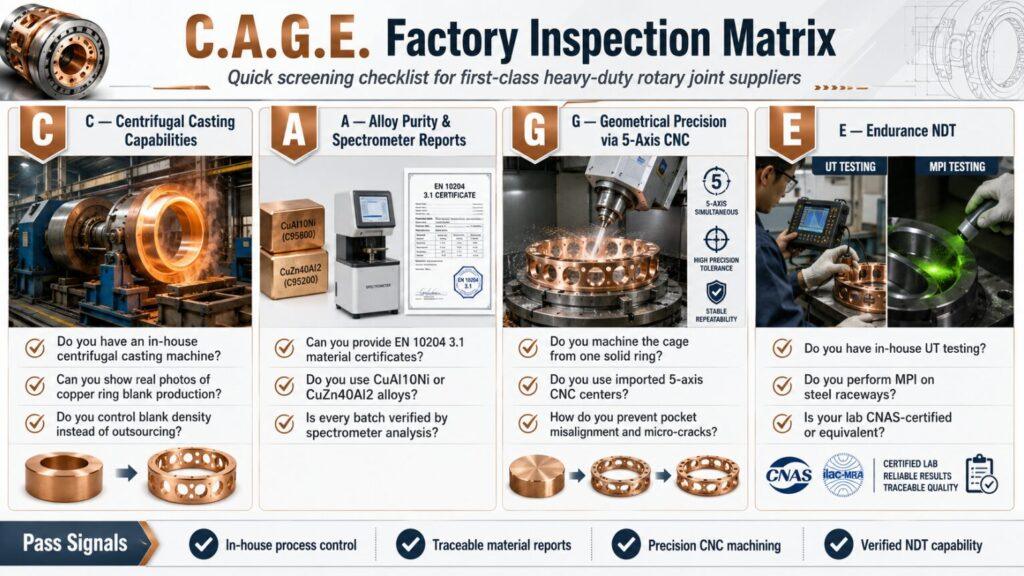
C.A.G.E. Factory Inspection Matrix: A glance at the bag company, accurate screening of first-class suppliers
Looking for a supplier for heavy-duty rotary joints, if you only look at Alibaba’s merchant homepage, your supply chain will have to roll over sooner or later. You must use this C.A.G.E. factory inspection matrix to dig deep into potential suppliers, so that foreign trade companies and low-end assembly plants can be exposed in an instant.
C: Centrifugal casting hard strength (Centrifugal Casting Capabilities)
Top factories make blanks for heavy-duty cages, and there is absolutely no need for low-end foundry technology. Centrifugal casting can make high-temperature copper water rotate at high speed, throwing all impurities and bubbles to the inner hole area, and cutting them off by one machine in the later period. Directly find the supplier to ask them for the real picture of the centrifugal casting machine. If their copper ring blank is bought by outsourcing, there is no way to control the density of the material inside.
A: Alloy Purity and Spectrometer Report (Alloy Purity and Spectrometer Reports)
In the domestic bearing circle, changing the material is the most common way to reduce the cost. A true one-piece copper cage requires high tensile strength alloys, such as aluminum bronze (CuAl10Ni) or high-strength brass (CuZn40Al2). Don’t listen to them, they are required to issue a spectrometer material certificate conforming to EN 10204 3.1 standard for each batch of goods.
G: Geometric accuracy of 5-axis CNC (Geometrical Precision via 5-Axis CNC)
The pockets of the fixed rolling element must be absolutely aligned, not even a trace. Cheap factory map to save trouble, directly with a punch or pull to make pocket holes, which will make tiny hidden cracks inside the copper ring. Major domestic first-line factories all use imported five-axis machining centers (such as Demaghi or Mazak) to mill out the entire cage directly on 1 whole forged solid copper ring at one time to ensure zero error.
E: NDT Durability Verification (Endurance NDT)
It is impossible to see whether there is a hole in the interior by looking at the surface alone. You must rigidly stipulate that the copper blank before processing must be ultrasonic flaw detection (UT) and the steel raceway must be magnetic particle flaw detection (MPI). The real head source factory is equipped with national CNAS certified laboratories to automatically complete these durability verification processes.
China’s three major slewing bearing core industry belt big decryption
China’s bearing industry has a strong regional. To buy different levels of slewing bearings, you have to go to the corresponding industrial belt.
Xuzhou plate: the “top priority” of construction machinery”
Backed by the big tree of Xugong Group, Xuzhou is definitely the ace of production of construction machinery slewing bearings. The manufacturers here are extremely good at making oversized, heavy-duty integrated copper cages for excavators, concrete pump trucks and tower cranes. If it is a high-impact, low-speed working condition, come here to buy the most cost-effective. Focus on those with large induction hardening production line factory, can handle the diameter of up to 5 meters raceway best.
Luoyang plate (Luo axis system): aerospace and high precision “national team”
China’s top precision bearing research and development team is basically clustered in Luoyang. If you need to give radar systems, shield machines (TBM) or offshore wind power pitch systems with slewing bearings, Luoyang’s giants are the absolute authority. They have a unique skill: they can produce zero-beat, ultra-high-precision negative-clearance slewing bearings, and use exclusive copper alloys that can withstand extreme marine corrosion.
Wafangdian Plate (Wafangdian System): Big Brother of Heavy Industry
Wafangdian is the birthplace of Chinese bearing industry. The manufacturers here specialize in large diameter slewing bearings, mainly for steel mills, mine stacker-reclaimer and port machinery. The integrated copper cages they produce are often heavily structurally reinforced to resist extremely harsh working environments and continuous and large overturning moments.
| Region Hub | Best For (Application) | Price Tier | Core Technological Strength |
|---|---|---|---|
| Xuzhou Plate | Construction machinery such as excavators, concrete pump trucks, and tower cranes; high-impact and low-speed working conditions | Cost-effective / Mid-range | Large-scale production of oversized heavy-duty slewing bearings; integrated copper cages; large induction hardening production lines; raceway diameters up to 5 meters |
| Luoyang Plate (Luo Axis System) | Aerospace systems, radar systems, tunnel boring machines (TBM), and offshore wind power pitch systems | Premium / High-end | Ultra-high-precision slewing bearings; zero-runout performance; negative-clearance technology; advanced copper alloys for extreme marine corrosion resistance |
| Wafangdian Plate (Wafangdian System) | Steel mills, mining stacker-reclaimers, port machinery, and other heavy industrial equipment | Mid-range / Heavy-duty | Large-diameter slewing bearings; reinforced integrated copper cages; strong structural design for continuous loads and large overturning moments |
Pits that only insiders can understand: segmented welding and recycling of waste brass
If a manufacturer’s quotation is 30% cheaper than the average market price, don’t be too happy too early, it is 100% raw materials with big holes. In order to cut costs, inferior suppliers will buy recycled waste brass that contains lead and zinc that seriously exceeds the standard.
They melted the scrap copper and poured it into a sand mold for casting. When encountering a large-diameter cage, in order to further save money, they will cut the cage into four or five segments and make them separately, and finally put them together with pins or welding, and then openly stick the label of “solid pure copper cage. However, under the ultimate radial load of the actual operation of the crane, the force of these spliced joints is extremely concentrated. Waste brass was already brittle due to a lot of impurities, and it was directly broken into slag in the raceway. Broken copper slag mixed with grease, the steel rollers scratched horribly, within a few weeks, the entire slewing bearing will be completely stuck and scrapped.
Remember, be sure to write in bold on your technical drawings: “Must be cast in one piece. Any segmented, spliced or pinned cage will be rejected.”
Real Case: Marine Deck Crane Upgrade
A European marine equipment buyer suffered a big loss before, and the slewing bearings of their 2.5-meter deck cranes broke down one after another. After investigation, it was found that the original supplier used a segmented nylon cage, which aged extremely fast under the destruction of ultraviolet rays and salt spray, causing the rollers to be squeezed and piled together.
Later, the buyer took our C.A.G.E. Matrix to Xuzhou Field Inspection Factory and locked up a large head factory. The Chinese factory directly redesigned the joint and replaced it with a ZCuAl10Fe3 (aluminum bronze) integrated cage, and readily provided a full set of ultrasonic flaw detection (UT) reports proving that there were no pores inside.
What was the result? The one-piece copper cage dissipates heat three times faster than the nylon model, completely eliminating the problem of roller cardon. This crane has been running steadily for 15000 hours in a highly corrosive marine environment, which perfectly proves that it is always more cost-effective to find a real source manufacturing factory than to find a second dealer assembly factory.
People Also Ask (FAQs)
Q: What exactly makes a one-piece copper cage superior to a segmented one?
A: A one-piece copper cage is CNC-machined directly from a single, continuous metal ring; this ensures exceptionally uniform load distribution and superior resistance to centrifugal forces and impacts. In contrast, segmented cages have physical breaks and joints—inherent weak points that are highly prone to fracturing when subjected to massive overturning moments.
Q: How can I verify if a Chinese supplier is a genuine, direct manufacturer?
A: Ask for a video call during business hours and request a “virtual tour” of their CNC machining and heat treatment workshops. A trading company simply cannot show you a real production floor on the spot. Additionally, ask for a copy of their ISO 9001 certificate and carefully cross-check the registered address against the actual factory location.
Q: Why is centrifugal casting the required method for copper alloy slewing bearing cages?
A: Centrifugal casting applies immense G-force (centrifugal force) as the metal cools. This force drives dense, pure copper toward the outer edge while pushing trapped gases, slag, and impurities toward the inner ring; these waste materials are then simply cut away during subsequent CNC machining. The resulting material structure is far denser and stronger than that produced by gravity-based sand casting.
Q: What is the typical lead time for purchasing a large-diameter slewing bearing with a one-piece copper cage from China?
A: For standard heavy-duty products (1 to 3 meters in diameter), leading Chinese manufacturers typically quote a lead time of 35 to 60 days. This period covers steel ring forging, centrifugal casting of the copper blank, 5-axis CNC machining, induction hardening of the raceways, and the necessary curing time for anti-corrosion treatments.
Q: Can the quality from top-tier Chinese manufacturers compete with European bearings?
A: Absolutely. Leading Chinese manufacturers now supply global giants such as Caterpillar, Liebherr, and Vestas directly. Provided that material grades are strictly specified in the blueprints (e.g., mandating 42CrMo4V steel and CuAl10Ni bronze) and Non-Destructive Testing (NDT) standards are rigorously enforced, the quality achieved by top-tier Chinese factories can easily rival—or even surpass—European standards, all while offering a significant price advantage.
Q: Do bronze cages require special grease?
A: Yes. Although bronze alloys possess excellent inherent self-lubricating properties that prevent scuffing (adhesive wear) against steel rollers, you must use a grease that is compatible with copper-based alloys. Strictly avoid lubricants containing highly active sulfur extreme-pressure (EP) additives; active sulfur reacts aggressively with bronze alloys, leading to rapid pitting and corrosion.