SWBTEC


Slewing Ring Bearing Applications: Core Uses Unlocked
In the field of heavy machinery, slewing bearings (Slewing ring bearings) is definitely the core of the structural hub. Such components are born to deal with complex force conditions-they have to carry down axial force, radial force and overturning moment while ensuring that the equipment can stably complete 360-degree accurate rotation.
Whether it is in the slewing mechanism of a hydraulic excavator, the yaw and pitch drive in a wind turbine, or the rotating platform of a mobile crane, you can see these key components. However, which kind of bearing to choose depends entirely on the specific force distribution of the equipment: does your application scenario need more anti-overturning torque capability, or does it pay more attention to the accuracy of high-speed rotation?
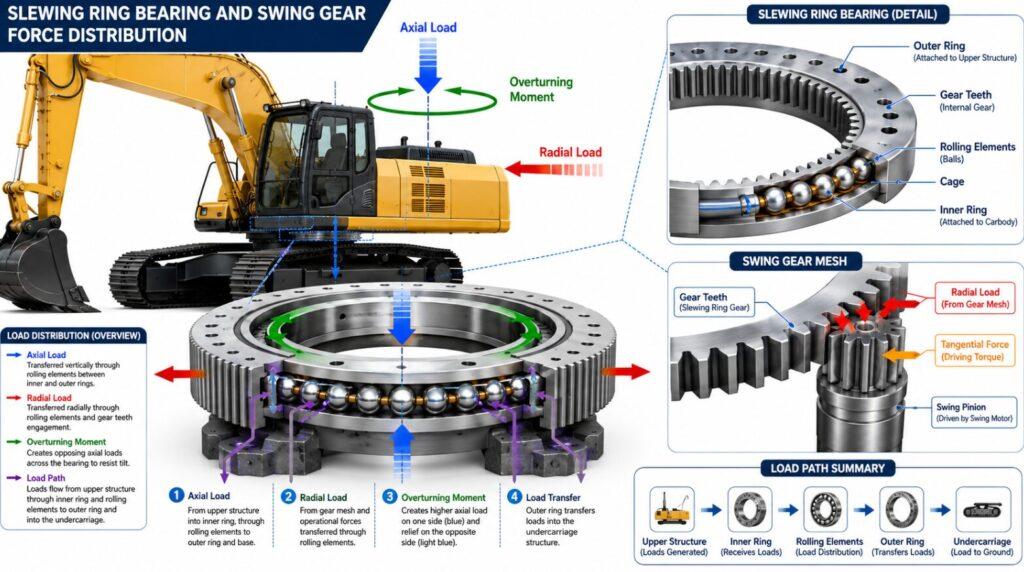
On the surface, what everyone is pursuing is a simple “turn up”, but the engineering logic behind it is quite tricky. Even a slight misjudgment of environmental stress or load frequency may lead to early scrapping of the bearing, directly causing the equipment to face catastrophic downtime. In this article, let’s talk about its core purpose and technical details-if you understand these, your equipment will run smoothly for a long time, otherwise it will probably become 1 maintenance nightmare.
Make The Design And The Actual Working Conditions Perfect Right
The internal geometry of the slewing bearing must be fully engaged with the dominant force direction of the equipment during operation. Don’t assume that all “spin” needs are the same. Let’s take the most common case of purchasing stepping pit: when the working condition requires three-row roller bearings with extremely strong compression resistance, a standard ball bearing is installed, which is a typical early selection error.
Conditions of partial axial load
In the case of a crane, the bearing here acts as a force fulcrum for the entire boom and counterweight. The biggest difficulty in this job is that it has to withstand extreme axial loads, plus a fairly violent overturning moment. In the face of this intermittent rotating operation, single-row four-point contact ball bearings are usually standard in the industry, because it can find an ideal balance between procurement cost and carrying capacity.
| Bearing Type | Load Capacity Characteristics | Rotation Behavior | Typical Application | Suitability in Crane Systems |
|---|---|---|---|---|
| Single-row four-point contact ball bearing | Moderate axial + radial load capacity with good moment handling for its size | Intermittent rotation, smooth slewing | Standard slewing systems, medium-duty cranes | Common choice for cost-effective crane slewing rings |
| Double-row four-point contact ball bearing | Higher axial load capacity and improved moment resistance compared to single-row | Intermittent rotation with improved stability | Larger cranes, heavier slewing platforms | Used when higher stability is required under load |
| Crossed roller bearing | Very high rigidity, excellent moment and axial load capacity | Precise, low-clearance rotation | Precision positioning systems, robotics, high-accuracy machinery | Used in high-precision crane slewing or special-duty applications |
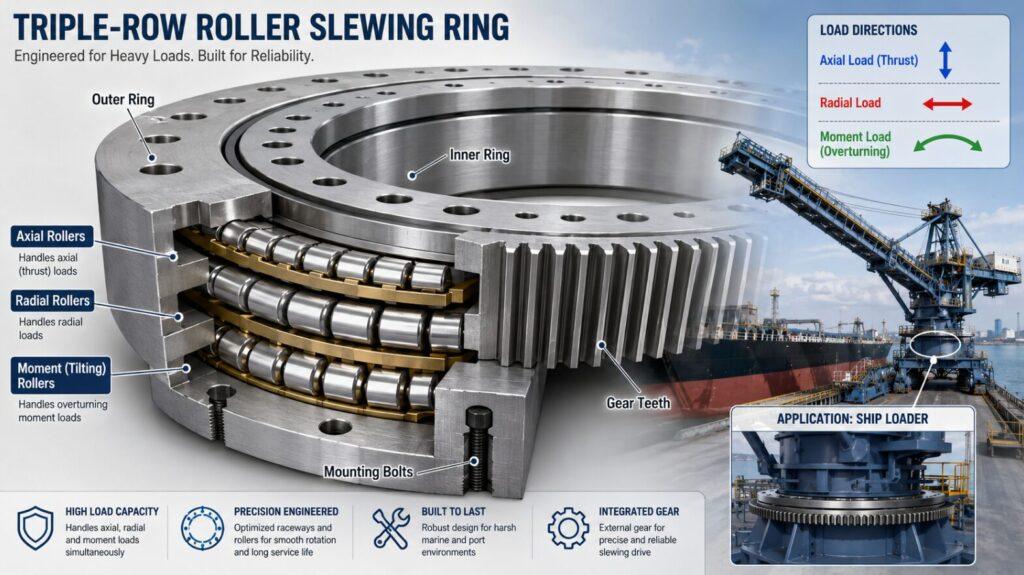
| Roulement à trois rangées de rouleaux | Extremely high axial, radial, and tilting moment capacity | Slow intermittent rotation under heavy load | Large port cranes, offshore cranes, wind turbine installation cranes | Preferred for ultra-heavy lifting applications |
| Slewing ring with gear-integrated design | High load capacity depending on roller configuration | Drives integrated rotation via gear system | Tower cranes, excavators, large industrial cranes | Widely used in construction machinery for combined drive + support |
Working condition of partial overturning moment
The situation of the excavator is completely different. Every time the bucket hits the ground hard, the slewing bearing is subjected to severe and repeated impact loads and extremely high overturning moments. In the face of this high-frequency and high-pressure operating environment, the raceway must undergo induction hardening treatment, which is absolutely not negotiable. In addition, the gear teeth (whether internal or external teeth) must be strong enough to withstand the huge shear force generated by the rapid acceleration and braking of the equipment.
Several Core Application Scenarios In Heavy Industry
If you want to choose the right part number, it is the key to understand the “temper” of each industry.
New energy: yaw and pitch system of wind turbine
In wind turbines, slewing bearings are responsible for two main functions: the 1 is yaw (allowing the nacelle to turn against the wind), and the 2 is pitch. In fact, this kind of bearing rarely rotates in a full circle, and most of the time it only swings back and forth in a small range. This brings a fatal hidden danger-“fretting wear (micro-pitting)”. In order to cope with the harsh environment of high salt spray and easy corrosion at sea, senior engineers now explicitly require the use of special surface coatings to prevent problems before they occur.
Material Handling: Port Cranes and Shiploaders
The size of the slewing bearing used in port equipment is amazing, with a diameter of more than 5 meters. The highlight here is the reliability of corrosion protection and sealing. Because these bearings are soaked in salty sea breeze and gravel dust every day, a reliable multi-stage sealing system is often the watershed of “stable use for 10 years” and “completely scrapped in 2 years.
Why Did The Bearing Arrive At The Scene
To be honest, the vast majority of slewing bearings are not natural “bad”, but planted in the installation or routine maintenance of low-level errors.
“Dark pit” of bolt pre-tightening force”
How strong the slewing bearing is depends largely on the bolts that hold it to the structure. We often see on site that some maintenance personnel try to save trouble and reuse old bolts, or do not apply torque according to the “star cross sequence” when fastening. This will directly lead to a small deformation of the support ring that is difficult to detect with the naked eye, resulting in a “stuck point” and rapid fatigue failure of the raceway. Remember: Be sure to use a professionally calibrated torque wrench and honestly match it with 10.9 or 12.9 high-strength fasteners.
“Oil starvation” due to vertical installation”
When the bearing is installed on the vertical axis (for example, on a vertical merry-go-round), the grease will slowly flow all the way to the bottom under the influence of gravity. As a result, in less than a few weeks, the upper part of the raceway will be in a state of dry friction. The solution of industry experts is to arrange several more grease injection nozzles at different heights and directly integrate the automatic lubrication system to ensure that the oil film is always online.
Foire aux questions
Q: Can I use slewing bearings on equipment that rotates continuously at high speed?
Answer: Usually not. The slewing bearing is designed for low-speed and high-torque working conditions (the speed is generally less than 30 r/min minutes). If you need to run at high speeds, traditional deep groove ball bearings or angular contact bearings are the positive solution.
Q: What is the most common reason for the abnormal noise of the newly installed slewing bearing?
Answer: Nine times out of ten, the gear backlash has not been adjusted properly. If the small gear and slewing ring gear meshing too dead, it will produce that kind of harsh friction sound, and accompanied by abnormal heating phenomenon.
Q: When choosing between internal and external gears, how should I decide?
Answer: The advantage of external teeth is that they are easy to maintain in the later period and allow matching with larger pinion gears. The internal tooth structure is more compact, the most important thing is that it can protect the gear to avoid external debris stuck in the tooth gap, which is why the excavator almost all use the internal tooth structure.
Q: Can different brands of slewing bearings be interchangeable and universal?
A: Very few are directly interchangeable. Even if the installation holes happen to be right, but like SKF (SKF), Rothe Erde (Rothe Erde) or other professional B2B brands of the same size products, the internal rated load, gear modulus and quenching depth are very different, the risk of mechanically moving is extremely high.
Q: Does ambient temperature affect the use of slewing bearings?
Answer: The impact is very large. Special low-temperature steel must be used in extremely cold environments, otherwise the metal is prone to brittle fracture; and in the high-temperature conditions of the steel plant, it must be equipped with a thermally stabilized ferrule and a high-temperature synthetic grease to use.