SWBTEC


Slewing Ring Bearing Catalog: Find Exact Sizes Quickly
In order to find the replacement parts accurately in the selection catalogue of slewing bearing (also called slewing bearing), you must first get 3 core data: outer diameter (OD), inner diameter (ID) and tooth shape. Generally, these parameters can be found on the original nameplate or maintenance manual of the machine. If the nameplate has long been worn out and can’t be seen clearly or even lost, don’t panic, just look down at our “S. I .G. Matching Rule” and teach you how to measure it yourself in 3 simple steps. After getting the data, use the following interactive selection tool to instantly screen out the 1 models you need from thousands of standard sizes.
Many maintenance teams have suffered this kind of dark loss: the replaced parts broke down soon, and when they resumed the disc, they found that it was because they were busy checking the inner and outer diameters and did not care about the meshing parameters of the gears. Imagine that the equipment is shutting down and rushing to make progress, and the original part number is blurred. If you skip the detailed tooth profile check and spend 12 hours with your pants on it, the machine will get stuck as soon as it starts. The following is to teach you to correctly check the posture of the selection manual to ensure that you can install it properly when you buy it back.
S. I .G. Matching Rule: 3-step replacement parameter verification
Facing an unidentified old bearing, you only need to prepare a caliper, pitch gauge (pitch gauge) and a ruler. With this set of S. I .G. matching rules covering size (Size), installation (Installation) and gear (Gear), you don’t have to rely on guesses when looking through our manual.
Step 1: “S”-Size Dimension (Don’t Just Look At The Inner And Outer Diameters)
The inner and outer diameters do determine whether the bearing can be placed in the physical space of the machine, but what really determines the carrying capacity is the cross-sectional height. Remember to measure the total height of the installed bearing ring, even if the height difference is only 2mm, the upper frame of the crane or excavator may not be able to sit back on the chassis firmly. Therefore, when looking at the size table, be sure to put the installation height (clearance height) in the first place.
Step 2: “I”-Mounting Hole Distribution (Bolt Circle)
The mounting holes must fit closely with the existing chassis. Note that you are measuring the diameter of the bolt hole distribution circle (BCD), not just the distance between two adjacent holes. In addition, remember to count the holes on the inner and outer rings carefully.
Engineer Old Bird’s Advice: * If the bolt hole center distance (BCD) you measured is 1mm different from the data in our manual, don’t rush to pay for the order. The original factory has very strict manufacturing tolerances for BCD, all within 0.5mm. If the deviation is larger than this, then the big probability you have on hand is a non-standard custom model from a certain host factory, which will have to be specially punched.
Step 3: “G”-Gear Parameters (Hard-Hit Areas, Easy To Roll Over)
80% of after-sales installation accidents are caused by gear mismatch. Selection time to see “external teeth” or “internal teeth” is useless. You must calculate the gear modulus (m): measure the outer diameter of the gear and divide it by (number of teeth +2).
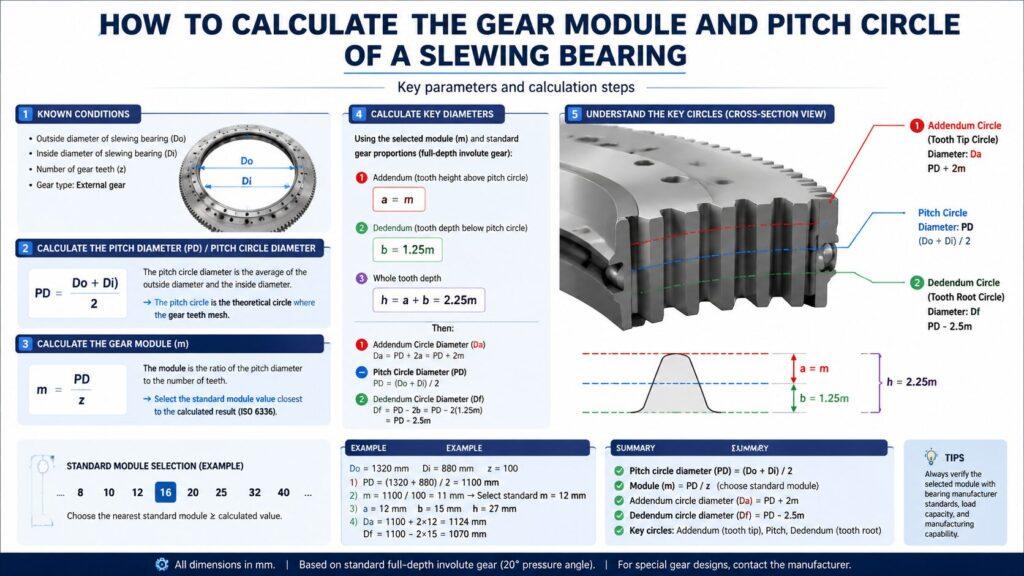
Pit Avoidance Guide: Neglected Gear Backlash (Backlash) Trap
Even if the size is not bad, as long as the displacement coefficient (addendum modification coefficient) is ignored, the machine will stop working. For example, excavator manufacturers often make positive displacement in order to make the pinion more resistant. If you buy a standard zero-displacement bearing from any catalog, the pinion and slewing ring will bite.
Before assembling and tightening, be sure to use lead wire to test the tooth side clearance. If the lead wire is flattened to less than 0.3mm after rotation, the displacement coefficient does not match. In our detailed selection manual, the displacement coefficient is marked for all heavy-duty series, which is to prevent this kind of mechanical stuck tragedy.
Interactive Slewing Bearing Selection Manual (Filter by Size Range)
Select the outer diameter range you need, and you can expand the specific specifications, load capacity and part numbers.
Light Series (Outer Diameter 200mm – 500mm)
Lightweight bearings are usually designed with a flanged cross-section, which is very suitable for packaging machinery, food processing lines and light automation equipment. They focus on low-friction smooth rotation, not extreme load.
| Part Number | OD (mm) | ID (mm) | Höhe (mm) | Getriebetyp | Gewicht (kg) |
| LS-0200-E | 200 | 110 | 35 | Externes Getriebe | 12.5 |
| LS-0350-I | 350 | 240 | 45 | Innenverzahnung | 24.0 |
| LS-0400-N | 400 | 285 | 45 | Gearless | 30.5 |
| LS-0480-E | 480 | 360 | 50 | Externes Getriebe | 38.2 |
Medium‑Size Series (Outer Diameter 500mm – 1,200 Mm)
This series can handle the vast majority of industrial applications, powering everything from truck cranes and aerial work platforms to compact excavators. To withstand high-impact loads, the internal raceway geometry has also been specially designed.
| Part Number | OD (mm) | ID (mm) | Höhe (mm) | Getriebetyp | Dynamic Load Rating (kN) | Gewicht (kg) |
| MS-0600-E | 600 | 460 | 60 | Externes Getriebe | 320 | 65.0 |
| MS-0850-I | 850 | 680 | 75 | Innenverzahnung | 540 | 115.5 |
| MS-1000-E | 1000 | 820 | 85 | Externes Getriebe | 780 | 160.0 |
| MS-1150-N | 1150 | 970 | 90 | Gearless | 950 | 205.0 |
Heavy-Duty Series (Outer Diameter> 1200 Mm)
Heavy-duty slewing bearings universally employ a three-row roller design, specifically engineered to withstand extreme overturning moments. This equipment is primarily intended for offshore cranes, bucket-wheel stacker-reclaimers, and large mining excavators.
| Part Number | OD (mm) | ID (mm) | Höhe (mm) | Getriebetyp | Tooth Quenching Hardness | Gewicht (kg) |
| HDS-1400-I | 1400 | 1150 | 120 | Innenverzahnung | 55-60 HRC | 420.0 |
| HDS-1800-E | 1800 | 1500 | 145 | Externes Getriebe | 55-60 HRC | 780.0 |
| HDS-2500-E | 2500 | 2150 | 180 | Externes Getriebe | 55-60 HRC | 1450.0 |
| HDS-3200-I | 3200 | 2800 | 220 | Innenverzahnung | 55-60 HRC | 2600.0 |
Reverse search by mechanical equipment type
If the original nameplate is still there, it is definitely much faster to search directly according to the brand and model of the machine than to measure it with a ruler.
Excavator: After-sales replacement parts like Carter, Komatsu, and Hitachi have special requirements for grease-keeping seals. See our Excavator Matching Comparison Table for details.
Tower crane: Replacement parts of Liebherr and Potain (Potain) must adopt internal tooth design with special tooth root quenching process.
Wind turbine: Yaw and pitch bearings face the offshore environment and have extremely high C4/C5 requirements for anti-corrosion coatings (such as zinc spray).

Frequently Asked Questions (People Also Ask)
How To Match The Slewing Bearing When The Nameplate Is Lost?
Take a vernier caliper with high accuracy and measure the outer diameter (OD), inner diameter (ID), total height and bolt hole circle diameter (BCD). Count the number of teeth, measure the diameter of the gear, and calculate the modulus of the gear. Just take these five core data and compare them 1 our directory.
Can I Replace The Cross Roller Slewing Ring With A Ball Bearing?
Absolutely not. Crossed roller bearings can withstand higher rigidity and overturning moments in a smaller volume. If you replace it with a single-row ball bearing of the same size, the raceway will soon be scrapped once it encounters heavy torque.
What Exactly Does “Clearance (Clearance)” In The Selection Table Mean?
Clearance refers to the clearance between the rolling body and the raceway. Negative clearance (I. e. pre-tightening) can provide machine tools with extremely high precision and rigidity; while positive clearance is reserved for heavy construction machinery to cope with thermal expansion and contraction.
Why Does The New Bearing I Just Changed Get Stuck When It Turns To A Certain Point?
Most of the installation surface is uneven. Slewing bearings are actually quite “soft” before they are filled with bolts. If the chassis of your machine is deformed by more than 0.2mm, forcibly tightening the bolts will pull the raceway out of shape and directly clamp the rollers inside.
How Do I Judge Whether My Equipment Should Use Internal Teeth Or External Teeth?
Look where the drive pinion on your device is. If the pinion is in the cavity in the middle of the bearing, it is the internal gear slewing support; if the pinion is on the outer ring of the bearing, it is the external gear.
Do You Have Dynamic Load Parameters In Your Catalog?
Of course there is. Each of our dimensional tables lists the axial, radial and moment bearing data for static and dynamic loads. You must first calculate the maximum overturning load of your equipment and make sure it falls within the static bearing curve we provide.