SWBTEC


Customized Heavy-Duty & Heavy-Load Slewing Bearing Specs
Defining the exact specifications for a customized heavy-duty slewing bearing requires precise engineering data: a minimum dynamic load rating exceeding 5,000 kN, raceway induction hardening depths between 4mm to 8mm (58-62 HRC), and the utilization of forged 42CrMo4V alloy steel verified by low-temperature Charpy V-notch testing. Designing a customized heavy-load slewing bearing demands matching the specific overturning moment and extreme axial/radial shock loads of your machinery directly with finite element analysis (FEA) verified raceway geometry. Relying on standard catalog dimensions results in catastrophic equipment failure. The technical breakdown below provides the exact metallurgical, dimensional, and load-rating specifications required to eliminate premature spalling and gear fatigue in high-stress environments.
The L.O.A.D. Engineering Framework for Custom Selection
Engineers fail when they treat slewing rings as standard commodities. Implementing the L.O.A.D. framework ensures absolute reliability when specifying technical parameters for mining excavators, offshore cranes, and tunnel boring machines.
Load Profiling Beyond Static Limits
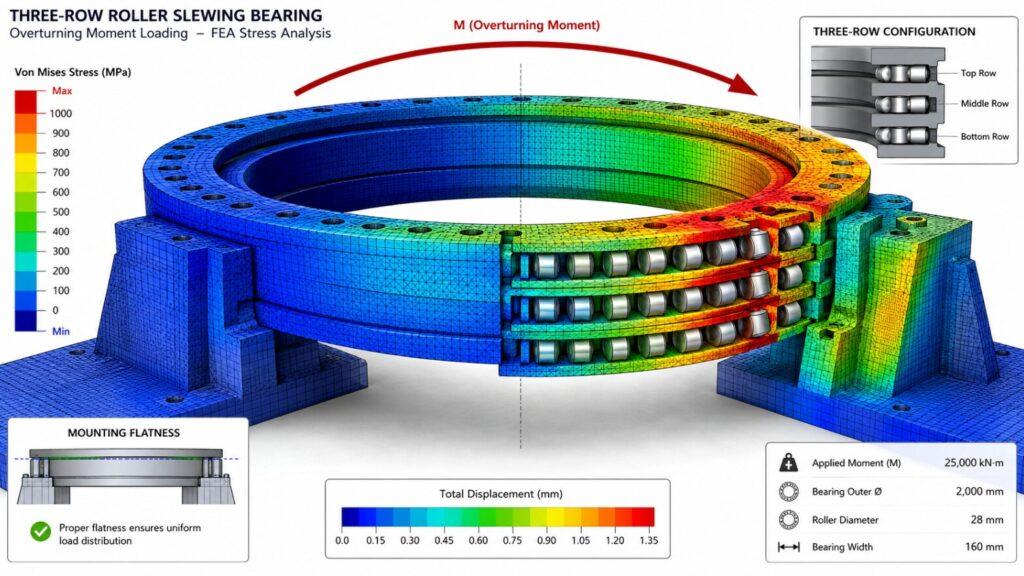
Static load capacity charts deceive design engineers operating in high-impact environments. You must calculate the equivalent dynamic load by factoring in a shock application factor (fs) of 1.5 to 3.0. A customized heavy-load slewing bearing relies on three-row roller configurations specifically to separate axial loads from massive radial shockwaves, preventing roller edge-loading.
Overturning Moment & Bolt Tensioning
Massive tipping moments dictate bearing survival. Your specification must detail the exact grade of tensioning fasteners (Grade 10.9 or 12.9) and the required pre-tensioning force. We engineer the raceway offset to handle moments exceeding 20,000 kN·m by simulating maximum boom extension loads under dynamic wind conditions.
Alloy Matrix and Deep Quenching
Material choice determines fatigue life. Standard 50Mn steel cracks under arctic temperatures. We specify 42CrMo4 or 42CrMo4V forged steel. The manufacturing process mandates deep induction quenching on the raceways. Achieving a 6mm effective case depth (ECD) guarantees the subsurface shear stress remains well within the material’s yield strength limits.
Deflection Tolerance of Mounting Structures
Mounting flatness directly controls internal load distribution. A heavy-duty slewing ring demands a mounting structure flatness of 0.1mm to 0.2mm per meter. Exceeding this tolerance causes load concentration on a single roller, drastically reducing the L10 bearing life.
Dimensional & Metallurgical Specification Matrix
Review the baseline technical specifications required for extreme heavy-duty applications. We adapt these baseline numbers based on your specific rotational speed, lubrication method, and environmental temperature.
| Parameter | Three-Row Roller Specs | Cross Roller Specs |
|---|---|---|
| Max Axial Load | 3,000–15,000 kN | 500–4,500 kN |
| Max Radial Load | 1,000–8,000 kN | 300–3,000 kN |
| Raceway Hardness (HRC) | 55–62 HRC | 58–62 HRC |
| Core Hardness (HB) | 229–280 HB | 229–269 HB |
| Getriebe Präzisionsklasse | ISO 8–10 / DIN 3967 | ISO 7–9 / DIN 3967 |
| Operating Temperature Range | -40°C to +120°C | -30°C to +110°C |
| Sealing Material | NBR / HNBR / FKM | NBR / FKM |
Gear Parameters and Backlash Control
Heavy-load applications destroy standard gears. Specifications for a customized heavy-duty slewing bearing must include surface-hardened gears (tooth flank hardening to HRC 50-55) leaving the tooth root soft to maintain toughness. We calculate precise backlash tolerances based on the pinion center distance, applying a tip relief profile to prevent destructive interference during thermal expansion.
Advanced Sealing and Lubrication Specs
Particulate contamination accounts for 70% of premature wear. We specify nitrile butadiene rubber (NBR) dual-lip seals for standard heavy-duty operations and Viton (FKM) seals for high-temperature or highly corrosive offshore environments. Centralized automatic lubrication grooves are machined directly into the ring to ensure an uninterrupted grease film (NLGI Grade 2) across all contact angles.
Field Failure Prevention: 3 Engineering Pitfalls
Engineers repeatedly make specific specification errors during the procurement phase. Avoid these technical missteps to guarantee equipment uptime.
Specifying Core Hardness Incorrectly
Engineers often push for maximum core hardness thinking it adds strength. High core hardness actually makes the ring brittle. Maintain a core hardness of 260-290 HB to absorb shock impacts, while keeping the raceway surface strictly at 58-62 HRC for wear resistance.
Ignoring the Subsurface Shear Stress
Surface hardness means nothing if the effective case depth (ECD) is too shallow. Heavy point loads generate maximum shear stress several millimeters below the raceway surface. If this stress point exceeds the hardening depth, subsurface cracking initiates, leading to massive spalling. Our engineering team calculates this exact depth using Hertzian contact stress formulas before manufacturing your customized heavy-load slewing bearing.
Overlooking Real-Time Condition Monitoring
Modern heavy machinery cannot rely on scheduled teardowns. We integrate fiber-optic strain sensors directly into the stationary ring during the manufacturing process. This 2025 technology trend allows your PLC to monitor micro-deflections and temperature spikes in real-time, predicting failure 3,000 operating hours before it occurs.
Real-World Data: 300-Ton Excavator Ring Redesign
A tier-1 mining equipment manufacturer experienced repeated failures on their 300-ton excavators at 4,000 hours of operation. Standard double-row ball bearings suffered from raceway plastic deformation.
We engineered a customized heavy-duty slewing bearing utilizing a three-row cylindrical roller design. We upgraded the material from 50Mn to 42CrMo4V, implementing a controlled raceway hardening depth of 7.5mm. By adjusting the gear module to a fractional pitch and applying profile grinding, we reduced gear meshing vibration by 34%.
The Result: The newly specified bearing surpassed 15,000 continuous operating hours under -20°C conditions without measurable raceway degradation.
People Also Ask (FAQ)
What is the maximum load capacity of a customized heavy-duty slewing bearing?
Load capacity depends heavily on the ring diameter and internal design. A customized three-row roller slewing bearing exceeding 4 meters in diameter can handle axial loads surpassing 15,000 kN and overturning moments over 40,000 kN·m.
Why use 42CrMo4 steel for a customized heavy-load slewing bearing?
42CrMo4 is a high-strength chromium-molybdenum alloy steel. It offers superior hardenability, toughness, and fatigue resistance compared to 50Mn, making it the strict standard for high-impact, low-temperature, heavy-load environments.
How do you determine the required raceway hardening depth?
Engineers calculate hardening depth using Hertzian contact pressure equations. The depth must extend past the point of maximum subsurface shear stress generated by the heaviest loaded rolling element. For heavy-duty operations, this typically ranges between 4mm and 8mm.
What is the difference between single-row ball and three-row roller designs?
Single-row ball bearings handle moderate simultaneous loads (axial, radial, and moment) through a 4-point contact design. Three-row roller bearings separate these forces: upper and lower rollers handle axial and moment loads, while radial rollers handle horizontal forces exclusively. This makes the three-row roller the only choice for extreme heavy-duty machinery.
How frequently should a heavy-load slewing ring be lubricated?
Operating conditions dictate lubrication intervals. For extreme heavy-duty machinery operating continuously, raceways require automatic continuous lubrication (small quantities every 1-2 hours). Gear teeth require open gear lubricant applied every 8 to 24 hours depending on dust exposure.
What causes premature gear tooth failure on slewing bearings?
Pinion misalignment and inadequate structural rigidity cause point-loading on the gear teeth. When the mounting structure deflects under heavy load, the gear mesh angle changes, stripping the hardened surface off the teeth. Precise tip relief design and maintaining strict mounting flatness tolerances eliminate this issue.