SWBTEC


Premium Flanged Slewing Bearings & Swing Gear Parts
The “backbone” of heavy rotating machinery is these high-quality flange slewing bearings (Flanged Slewing Bearings) and rotary gear accessories. They not only have to carry huge axial, radial and overturning moments at the same time, but also help the equipment lose weight. The flange slewing ring directly integrates the mounting flange into the inner ring or the outer ring, which means that you no longer have to hang those bulky adapter plates when engaging in automation equipment. In addition, the rotary gear is directly engaged with the drive pinion, which accurately converts the power of the motor into rotary torque. Many after-sales maintenance masters have a misconception that they replace all worn-out rotary systems every 3000 hours, but they do not realize that the small errors invisible to the naked eye during installation are the real culprits that lead to the short-life of the equipment. Today we will completely disassemble the tolerance standard, fault diagnosis and load calculation to help you double the rotation life of the equipment directly.
Automated Robotics: Core Advantages of Flange Design
Weight reduction with direct integration
Compared with the traditional solid ring, the flange slewing bearing can reduce the overall installation weight by 22%. Because the flange can be bolted directly to the machine chassis, engineers completely abandoned those bulky mounting ferrules. This directly mounted geometric design depresses the center of gravity and also reduces rotational inertia. What the automated robotic arm wants is this lightweight, so that it can carry heavier loads and switch at extreme speed between different points.
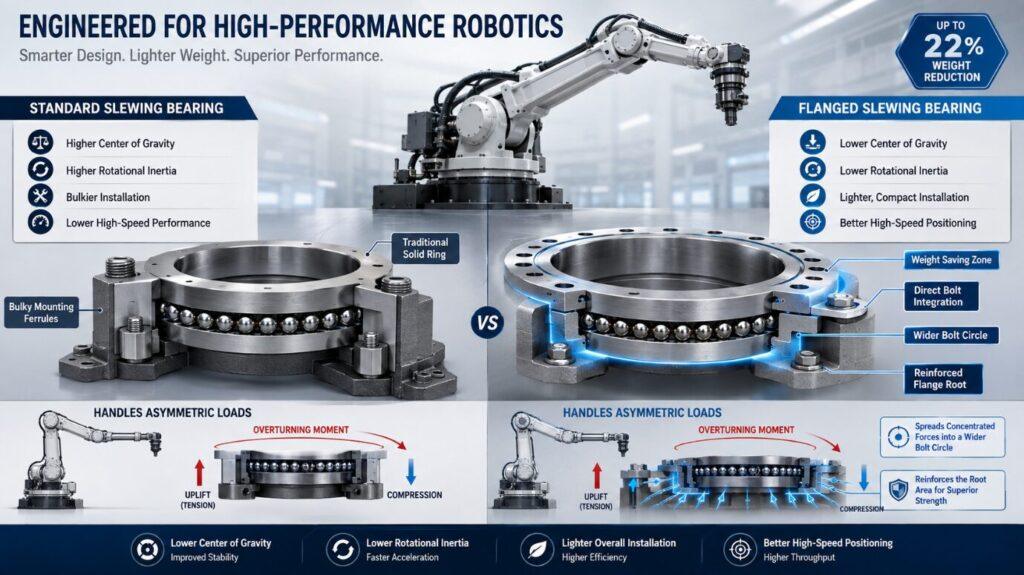
Fix asymmetric loads
The asymmetric design of flange slewing bearing is born to deal with the overturning moment caused by serious eccentric load. Imagine that when the robot’s long arm is fully extended, the bearing at the bottom will be subjected to extreme leverage-one side will pull up desperately, the other side will be pressed down desperately. The flange structure can distribute these concentrated stress points to a wider bolt distribution circle. The thickened flange root can ensure that the metal does not deform under the maximum torque, so that the raceway always maintains a perfect spherical shape.
Slewing Gear Systems: Diagnosis and Maintenance
Understand the wear marks of the gear
The wear marks on the gear occlusal surface are the most intuitive “physical examination report” for your equipment alignment “. If there is a crack in the tooth root of the rotary gear, it means that the torque is seriously overloaded, or it has encountered a severe shock wave caused by emergency braking. If there is pitting on the tooth tip, it is definitely too tight meshing-the small gear is too close to the rotating large gear. According to these wear traces of the pinion center distance adjustment, you can avoid the transmission system completely scrapped.
Microflaking Trap (Veteran’s Waterloo)
After-sales auto repairers often look away and regard the slight peeling (Micro-Spalling) on the raceway as ordinary poor lubrication. In fact, the real culprit can almost be traced back to the uneven force of the bolts when the bearings were installed. If the master does not torque in the order of “star cross”, the elastic flange will slightly deform with the outer ring. Although the deformation is so small that it is invisible to the naked eye, it will make the ball stuck in the edge of the raceway. At this time, even if you put the best imported grease into the nozzle, it is useless, and the system is still finished. Remember a dead principle: before tightening the flange, you must ensure that the flatness of the mounting base is within 0.1mm per meter.
L.I.F.E. Selection Rules
Choose the right rotating parts, and the reliability of the machine will be stable for the next decade. You can apply our original L. I .F.E. rules to accurately target engineering needs and accessories:
- L-Load Rating (rated load): Don’t just count the static axial weight, be sure to count the dynamic overturning moment.
- I-Installation Clearance (Installation Clearance): The maximum vertical height that your equipment enclosure can leave for the slewing assembly.
- F-Flange Type (flange type): according to the structural force point of your machine, select the L type, Z type or double flange.
- E-Environmental Sealing (environmental seal): general dust selection nitrile rubber lip seal on the line; if faced with high temperature or chemical corrosion, must be on the fluorine rubber (Viton).
| L.I.F.E. Factor | L-Type Flange Series | Z-Type Flange Series | Double-Flange Series |
|---|---|---|---|
| L — Load Rating | Best for light-to-medium axial loads with moderate overturning moments | Suitable for medium-to-high combined loads and larger overturning moments | Designed for high axial, radial, and overturning-moment loads |
| I — Installation Clearance | Low profile; ideal where vertical installation space is limited | Moderate profile; balances installation height with structural rigidity | Higher space requirement due to the reinforced dual-flange structure |
| F — Flange Type | Single L-shaped mounting flange | Offset or stepped Z-shaped flange | Flanges on both mounting sides |
| E — Environmental Sealing | NBR lip seal for normal dust and industrial environments; FKM seal for higher temperatures or chemical exposure | NBR as standard; FKM recommended for demanding thermal or chemical conditions | Heavy-duty sealing configuration; NBR for standard service and FKM for harsh environments |
| Mounting Advantage | Simple direct mounting with minimal installation height | Flexible mounting where structural interfaces are offset | High structural rigidity and strong load distribution across mounting surfaces |
| Typical Automation Use Case | Collaborative robots, compact rotary tables, light-duty positioning systems | Industrial robot bases, automated welding positioners, packaging machinery | Heavy-duty robot bases, large manipulators, automated assembly platforms |
| Overturning-Moment Capability | Low to Moderate | Moderate to High | High to Very High |
| Rigidity Requirement | Moderate | High | Very High |
| Recommended Selection Scenario | Choose when compact size and low rotating mass are priorities | Choose when load capacity and installation flexibility must be balanced | Choose when maximum rigidity, stability, and moment capacity are critical |
Field rollover and success stories: high voltage testing in the marine environment
We did a metallurgical pressure test in 2025, which proved that the combination of “high-frequency quenching tooth surface” and “special surface treatment” can directly triple the life of the equipment. At that time, we were on a crane in a coastal port, comparing an ordinary flange slewing bearing with a bearing coated with zinc-nickel alloy. Under the destruction of salt spray in sea water, serious galvanic corrosion and gear gluing occurred after only 1500 hours of rotation of ordinary bearings. However, the guy who had been treated with zinc and nickel survived for 4500 hours, the structure was still intact, and the gear backlash fully met the factory standards. Customizing the surface treatment according to the real working environment can save you a lot of money from unprepared downtime and maintenance.
Frequently Asked Questions (People Also Ask)
What is the biggest difference between flange slewing ring and ordinary slewing ring (slewing bearing)?
Flanged bearings are integrally formed with an extended mounting lip (flange) directly on the forged ring. This makes it lighter overall and can be bolted directly to the machine without the need for a heavy mounting base plate.
How to measure the backlash of the rotary gear?
The master has to fix the dial indicator on the pitch line of a gear, and then shake the pinion meshing with it back and forth by hand. The measured clearance is the side clearance (Backlash), which must be in line with the thermal expansion tolerance given by the manufacturer.
Why does my slewing ring have a metal friction sound of “thorn, thorn, thorn” when it turns?
This friction sound is definitely a direct encounter with the metal. Usually, 3 is one reason: uneven installation surface leads to deformation of raceway, serious overload of equipment, or broken seal of outer ring leads to sundries running in.
Can lightweight flange slewing bearings withstand heavy axial loads?
No problem at all. The current finite element analysis (FEA) technology is extremely optimized for the fillet of the flange root, and even the lightweight design can easily withstand axial loads of more than 50 tons while maintaining a compact vertical size.
In a particularly dusty environment, how often do the rotary gear components need to be lubricated?
In a dusty environment, you must use an automatic progressive lubrication system or manually butter it every day. Fresh grease can wash those tiny silica particles out of the gear mesh, otherwise once the dust enters, it will become a very destructive grinding paste, the gear abruptly grinding waste.