SWBTEC


Slewing Ring Bearing Manufacturers & Turntable Suppliers
Top-tier slewing bearing manufacturers typically keep the entire metallurgical and machining process firmly in their own hands, leaving nothing to chance—from forging the blank ring to performing seamless induction hardening. As for ordinary slewing bearing suppliers, they often outsource the most critical raceway grinding process. For original equipment manufacturers (OEMs) that produce heavy excavators and cranes, avoiding catastrophic equipment failures on job sites requires partnering with suppliers that possess proven CNC gear‑cutting capabilities and non‑destructive testing (NDT) equipment. In fact, many procurement teams unwittingly place orders with shell trading companies that do not even possess heavy-duty machining equipment. To help everyone get a clear picture, our engineering team conducted on-site assessments of more than 50 industrial manufacturing plants, identifying the key mechanical and production‑capacity thresholds that distinguish genuine original‑source manufacturers from mere assembly‑only operations.
Uncover the Veil of “Traders” and “Real Factory”
If you want to identify whether a slewing bearing factory is a real guy, don’t just look at the brochure they print on the tall, you have to check if they have any heavy asset grinding and heat treatment equipment in their factory. Traders disguised as factories usually buy forged rings that have not been quenched and then find small workshops outside to grind the raceway, which is extremely easy to create serious tolerance stacking errors.
Real manufacturing plants will run the kind of giant internal CNC raceway grinders that can process more than 3 meters in diameter. You should know that the raceway grinding process directly determines the axial and radial runout of the final bearing. Once the supplier outsources this step, they completely lose control of the surface finish and geometric accuracy, and the final turntable bearing will often peel off the metal early when it is subjected to heavy turning torque. Therefore, the purchasing managers must be a little tough and ask the other party to provide live video of the CNC grinding station, or simply go directly to the on-site factory inspection.
| Audit Criteria | True Manufacturer | Trading Company / Assembler |
|---|---|---|
| CNC Raceway Grinding | In-house CNC raceway grinding machines capable of processing large slewing rings (3+ meter diameter), ensuring full control of surface finish, roundness, and runout accuracy | Outsourced grinding operations through small workshops, with limited control over machining precision and geometric consistency |
| Manufacturing Control | Complete control of the production chain, including forging, machining, grinding, heat treatment, inspection, and final assembly | Mainly manages orders and suppliers, relying on external factories for critical manufacturing processes |
| Heat Treatment Capability | Internal heat treatment furnaces with controlled quenching and tempering processes to improve raceway hardness and fatigue resistance | No heavy heat-treatment equipment; purchases untreated forged rings and relies on external providers |
| Non-Destructive Testing (NDT) | Integrated NDT systems such as ultrasonic testing, magnetic particle inspection, and hardness verification performed in-house | Relies on third-party inspection reports or paper certifications without direct process control |
| Quality Traceability | Complete production records, material certificates, machining data, and inspection reports linked to each bearing | Limited traceability, often dependent on supplier documentation and external records |
| Accuracy Control | Direct control of axial/radial runout, raceway geometry, and surface roughness during manufacturing | Higher risk of tolerance stacking errors due to multiple outsourced processes |
| Factory Verification | Can provide live video or on-site access to CNC grinding stations, heat treatment areas, and inspection labs | Difficult to demonstrate real production capability beyond office facilities or assembly areas |
| Final Bearing Reliability | Higher resistance to heavy loads, impact torque, and long-term operating fatigue | Increased risk of premature raceway wear, metal peeling, and reduced service life |
“M.T.V.” Hardcore Rules for Supplier Audits
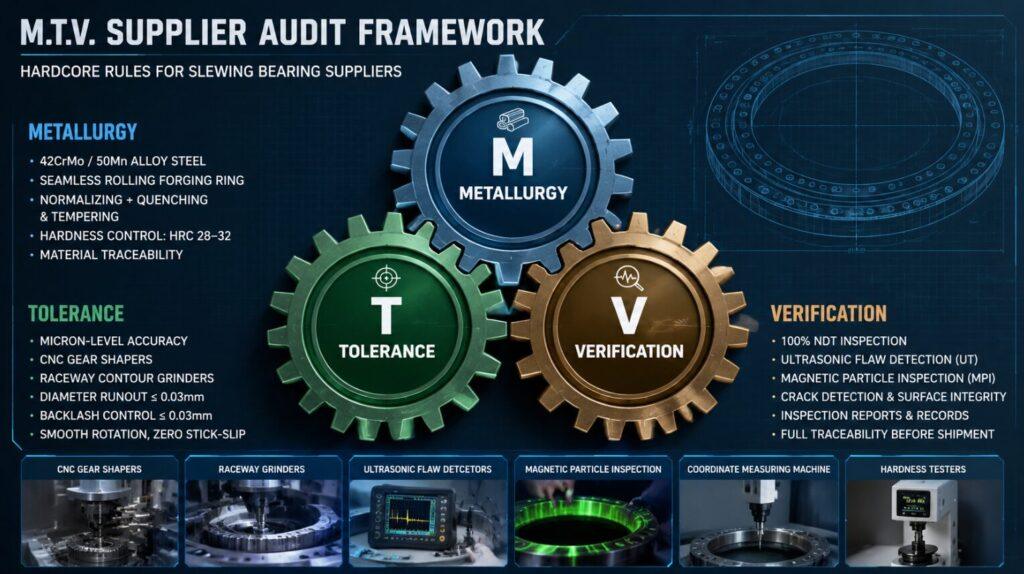
When evaluating potential suppliers of slewing bearings, heavy machinery OEMs usually use a very strict set of “M.T.V. audit rules”:
- Metallurgy (Metallurgy, raw material forging and heat treatment): high bearing capacity must use 42CrMo or 50Mn alloy steel, and is a seamless rolling forging ring.
- Tolerance (Tolerance, machining accuracy): The gear cutting and raceway contour processing must reach micron-level accuracy, so that it can turn smoothly without backlash.
- Verification (Verification, NDT): Before leaving the factory, the factory must do ultrasonic flaw detection (UT) and magnetic particle flaw detection (MPI) to find out all the microcracks invisible to the naked eye.
Engineering Technology Pain Points: How to Eliminate “Soft Belt”
In high-level heavy-duty conditions, the bearing must be seamless induction hardened on the entire raceway so that local structural collapse does not occur. General slewing bearings usually leave a “soft belt” (that is, a blank area that is not quenched and burned), which is the place where the starting point and the ending point of the induction heating coil meet after 360 degrees.
This soft belt is an extremely deadly structural weakness. Think about it, if the excavator master repeatedly pulls the boom torque to the maximum while working, and this soft belt just turns to the main stress route, the raceway will deform on the spot. How do the top manufacturers handle this problem? They will use special seamless induction hardening technology to make the temperature gradient of the heat treatment perfectly overlap. This process completely eliminated the soft belt, to ensure that the hardness of the entire circumference is uniform (usually can reach 55-60 HRC), directly so that the service life of the slewing bearing in the harsh mine environment doubled by 1 times.
How should heavy duty OEMs evaluate slewing bearing suppliers?
When OEMs select suppliers, they have to see if they can customize the internal clearance and tooth profile for specific torque requirements. In the field of construction machinery, general-purpose bearings bought directly from sample catalogues usually break down quickly because they use the same axial clearance.
For example, in order to prevent the big arm from shaking and tilting when digging, the excavator needs a negative clearance (pre-tightening); but the tower crane is different, it needs a specific positive clearance, so that it will not be stuck when dealing with a huge overturning moment. Powerful suppliers have their own in-house engineering teams dedicated to calculating accurate load distribution curves. They will strictly based on the finite element analysis (FEA) data provided by the OEM to modify the geometry of the raceway and select the most suitable cross roller or multi-ball structure.
Expert Pit Avoidance Guide: Beware of “False High Load” Traps
Many inexperienced procurement engineers are prone to fall into a big hole: just staring at the static load table given by the supplier for comparison. The static load (Co) represents only the absolute physical limit of the steel before permanent deformation, but the machine operation is dynamic.
Some dishonest suppliers artificially quench the surface of the raceway extremely hard in order to make the paper data look good, but the internal core material is not tempered. This leads to this kind of bearing looking very tough on the static table, but in the real construction operation, it is 1 hit by the dynamic impact load and is as brittle as glass. A really strong raceway, the appearance must be hard, the interior must be full of toughness of the steel core to absorb the shock. Engineers must ask the supplier for a “hardness gradient curve” to verify that the transition from the hard surface to the high toughness core is smooth and structurally sound.
People Also Ask (FAQ)
How to tell who is a reliable manufacturer of slewing bearings?
Reliable manufacturers must have their own blank ring forging, CNC raceway grinding machine and induction hardening equipment. If you want to identify them, verify their physical machining assets, ask to see the actual material test report (MTR), and be sure to confirm that their factory has non-destructive testing (NDT) capabilities.
What is the difference between slewing ring and slewing bearing?
In the heavy machinery industry, engineers basically use the two words together. They refer to the kind of large diameter bearings designed to withstand axial force, radial force and overturning moment at the same time, usually with mounting holes and cut gears.
Why is the slewing bearing on the excavator easy to break?
The scrapping of turntable bearings is mainly due to poor lubrication, peeling of raceway caused by severe impact load, or local deformation at the “soft belt” position. In addition, if the negative clearance (pre-tightening) is not adjusted in the manufacturing stage, it will also cause the gear to wear extremely fast and even jam early.
What steel do the top slewing bearing suppliers use?
Top suppliers mainly use 42CrMo or 50Mn alloy steel. Especially 42CrMo, which has excellent core toughness and deep hardenability, is a strict standard material for heavy excavators, wind turbines and offshore cranes.
How is the bearing capacity of the slewing bearing measured?
Manufacturers will use special static and dynamic hydraulic test benches for testing. They simultaneously apply simulated axial, radial, and rollover moment loads and measure the deformation, torque resistance, and rotational friction of the raceways in real time with built-in sensors.