SWBTEC


What Is A Ring Bearing? Slew Bearing Types Explained
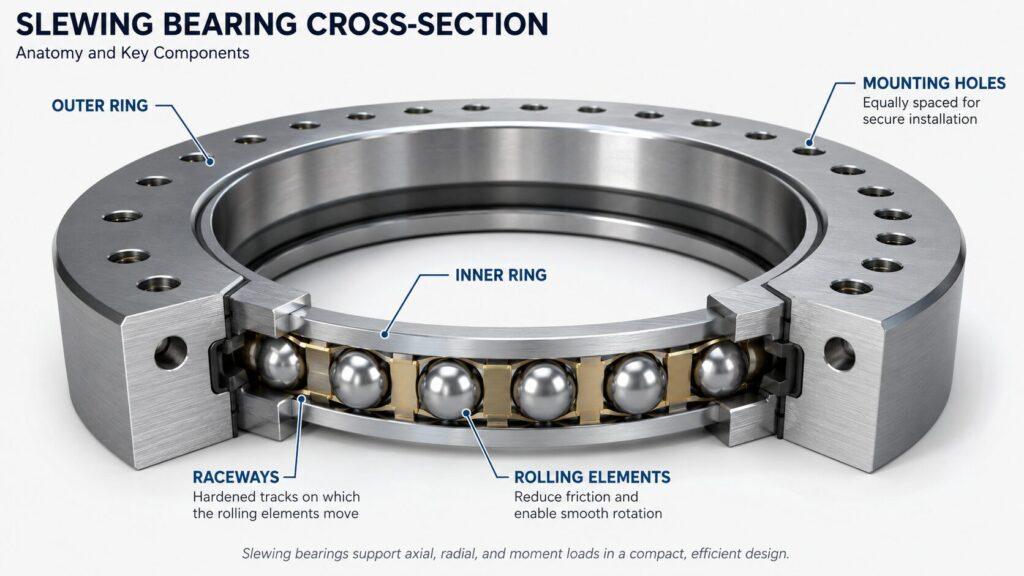
In the industrial field, we are more accustomed to the “ring bearing” known as the slewing bearing. As the 1 large rotary joint, its core task is to deal with axial force, radial force and overturning moment at the same time. If you look at the heavy equipment, you will know that the slewing ring is their “skeletal hub”, which connects the fixed base and the rotating part steadily.
Many mechanical students and junior designers often have a misunderstanding that selection is to take the weight of the equipment to the rated load on the hard set manufacturer’s sample. As everyone knows, it is this taken for granted that more than 60% of the rotating system is scrapped in advance. To put it bluntly, whether the slewing bearing is reliable depends to a large extent on the rigidity of the installation structure, the meshing state of the gears, and the extremely strict installation tolerance.
Today, we will come to the technical principle and core classification of 1 slewing bearings, and give you a set of guidelines for project selection and pit avoidance.
Slewing Bearing Selection Guide: The L.E.A.D. Rule
Choosing the right swivel requires a systematic methodology. Field engineers often use the L.E.A.D. rule as a way to eliminate blind guesswork while avoiding the waste of overdesign.
L-Load curve (Load Profile)
Don’t just look at static loads, dynamic loads have to be counted together. It is almost impossible for the slewing bearing to bear only the axial weight. Imagine the scene when a crane lifts a heavy object, which creates a huge overturning moment. You have to combine the thrust, radial load and overturning moment together for accurate calculations.
E-Working Environment (Environment)
Where the equipment landed, environmental problems must be confirmed at the first time. The bearings of offshore wind turbines blow corrosive salt spray every day, so they must be coated with thermal spray zinc coating and heavy nitrile rubber sealing rings. However, mining excavators eat soil every day and have to be equipped with special labyrinth seals as standard.
A- Connection structure (Attachment Structure)
Remember one thing: how hard the bearing is depends entirely on the base of what structure it is screwed on. If a highly rigid slewing bearing is bolted to a thin and soft steel plate, it will definitely deform after being stressed, which is called “potato chip effect” in the industry “. The support structure must have sufficient thickness and flatness, otherwise the raceway will definitely twist.
D-Drive mode (Drive Mechanism)
What does the equipment rely on to turn it? There are usually three drive configurations for slewing bearings: internal gears, external gears, or simply no gears.
Detailed Classification Of Slewing Bearing Core
Engineers are mainly based on the internal rolling body to distinguish the slewing bearing. Each structure has specific housekeeping skills in terms of speed, rigidity and friction.
Single row four-point contact ball slewing bearing
This is the most cost-effective solution in conventional rotating equipment. Its raceway section is specially designed, and the steel ball can contact the inner and outer rings at four points. This geometry can cope with moderate axial, radial and moment combined loads. Its advantage is good toughness, and compared with roller bearings, the installation surface of a little bit less sensitive to small flaws.
double volleyball slewing bearing
The double-row design is to stack two sets of ball bearings together to resist large loads. The upper row is mainly responsible for bearing the axial thrust brought by the dead weight of the equipment, while the lower row firmly bites the overturning moment. Industrial designers are particularly fond of it when doing heavy construction machinery. After all, such equipment requires continuous rotation, and the center of gravity often shifts suddenly.
| Tipo de rodamiento | Load Capacity (Axial/Radial/Moment) | Tolerance to Uneven Mounting | Typical Applications |
| Single-Row Ball | Moderate combinations of axial, radial, and moment loads | Good (more forgiving of minor mounting surface irregularities) | Standard rotary applications |
| Double-Row Ball | Massive loads (top row for primary axial thrust; bottom row for overturning moments) | Moderate | Heavy-duty construction equipment |
| Crossed Roller | High rigidity and load capacity across all three load directions | Low (less forgiving than ball designs; requires highly flat mounting) | Precision robotics, machine tools, medical equipment |
| Three-Row Roller | Maximum capacity (handles extreme loads independently via separate roller rows) | Very Low (strict requirement for exceptionally rigid and flat mounting) | Offshore cranes, bucket wheel excavators, tunnel boring machines |
Rodamiento giratorio de rodillos cruzados
If you pick the one with the highest precision in a single-row design, that’s it. Cylindrical rollers are arranged alternately at 90 degrees in a raceway. This structure directly eliminates the small deformation caused by the point contact of the ball bearing, and the rigidity is extremely overbearing. If you are making precision equipment such as radar antennas, industrial robots or medical image scanners, you have no choice but to use it.
Rodamiento giratorio de rodillos de tres hileras
If we say the “ceiling” of heavy load capacity, it is definitely three rows of rollers. It uses 3 sets of completely independent cylindrical rollers: the upper row carries the weight, the lower row resists the moment, and the radial rollers on the side specially deal with the lateral force. Because the force direction is completely diverted, the internal friction is greatly reduced. Shield machines, ship unloaders and offshore drilling platforms are basically behemoths of this level.
Slewing Bearing In The End Is How Bad?
The parameters on the manufacturer’s samples are based on the ideal assumption that the installation surface is perfectly flat and the rigidity is absolutely up to standard. However, it is almost impossible to achieve this perfect state of sheet metal weldments in practice.
If a precision-machined slewing bearing is screwed hard on a bumpy chassis, the bearing ring will be forced to bend to fit the deformed structure. In a 1.2-meter external gear slewing bearing failure case that we recently disassembled and analyzed, this point is just confirmed: the error of the mounting surface only exceeds the allowable tolerance by 0.15mm, and this micro-level warping causes the rolling body to be stuck in some specific quadrants of the raceway. The instantaneous soaring friction directly triggered microscopic spalling inside the steel, abruptly cutting the theoretical life of the bearing by 42%.
How to break it? The technical director must impose a rule that after the structural installation pad is welded, it must be finished by welding on the machine tool. Also, don’t use spacers to fill the huge gaps under the bearings! The gasket will create local stress concentration points, which is simply the “killer” of the raceway “.
Intelligent Slewing Bearing And Predictive Maintenance
In the past, when checking the wear of the slewing bearing, we used a dial indicator to measure the tilt clearance while shutting down for maintenance. Now, engineering teams are largely eliminating this time-consuming manual work.
Current industrial designs have long integrated condition monitoring directly into bearings. Manufacturers will embed miniature strain gauges and vibration sensors behind the raceway walls. These “smart bearings” can transmit real-time telemetry data such as torque mutations, temperature fluctuations and acoustic emissions 1 the femoral brain to the edge computing controller. Now R & D engineers no longer have to rely on calendars to change bearings by feeling. They use digital twin models and look at actual fatigue data to accurately calculate when the equipment will fail.
Frequently Asked Questions (FAQs)
Slewing bearing can withstand multiple loads?
It all depends on its diameter and internal structure. As small as 100mm automatic mechanical arm bearings, bearing hundreds of kilograms; As large as the 10-meter three-row roller bearing used in offshore cranes, it is not a problem to carry tens of thousands of tons.
What is the difference between Slew Drive and Slewing Bearing?
Slewing bearing is a simple mechanical joint, responsible for turning the equipment. The rotary drive is a highly integrated fully enclosed gear box system. It is not only equipped with a rotary bearing, but also equipped with a worm gear or pinion. The outside is covered with a protective shell, which can be directly installed and used when purchased.
Can ring bearings be repaired or refurbished?
Of course. Large slewing ring renovation cost-effective. Professional repair shops will re-polish and expand the worn raceway, and then replace it with rolling elements with larger sizes. After a set of processes, the tolerance standard of the original factory can be restored.
What is the rattling or squeaking sound when spinning?
Once this sound appears, it means that the interior has been seriously damaged. Usually it is because the lubrication is not in place that the metal is directly dry friction, or the sealing ring is damaged into the foreign body. The more serious situation is that the structure is overloaded too hard, causing the metal on the raceway to have shattered and peeled off.
How to measure the degree of wear of a slewing bearing?
Engineers generally evaluate by means of a “tilt clearance test. Fix the dial indicator on a stationary base, apply a known overturning load to the rotating part, record the overall vertical displacement, and then compare this data with the maximum allowable wear limit given by the manufacturer.
How often should the slewing bearing be lubricated?
This depends on the speed and working environment. Those heavy and slow equipment, raceways and gears usually need to be buttered every day; and for those rotary joints that are lightly loaded and fully enclosed, they may only need maintenance once every several months. Remember a little trick: when making butter, be sure to make the bearing turn while making it, so that the grease can be evenly distributed.