SWBTEC


Durable Excavator Slew Ring: Heavy-Duty OEM Supplier
The slewing bearing of the excavator (often called the big turntable in the industry) is a real “big guy”. As the core heavy-duty bearing connecting the lower frame and the upper cab, it must resist the huge axial load, radial force and overturning moment at the same time when the machine is excavated. If the excavator fleet under your hand works in the quarry all the year round, or the hydraulic breaker is hung every day to “gnaw hard bones”, then you must bypass those ordinary auto parts dealers and go directly to the heavy OEM source manufacturers with real metallurgical strength when purchasing.
Why? Because ordinary aftermarket replacement parts, under the brutal shock waves of a hydraulic breaker, will inevitably fail completely after just 2,000 hours of operation. They often cut corners and eliminate the two most critical processes: deep induction hardening and negative clearance design. Today, I have broken down the underlying engineering logic behind this extreme durability and made it clear to everyone. Incidentally, I have exposed several installation traps that will cause the new gear to “break teeth” directly if I am not careful. Finally, I will attach the real hard core impact test data to help you firmly lock the real heavy-duty hard goods in the next purchase.
C.R.A.S.H. Matrix: The “Touchstone” for Heavy-Duty OEM Manufacturers
As a purchasing director, don’t just stare at those ISO certificates when you go to the factory. You have to look at their actual metallurgical data. I usually audit OEM suppliers and use a set of “C.R.A.S.H. matrices”-that is, clearance (Clearance), raceway (Raceway), alloy (Alloy), seal (Sealing) and hardness (Hardness). With this set of standards, small workshops that are simply unable to produce mine-grade accessories can be eliminated in a second.
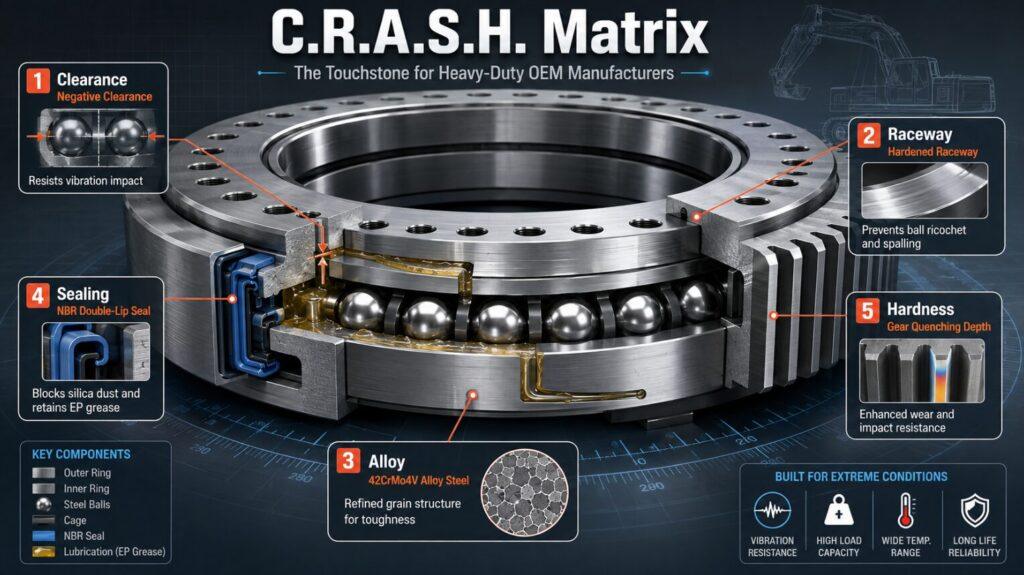
Clearance: Strictly adhere to the “negative clearance” standard.
As long as your excavator is equipped with a hydraulic breaker, the slewing bearing must be designed with a strict negative clearance. Standard excavators use positive clearance (a slight gap between the steel balls and the raceways) to ensure smooth rotation when digging soil or trenches. However, if you install a bearing with this type of positive clearance on a mining machine, the crushing‑hammer‑like vibrations will cause the balls to ricochet wildly within the raceways, quickly generating microcracks and structural spalling.
Raceway & Alloy: Decisive upgrade to 42CrMo4V
For heavy-duty excavators, there’s no alternative: you must use 42CrMo4V alloy steel—never even consider the cheap 50Mn steel. The addition of vanadium (V) significantly refines the steel’s internal grain structure during forging, dramatically enhancing the turntable’s impact toughness. This specialized alloy can withstand the sustained, violent vibrations exerted by a 50‑ton behemoth, thereby preventing premature metal fatigue.
Sealing & Hardness: Resistant to high-abrasion silicon dust and hard impacts
There’s an old saying in the industry: “If the seal leaks, the rotary table will inevitably get stuck, and it won’t last more than a few weeks.” In the mining environment, highly abrasive silica dust and rock debris are constantly eroding bearing clearances. Top-tier OEM manufacturers will equip you with double-lip nitrile rubber (NBR) seals reinforced with a steel skeleton, which not only effectively keep external contaminants at bay but also securely retain the highly viscous extreme‑pressure (EP) grease within the raceway.
Hardcore Test Data: Survival Rate Under Hydraulic Breaker Operating Conditions
Words are not enough; the data speak for themselves. We selected two slewing bearings manufactured using different processes and, under an overturning moment of 400 kN, conducted an endurance test simulating 3,000 hours of hydraulic rock-breaking conditions, specifically to assess raceway wear. The only difference between these two discs lies in the steel alloy grade and the internal clearance tolerances.
| Bearing Specification | Alloy & Clearance | Wear Depth at 1,500 Hours | Final 3,000-Hour Result |
|---|---|---|---|
| Standard Aftermarket Ring | 50Mn (Positive Clearance) | 1.8 mm Wear | Catastrophic Failure (Steel Balls Shattered) |
| Heavy-Duty OEM Ring | 42CrMo4V (Negative Clearance) | 0.2 mm Wear | Perfect Condition (Normal Wear) |
The data speaks for itself: Fitting an excavator equipped with a hydraulic breaker with a standard aftermarket slewing bearing is a waste of money—it will absolutely not last past the 2,000-hour mark. By going directly to the OEM for a custom-made slewing bearing with negative clearance and high-end alloy materials, the service life of this slewing bearing can even outlast the engine’s overhaul cycle.
Guide to Avoiding Pitfalls: The Two Deadly Traps That Can Destroy Slewing Bearings
1. The “Soft Band” Installation Trap
If a mechanic installs the unhardened “soft band” on the turntable in the main load-bearing area, I can guarantee that the gears will shatter on the very first day of operation. All induction-hardened slewing bearings have a mandatory “soft band” (usually marked with an “S” stamp or a paint dot)—this is where the hardening coil begins and ends, leaving a gap that hasn’t been hardened. You must keep a close eye on the mechanic to ensure this soft zone is precisely aligned perpendicular to the excavator’s boom (i.e., the area subject to the least overturning force).
2. The “Polished Old Core” Refurbishment Scam
Some unscrupulous dealers specifically go to scrap yards to buy scrapped slewing rings at scrap metal prices. They repolish the pitted raceways, stuff in larger-sized steel balls to fill the gaps caused by wear, and then sell them as brand-new OEM parts. The most critical issue with these “polished parts” is that they grind away the most crucial quenched hardened layer. How can you expose them? Directly request an ultrasonic testing (UT) report and ask the supplier to provide actual footage of the steel ingots entering their own forging presses.
Choose Genuine Heavy-Duty OEM Source Factories
Working directly with heavy-duty OEM factories allows your supply chain to completely avoid the markups and counterfeit risks associated with middlemen. Genuine source manufacturers can control every variable in-house—from ultrasonic testing of the raw steel ingots to the final step of CNC gear hobbing. This direct partnership not only allows procurement directors to customize gear backlash according to specific needs—such as requesting a special anti-corrosion zinc coating for Hainan Aviation’s dredging excavators—but also secures factory-direct wholesale prices that trading companies simply cannot match.
People Also Ask (FAQ)
How long does an excavator slewing bearing typically last?
As long as it’s a high-quality part, it can easily last 8,000 to 10,000 hours under normal excavation conditions. However, under heavy-duty conditions—such as daily use of a hydraulic hammer or an electromagnetic disc to pick up scrap metal—the service life will be cut in half to 5,000 hours—unless you specifically order a negative-clearance bearing from the OEM.
What are the common causes of premature failure in slewing bearings?
Contamination and lack of lubrication are the number one culprits. Once the rubber dust seal on the outer ring breaks, sand and dirt seep in and mix with the grease inside, turning into an extremely destructive “abrasive paste” that can completely destroy the steel balls and raceways in just a few weeks.
How do you measure the wear on an excavator’s swivel bearing?
Use a magnetic dial indicator to attach it between the undercarriage and the upper rotating structure. Then lower the excavator’s boom toward the ground to lift the front of the machine off the ground. If you find that the vertical axial play exceeds 2.5 mm to 3.0 mm (depending on the machine model), don’t hesitate—replace the swivel bearing immediately.
Can a damaged swivel bearing be welded or repaired?
Absolutely not! Once the structural integrity of a heavy-duty construction machinery swivel bearing is compromised, it must not be repaired haphazardly. If the raceway is fractured or the internal teeth are broken, forcing a weld or machining will completely destroy its structural integrity. This poses a fatal safety hazard to the operator.
What is the best grease to use for a slewing bearing?
You must—and can only—use an extreme-pressure (EP) lithium-based grease containing “molybdenum disulfide (Moly)” additives. This heavy-duty grease adheres firmly to the steel balls and gears, preventing deadly “metal-on-metal” contact even during moments of extreme localized stress caused by overturning moments.
Why does my excavator make a clicking noise whenever it rotates?
If you hear a crisp metallic snapping sound or a screeching friction noise during rotation, it’s highly likely that the steel balls inside have shattered, or that a broken gear is jammed in the slewing motor’s pinion gear. Take my advice: shut down the machine immediately! If you keep forcing it to rotate, you’ll end up destroying the incredibly expensive slewing motor gearbox mounted on the turntable as well.