SWBTEC


Top Double Row Ball Slewing Bearing Factory Direct
What is the “direct mining” of the double volleyball slewing bearing? Simply put, it is to bypass the middleman and go directly to the original equipment manufacturer (OEM) to buy this heavy-duty rotary joint (containing two concentric steel balls) designed to withstand huge axial loads and overturning moments. As long as you avoid trading companies and regional agents, the cost on your purchase bill can be cut by 20% to 30% immediately. Not only that, docking directly with the production workshop means that you have absolute control over key engineering parameters-such as the quenching process of the internal gear, the depth of the hardened layer of the raceway, and the specific steel used in forging (e. g. 50Mn or 42CrMo). Today, I will teach you how to audit a real manufacturing factory, unpick the tricks played by middlemen on materials, and show our internal mechanical measured data to ensure the safe operation of your heavy equipment without losing the chain.
T.A.P. Direct Mining Rule: How to Check the Real Factory
When inspecting a double-row slewing bearing factory, don’t be fooled by their decorated English website. You have to keep an eye on their most primitive production workshop. In order to help global purchasing directors distinguish between real big factories and fake ones, I have summarized a set of “T.A.P. rules”-namely traceability (Traceability), accuracy (Accuracy) and price gree (Pricing).
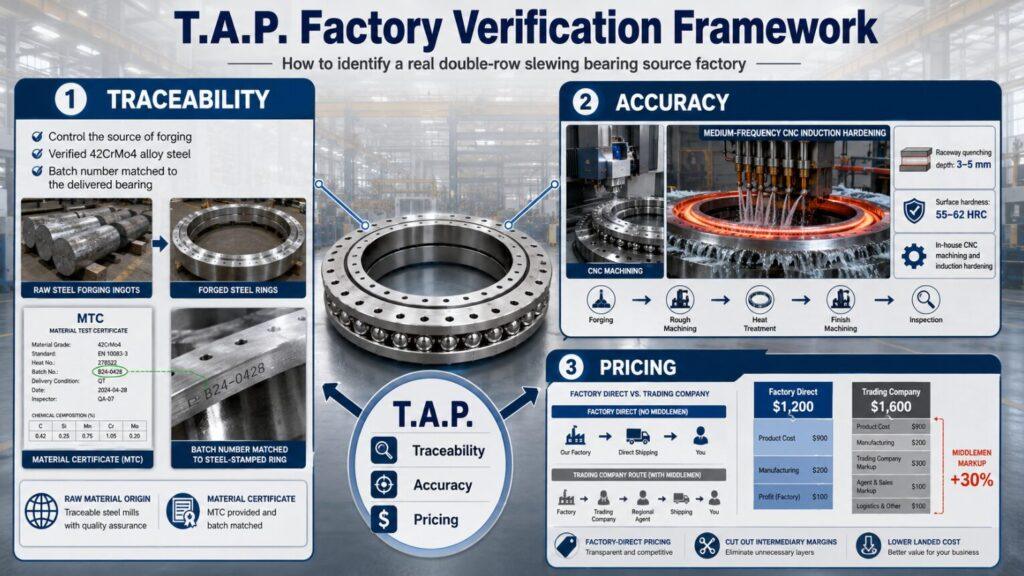
Traceability (Traceability): Control the source of forging
A genuine source factory has pinched the raw materials in its own hands from the moment the ingot is pushed into the forging workshop. And what about those trading companies? They would only go to the cheap secondary market to pour out roughed steel rings, and they were not sure about the specific chemical composition of this batch of goods. The real direct supply manufacturer can give you an authoritative material certificate (MTC). The batch number above fits tightly with the steel seal on the double-row support you received, which ensures that you get pure 42CrMo4 high-carbon alloy steel instead of scrap iron to fill up the number of defective products.
Accuracy (Accuracy): their own CNC induction hardening
How long the double volleyball slewing bearing can live depends on the accuracy of raceway quenching. Heavy equipment such as tower cranes and bucket wheel excavators have extremely abnormal overturning moments when working. If the raceway is soft, it will be directly crushed and discarded. The source of large factories have their own medium frequency CNC induction quenching machine tools, can steadily control the hardening layer depth between 3 to 5mm, surface hardness of 55-62 HRC, fully understand your engineering drawings.
Price Competitiveness (Pricing): Cut out 30% of the middlemen’s “intelligence tax.”
By sourcing directly from the origin, the most immediate benefit is squeezing out all intermediary margins, resulting in a dramatic drop in landed costs. To give a very practical example, a trading company buys a 1,500-mm double-row slewing ring bearing for $1,200 and then dares to sell it to you for $1,600, without adding even the slightest technical value in between. We work directly with major OEM manufacturers, so you get the bare‑machine factory price, and for large volumes, you can even negotiate bulk discounts with the factory director.
A Pro’s Guide to Avoiding Pitfalls: Exposing B2B Slewing Bearing Scams
The “death by exposure” of factory inspections via video
Nowadays, many trading companies are investing heavily in showroom designs that look even more like real factories than the real thing. Want to expose them? One move is all it takes: just make a surprise video call on WeChat or WhatsApp. Have your sales representative take a smartphone out of the office and head to the shop floor to show you the CNC gear‑hobbing machine cutting that double‑row support gear of yours. Those middlemen will instantly come up with excuses like “safety regulations in the workshop don’t allow photography” or “the factory’s internet is too slow”—and for a simple reason: they don’t even have a workshop to begin with.
The fatal flaw of insufficient hardening depth in the raceway
To cut costs, some low‑cost suppliers will relentlessly increase the induction‑hardening speed, resulting in a severely shallow hardened layer. A raceway just 1.5mm deep might barely pass a basic surface‑hardness test (HRC), but under high‑intensity radial loads, subsurface fatigue and spalling are virtually guaranteed within six months. Therefore, before approving shipment, you must require the factory to provide the ultrasonic testing (UT) report and macro‑etching cross‑section photographs to verify the actual case-hardening depth.
Measured data speak: quenching depth VS life
We took two identical 42CrMo double volleyball slewing bearings and did a 1 field acceleration continuous rotation test under the overturning moment of 500kN. The only variable in the field is the depth of the raceway induction hardening.
| Quenching Depth (mm) | Surface Hardness (HRC) | Consecutive Rotations Before Failure | Failure Mode |
|---|---|---|---|
| 1.5 mm — Inferior Supplier Standard | 58 HRC | 120,000 rotations | Subsurface spalling and crushed steel balls |
| 4.5 mm — Major Manufacturer Standard | 58 HRC | 650,000 rotations | Normal wear with no structural failure |
The data is very straightforward: no matter how high the surface hardness is, if the depth is not enough, it is also nonsense. The real source factory will specifically design the quenching depth according to the actual load of your equipment, cutting off the catastrophic mechanical failure of the most popular market currency from the root.
People Also Ask (FAQ)
Why must a double-row ball slewing bearing be used? Wouldn’t a single-row one do?
A double-row ball slewing bearing contains two independent rows of steel balls. Compared with a single-row design, it can withstand significantly higher axial loads and extremely severe overturning moments. For heavy-duty equipment with extremely high safety and stability requirements—such as port cranes, mining excavators, and wind turbine pitch systems—engineers specify the use of double-row bearings.
How can I verify whether a double-row slewing bearing factory is legitimate?
Verify their credentials by checking these points: request their ISO 9001 certification, ask for a live video stream of their forging and CNC machining workshops, and then review their official export records. In reputable factories, seasoned mechanical engineers are always on hand; when it comes to technical issues like axial clearance and gear backlash, they can provide instant, precise answers without the slightest ambiguity.
What type of steel is most suitable for manufacturing slewing bearings?
The industry’s premium standard is: 50Mn (high-carbon steel) for routine loads, with 42CrMo (chromium-molybdenum alloy steel) mandatory for heavy-duty applications. 42CrMo boasts outstanding hardenability and impact toughness; if your double-row support is subjected to extreme impact loads, it’s a sure‑fire choice.
Can the original‑source factory customize gears according to specifications?
Of course. A true manufacturing facility is equipped with CNC gear‑hobbing and gear‑shaping machines, capable of producing raceways—whether internal, external, or toothless—in full compliance with your CAD drawings. They can even perform localized hardening on the gear teeth, further elevating the wear resistance of the pinion’s meshing zone to a higher level.
If I order directly from the factory, how long will the lead time be?
The standard production lead time for custom double-row ball slewing bearings typically ranges from 35 to 50 days, depending on the forging schedule and the bearing’s diameter. Because the original‑source manufacturers have absolute control over their production lines, if you urgently need replacement parts delivered right away, they can immediately prioritize your order for expedited production—something that trading companies, no matter how hard they try, simply cannot guarantee.