SWBTEC


Customized Digger Slew Ring: Cut Maintenance Costs
A highly effective slewing bearing crane safety checklist dictates strict thresholds for axial clearance limits, bolt tensioning data, and grease particulate analysis. Relying on generic maintenance schedules often leads to undetected raceway micro-fractures and catastrophic equipment failure.
Most operator manuals instruct crews to “grease the bearing and check for noises.” This vague directive causes 60% of slew bearing crane failures on active job sites. Site managers need specific, quantifiable metrics to evaluate the structural integrity of a slew ring crane before a load is lifted. This guide provides the exact engineering tolerances, testing protocols, and daily visual audits required to keep your heavy lifting operations compliant and safe.
The 4-C Slew Ring Reliability Matrix
Industry leaders replace outdated maintenance sheets with the 4-C Matrix. This framework isolates the precise failure points of a slew bearing crane, removing the guesswork from site compliance audits.
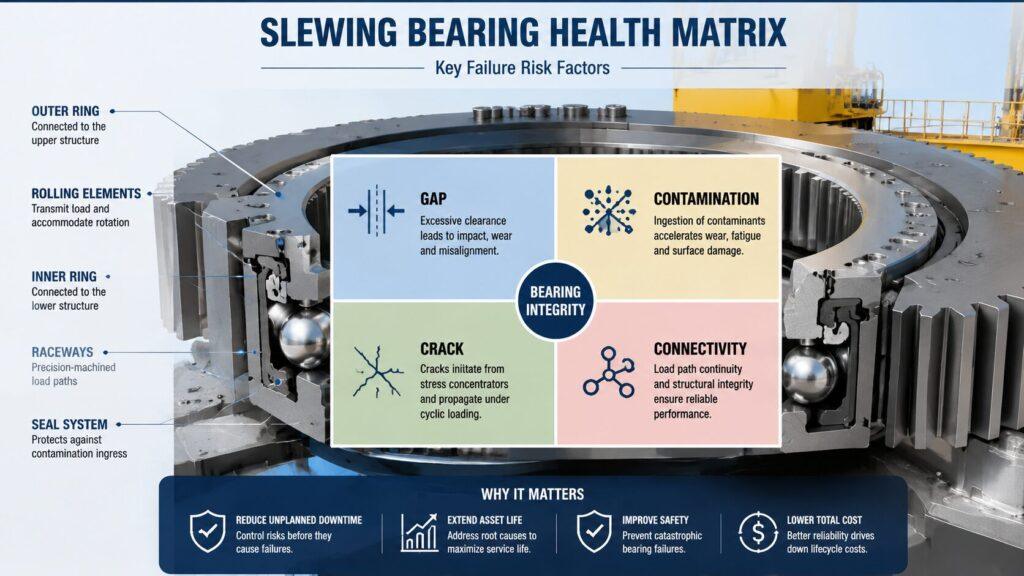
1. Clearance: Mastering Tilt And Axial Measurement
Measuring tilt clearance defines the remaining lifespan of your slew bearing crane. A dial indicator mounted between the upper and lower structures tracks exact deflection under load. When the axial clearance exceeds 1.5mm to 2.0mm (depending on the specific OEM diameter), the bearing requires immediate replacement.
Project managers frequently misinterpret clearance data by conducting tests on uneven ground. A rigid, leveled testing environment guarantees accurate dial indicator readings.
2. Contamination: The Over-Greasing Trap
Excessive lubrication destroys the protective seals of a slew ring crane. Pumping too much grease forces the elastomeric seals out of their grooves, creating an open gateway for abrasive silica dust and moisture.
Safety compliance officers must implement a structured grease sampling protocol. Sending used grease to a lab for ferrography analysis reveals microscopic metal flakes. High concentrations of spherical iron particles indicate severe raceway fatigue long before the operator hears any grinding noises.
3. Cracks: Advanced Non-Destructive Testing (NDT)
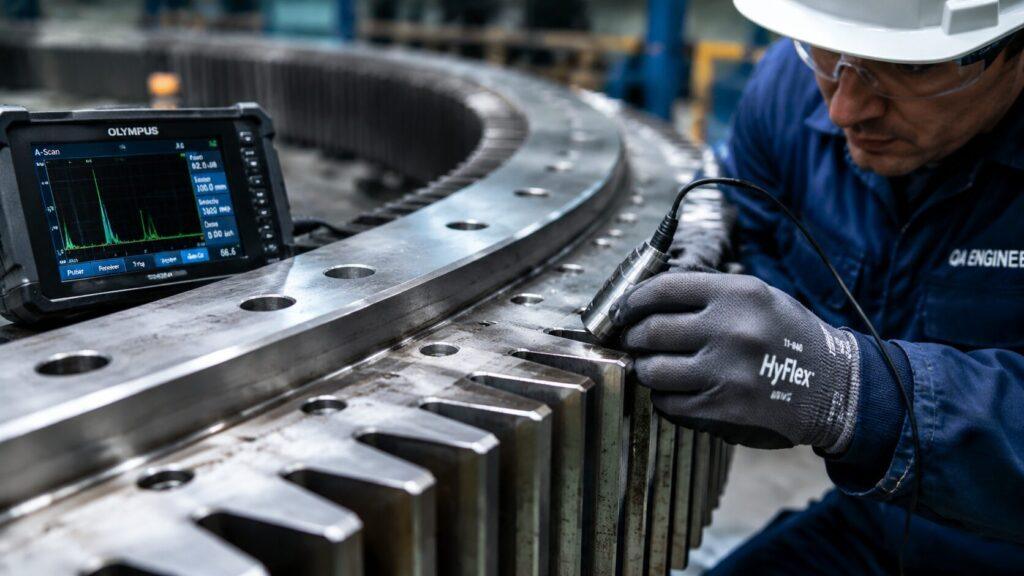
Visual inspections miss internal stress fractures propagating inside the slew pinion gear and raceway. Ultrasonic Testing (UT) combined with Magnetic Particle Inspection (MPI) detects subsurface anomalies at the molecular level.
Standard walkarounds only spot rust. UT scans identify the specific depth of a micro-crack near the gear root, allowing engineering teams to calculate exact risk ratios before a critical lift.
4. Connectivity: Bolt Tensioning And Micro-Movements
A slew bearing crane relies entirely on the preload of its mounting bolts. Loss of preload causes micro-movements between the bearing and the mounting structure, leading directly to bolt fatigue and eventual shearing.
Using a calibrated hydraulic torque wrench guarantees exact fastening force. Mechanics must measure bolt elongation rather than just relying on torque values, as friction threads heavily distort standard torque readings.
The Ultimate Slew Bearing Crane Safety Checklist
Site supervisors demand actionable workflows. Implementing this tiered checklist protects equipment assets and ensures strict adherence to OSHA and ISO 4309 safety directives.
The Ultimate Slew Bearing Crane Safety Checklist
| Inspection Frequency | Component | Acceptable Tolerance | Action Required |
| Daily | Bearing Interface & Mounting Structure | Zero micro-movements or gaps between the slew bearing and mounting structure. | Conduct visual and operational checks for any shifting or early signs of preload loss. |
| Monthly | Mounting Bolts | Bolt elongation must strictly match specifications (standard torque readings are unacceptable due to thread friction distortion). | Measure actual bolt elongation rather than relying on standard torque values to verify accurate preload. |
| Annual | Complete Fastening System | 100% adherence to exact fastening force requirements, OSHA, and ISO 4309 safety directives; zero bolt fatigue or shearing. | Use a calibrated hydraulic torque wrench to guarantee exact fastening force. Replace any bolts exhibiting fatigue to prevent eventual shearing. |
The Ultimate Slew Bearing Crane Safety Checklist
Daily Operator Walkaround (Visual & Auditory)
The operator serves as the primary defense against slew bearing crane failure. This quick audit occurs before the engine starts.
- Seal Integrity: Run a clean cloth along the visible seal of the slew ring crane. Fresh grease leaking aggressively indicates a ruptured seal.
- Comprobación auditiva: Rotate the upper structure 360 degrees without a load. Popping or grinding sounds dictate an immediate halt to operations; these noises signal broken rolling elements jamming the raceway.
- Load Moment Indicator (LMI) Verification: Test the LMI display. A functioning LMI prevents the operator from exceeding the maximum structural moment the slew bearing can handle.
Monthly Compliance Inspections (Lubrication & Gear Mesh)
Maintenance crews execute this phase to stabilize the mechanical environment of the crane.
- Pinion Gear Mesh: Inspect the backlash between the slew pinion gear and the main ring gear. Excessive backlash points to abnormal tooth wear.
- Grease Purging: Pump new grease into the fittings while rotating the crane slowly. Stop immediately when old grease begins to extrude from the seal lips.
- Structural Base Check: Examine the weldments connecting the slew ring base to the crane chassis. Paint flaking around welds highlights underlying metal flexing.
Annual Structural Audits (Bolt Deflection & NDT)
This heavy-duty audit requires certified third-party engineers or senior maintenance directors.
- 100% Bolt Replacement Cycle Check: Verify the age of the mounting bolts. Heavy equipment operation standards dictate replacing all slew bearing bolts after 7 to 10 years of service, regardless of their visual condition.
- Rocking Test (Tilt Clearance): Execute a maximum-capacity test lift while monitoring the exact separation distance at the slew bearing interface. Log this data against the baseline measurements from the crane’s commissioning date.
- Ultrasonic Raceway Scan: Hire an NDT specialist to map the internal hardness of the raceway and pinpoint any deep-level fatigue cracking.
Expert Case Study: Catastrophic Slew Ring Failure Prevented
Data sourced from a 2024 North Sea Offshore Crane Audit.
A 250-ton offshore slew bearing crane experienced frequent limit switch errors. Standard maintenance crews recommended replacing the electronic sensors. A senior safety compliance officer intervened and mandated a grease ferrography test based on the 4-C Matrix.
The lab results showed an extreme spike in chromium and high-carbon steel particulates. This specific metallurgical signature confirmed the internal ball bearings were disintegrating. The crane was immediately taken out of service. A subsequent teardown revealed severe galling on the inner raceway. If the crane had executed its scheduled 150-ton lift the next day, the slew ring would have decoupled, resulting in a total structural collapse. Tracking particulate data saved millions in asset loss and protected the lives of the deck crew.
Frequently Asked Questions (People Also Ask)
How Do You Test A Slewing Bearing On A Crane?
You test a slewing bearing by conducting a tilt clearance measurement using a dial indicator during a test lift. Engineers also perform grease particulate analysis and ultrasonic testing to identify internal raceway wear and gear root cracks.
What Is The Maximum Allowable Wear On A Slew Bearing Crane?
The maximum allowable axial wear usually ranges from 1.5mm to 2.5mm, depending strictly on the diameter of the bearing and the manufacturer’s engineering limits. Surpassing this threshold requires immediate bearing replacement.
How Often Should A Slew Ring Crane Be Greased?
Operators must lubricate the slewing ring gear every 50 operating hours, and the internal raceway every 100 hours. High-dust or marine environments demand shortening this interval to every 20 to 30 hours to prevent contamination.
Why Do Slew Bearing Crane Bolts Fail?
Bolt failure originates from a loss of preload tension. When bolts loosen slightly, the resulting micro-movements stretch the metal beyond its yield strength, causing rapid fatigue and eventual shearing under heavy loads.
Can You Repair A Damaged Slew Bearing Crane Raceway?
Minor surface wear can sometimes be refurbished by specialized machining facilities, but deep raceway cracks or severe galling require a complete replacement of the slewing ring to meet heavy lifting safety compliance.
What Causes A Slew Bearing Crane To Make Grinding Noises?
Grinding noises indicate metal-to-metal contact. This occurs when the grease film breaks down, foreign debris enters through a blown seal, or internal rolling elements shatter and jam inside the raceway.