SWBTEC


Rodamiento giratorio de engranajes externos a medida: especificaciones y costes
The final cost of customized external gear slewing bearing often depends to a large extent on its outer diameter size, special customized tooth profile and specific induction hardening requirements. In order for the equipment to successfully cope with high torque conditions, you need extremely precise technical specifications. Similarly, in order to gain a foothold in the internal procurement budget approval, 1 a clear and thorough cost breakdown is also indispensable.
Next, we’ll provide you with an in-depth analysis of the most core engineering parameters, OEM (OEM) unknown pricing logic, and common design pitfalls that can easily lead to premature gear obsolescence.
“3C Cost Premium Matrix”
Many B2B purchasers often feel confused: Why are the prices quoted by different suppliers for the same customized external gear slewing bearing? In fact, this price difference is rarely caused by the different weight of the basic steel. We might as well use the “3C Cost Premium Matrix” to sort out and see where your budget has gone.
Specifications & Capacity (Capacity)
The choice of outer diameter size and raw materials directly frame the benchmark price of the product. Take the standard 1000mm outer diameter slewing bearing forged with 42CrMo4 steel as an example, it constitutes the basic cost line. However, once the outer diameter is enlarged to 3000mm, the basic cost will soar to more than US $10,000 in an instant due to the need to use super-large forging rings and the scarcity of machine tools that can process this size worldwide.
Customization process (Customization)
The custom engineering of the gear is the biggest part of the price fluctuation. Standard gears usually only need to go simple hobbing processing. However, under high torque conditions, in order to prevent gear undercutting, it is necessary to adopt a modified gear design, which will increase the processing cost by 15% to 20%. If the drawing further requires single tooth induction hardening, the cost will increase by 10% to 30% compared to the conventional overall quenching and tempering treatment.
Compliance and Certification (Compliance)
If the equipment is used in the marine or offshore field, heavy machinery engineers will usually require DNV (Det Norske Veritas), ABS (American Bureau of Shipping) or Lloyd’s Register certification. When it comes to single-batch certification with full material traceability, you typically incur a fixed certification audit fee ranging from $2000 to $5000, regardless of your purchase order size.
| Length | Standard Model Cost Range | Hardened/Certified Custom Model Cost Range |
| 500mm | $100 – $250 | $300 – $700 |
| 1500mm | $300 – $700 | $800 – $1800 |
| 3000mm | $600 – $1500 | $1600 – $3500 |
Deep Considerations Beyond Conventional Size
When specifying the specifications of the external tooth slewing bearing, there is a hard premise: it is necessary to ensure a perfect balance between the bearing capacity of the raceway and the bending strength of the gear teeth. Once the two are out of balance, the subsequent failure of the equipment is almost doomed.
Game between dynamic and static load capacity and gear rating parameters
The static load capacity of the raceway determines how much weight the slewing bearing can carry when it is stationary; but at the same time, the external gear must also withstand the violent impact of the peak dynamic torque when the equipment accelerates. An extremely common misconception in the industry is that the selected slewing bearing is as stable as Mount Tai when bearing axial load (such as 500 kN), but its standard modulus gear is directly torn off under the rotational impact load of 120 kNm. Therefore, be sure to repeatedly cross-check the bending stress limit of the gear with the maximum torque of the drive pinion.
Customized external gear tooth profile for high torque conditions
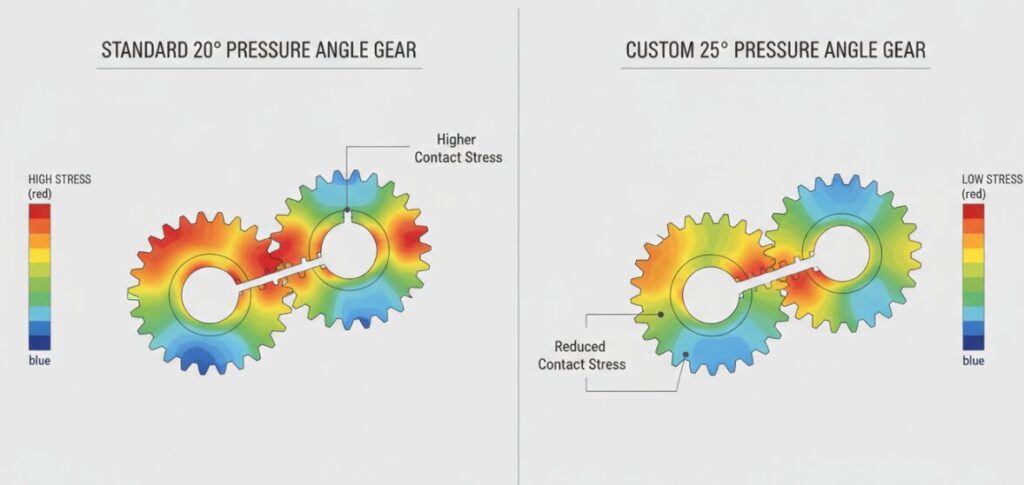
In the heavy excavator or large tower crane that harsh conditions, the standard 20 degree pressure angle gear is often too much. Modifications to the tooth profile at this time-especially increasing the pressure angle to 25 degrees, or directly using a positive displacement design-can be very effective in thickening the tooth root. This custom design not only does not need to expand the physical size of the slewing bearing, but also can increase the maximum tangential load limit of the gear teeth by up to 25%.
Backlash and thermal expansion traps
In order to pursue the ultimate mechanical accuracy, many mechanical engineers will be forced to indicate “zero backlash” (zero tooth side clearance) on the manufacturing drawings of customized external gear slewing bearings. However, such overly stringent tolerance requirements can ruin heavy equipment.
Since heavy steel components are mostly operated outdoors, they are susceptible to severe thermal expansion. The “zero backlash” gear meshing adjusted at an ambient temperature of 20°C will quickly evolve into an extremely serious gear jam once the equipment heats up to 60°C under continuous full load operation. The thermal expansion of the pinion and the slewing bearing will swallow up the gap that does not exist in one bite, resulting in direct hard grinding between metal and metal, and the friction force will soar instantly, which will directly cause the motor to overload and burn.
The correct approach is that a scientifically calculated backlash range must be specified on the drawing. Be sure to leave a sufficient margin for the thermal expansion of the metal and the oil film thickness of the heavy load grease.
Improved Additional Components, Significantly Extend The Life Of Marine Crane
We worked intensively with a marine deck crane manufacturer. At that time, the problem they faced was that the original standard slewing bearing had frequent severe gear wear after 18 months of seawater erosion and heavy lifting.
The customer’s original plan is: the outer diameter of 2200mm, using standard hobbing process and basic overall tempering. In response to these 1 pain points, our engineer team redesigned this custom external gear slewing bearing, and the core parameters were adjusted as follows:
- Material upgrade: replaced with 50Mn steel, and additional spraying a special anti-corrosion zinc layer.
- Tooth shape specification: introduce +0.5 displacement coefficient (positive displacement), specially used to thicken tooth root.
- Heat treatment process: implement very precise tooth profile induction hardening, pull the tooth surface hardness to 58 HRC, and strictly control the hardness of the core to keep it at 28 HRC, thus retaining sufficient toughness to absorb impact load.
The final field data verified the success of this scheme. The improved tooth root reduces the peak bending stress by 18%, and the equipment has been operated continuously without failure for more than 30 months, during which there is neither visible gear pitting nor any raceway deformation.n.
Preguntas frecuentes
Q1: Customized external gear slewing bearing maximum outer diameter can do much?
At present, most heavy-duty bearing manufacturers can produce customized external gear slewing bearings with an outer diameter of up to 6000mm (6 m). However, considering the limitation of logistics transportation and the processing physical limit of numerical control machine tools (CNC), once the outer diameter exceeds 4000mm, the industry usually no longer uses a single-piece integral forging ring, but instead uses a segmented gear splicing design.
Q2: How do I choose between internal and external gear slewing bearings?
As long as your equipment structure layout allows the drive motor and pinion gear to be arranged on the outside of the slewing bearing, please choose the external tooth structure decisively. Compared with internal teeth, external gear slewing bearings are much more convenient in post-maintenance, quick visual inspection and grease application. The internal tooth structure is basically designed for compact designs where space is limited and the drive mechanism must be inserted inside the ring gear.
Q3: Will induction hardening of external gears extend the delivery time of customized orders?
I will. The addition of a profile induction hardening process to the external teeth usually extends the entire production cycle by 1 to 2 weeks. Because this process requires extremely precise temperature calibration to prevent thermal deformation of the ring gear, and the depth of the quench-hardened layer must be strictly controlled within the tolerance zone of 1.5mm to 3.0mm.
Q4: If I don’t want to replace the existing drive pinion, can I directly replace the original standard external gear slewing bearing with a customized model?
Of course. The premise is that this customized slewing bearing must maintain exactly the same gear module, number of teeth and pressure angle as the original part. However, it should be noted that if you have customized the displacement gear to improve the strength, you must recalculate the center distance to ensure that the old pinion can still mesh accurately.
Q5: How long does it usually take for a pure custom external gear slewing bearing to be delivered?
From the final approval of the drawing to the shipment, a fully customized slewing bearing takes about 45 to 90 days. It takes 30 days to purchase large forging blank rings alone. The rest of the time is used for CNC hobbing customization, raceway grinding and a series of special heat treatment processes.
Q6: Why does my external gear slewing ring have broken teeth?
The root of broken teeth usually lies in the unreasonable hardness configuration of the surface and the heart. If the manufacturer blindly quenches the tooth surface hardness to 60 HRC, but fails to retain the softness and toughness of the heart, the entire gear tooth will become as brittle as glass. In this case, even a little sudden impact load caused by emergency braking or slight overload will directly cut off these brittle teeth from the ring gear.