SWBTEC


Slewing bearing: Structure, Loads, and System Limits
Slewing support (also known as turntable bearing) is a large-diameter rolling support component. Its special feature is that it integrates the three major functions of structural connection, load transmission and relative rotation into one support position. Generally speaking, its inner and outer rings will be fixed to different equipment structures, and then the two will rotate relative to each other. The specific method of fixing the overall design requirements is as follows. It can rotate continuously, swing back and forth within a limited angle, or perform intermittent positioning by stopping and going. It should be noted that different movement modes will result in significant differences in lubrication status, heating conditions, and actual service life.
First, let’s see what it’s really carrying
The greatest skill of rotary support is that it can simultaneously bear axial load, radial load and overturning moment in the same position. The axial force is pressed along the direction of the rotation axis, and the radial force is pressed perpendicular to the rotation axis. The overturning moment is the most difficult, as it will cause severe uneven force on both sides of the support (one end is pressed and the other end is pulled).
However, how much force it can actually withstand depends on its internal structure, size, contact angle, type of rolling element, bolts, and the strength of the base support structure. There is a common misconception here: the load-bearing capacity of the overturning moment should never be directly replaced by the rated axial load. In practical applications, the three forces of axial force, radial force and overturning moment must be comprehensively considered under combined working conditions.
Structure determines the way forces are applied
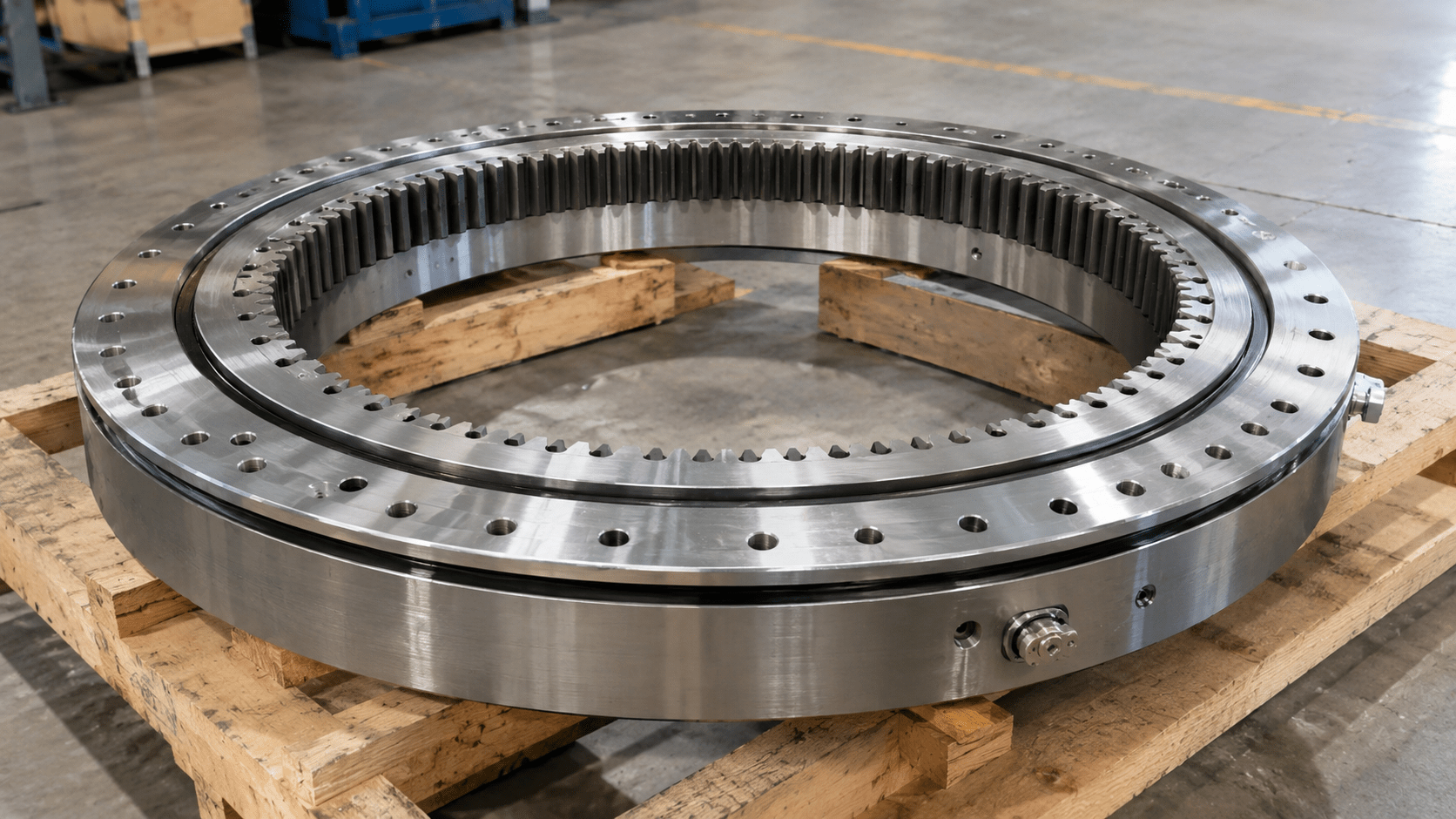
There are four main core load-bearing components for slewing bearings: inner ring, outer ring, rolling elements and raceways. The rolling elements inside can be steel balls or cylindrical rollers, and sometimes even a mixture of balls and rollers. Don’t underestimate the difference in shape; it will directly change the internal contact method, overall rigidity, friction, and force distribution. To prevent adjacent rolling elements from rubbing against each other “fighting”, internal cages, isolation blocks, or isolation balls are used to control the spacing, but different designs may not necessarily use a complete one-piece cage.
The inner and outer rings actually provide ready-made installation interfaces. The holes punched on it (whether light or threaded) are used to firmly bolt the support structures at both ends of the equipment together. The seals installed on the edges are to prevent the internal grease from running out and to keep the external dust and moisture out of the door; while the lubrication holes, nozzles or oil passages left on the ring body are to facilitate daily replenishment of grease to the raceway.
Also, whether or not there are gears is another matter entirely. Internal or external teeth can be directly machined from the inner and outer rings, or they can be bare toothless structures. Just looking at its ring-shaped appearance, it’s impossible to tell whether this product has teeth or not.
What is the name does not equal what structure
When you look at English mechanical materials, you will find that slewing bearing, slewing ring and slew ring are often used interchangeably, and slew bearing is also a very common abbreviation. These general terms actually refer to similar products, but the names themselves do not indicate whether they contain balls or rollers, whether they have gears or not, or whether they have high or low precision. Therefore, when confirming the project, you must honestly return to the specific model, drawings and technical specifications, and never make a final decision based solely on the literal meaning of a few English words.
Clearly distinguish individual bearing components from system boundaries
If it is a toothless rotating support, it itself does not provide driving force. If the inner and outer rings want to rotate relative to each other, they must rely on external mechanisms to drive them. Although toothed bearings can transmit torque through the ring gear and pinion, you should understand that the matching gear pair, drive motor and brake are not necessarily included in the bearing supply range.
In fact, a complete slewing support system, in addition to the bearing itself, often also includes the mounting structure, high-strength connecting bolts, drive unit, lubrication system and protective components. One crucial point is that the stiffness and flatness of the mounting base, coupled with the tightening state of the bolts, directly affect the force distribution of the internal raceway; if the external structure deforms, this force distribution will also change. Therefore, when we understand this type of product, we must separate the “carrying and rotating” functions of the rotary support itself from the external configurations of the entire system “driving, lubrication, protection”, and so on, and count them one code at a time.