SWBTEC


Don’t be fooled by the name: judging by the label alone won’t do.
In the industrial machinery industry, “slew bearing” is actually the abbreviation of the slewing bearing (slewing bearing). However, based on such a general name, you can’t figure out the details of it at all-whether it is a ball type or a roller type? With or without gears? How about the accuracy? It is impossible to determine the specific product by looking at the name alone.
The names are pretty much the same, but the actual products might be quite different.
There are many similar names in the industry, such as slewing bearing, slewing ring or slew ring, which usually refer to the same thing. If you add “bearing” (such as slewing ring bearing), it is emphasizing its bearing properties. But don’t ever assume that just because the names are similar, their internal structures can be swapped around at will.
For example, the “swing bearing” (rotary motor bearing/rotary bearing) often called in excavator accessories depends on the actual object. Another example is “turntable bearing” (turntable bearing), which is broader. In addition to heavy industry turntables, sometimes even the turntables on the dining table at home or the rotating parts in some small equipment will use this word. So, don’t let the name throw you off.
Pull away the appearance and look at the basic structure first.
Conventional slewing bearings, to put it bluntly, are mainly the inner ring, outer ring, rolling elements and raceway. The rolling elements inside may be steel balls, cylindrical rollers, or a combination of both. In order to control the spacing of these balls or rollers, manufacturers will use cages, spacers or spacers (different designs do not necessarily have to use complete cages). In addition, in order to prevent the lubricating oil inside from leaking out and the dust outside from running in, sealing strips will be installed and oil holes, nozzles or oil passages will be reserved for us to make butter later.
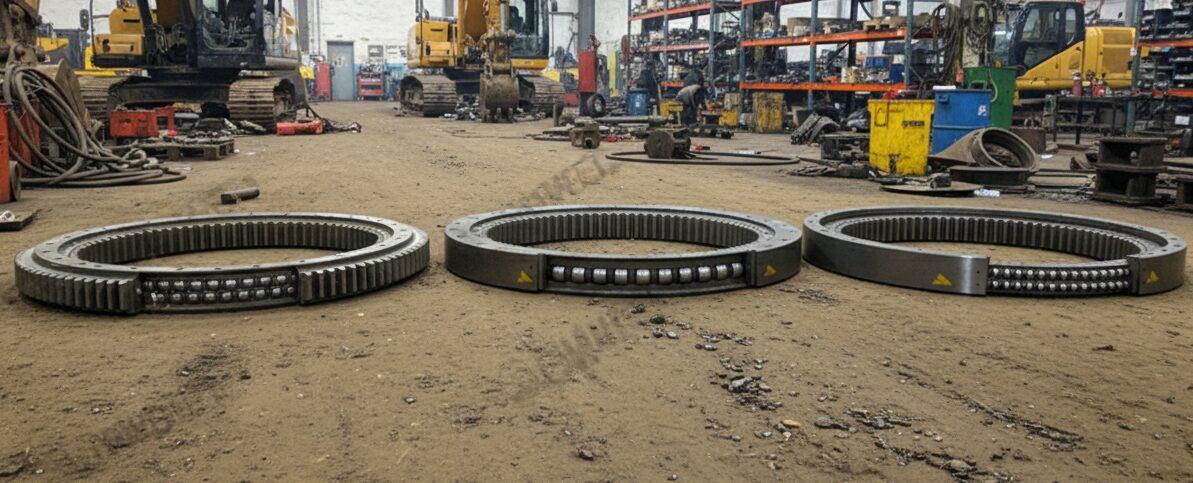
When selecting components, don’t just look at the overall structure—pay attention to the details.
Common styles on the market are single-row four-point contact ball, double volleyball, cross roller, three-row roller, and ball roller combination. Which structure to choose, must not just focus on the “rated load” this item, but also comprehensive calculation of rotation accuracy, rigidity, installation space, speed, impact resistance, service life and later maintenance conditions.

Knowing a structural name can only help you narrow down the selection range at most. If you really want to decide, you have to take the specific model and actual working conditions to “knock”.
The loading conditions must be considered as a whole.
Slewing bearing is an “all-round player”, can bear the axial force, radial force and overturning moment. However, this does not mean that any force can be added up casually. How much force it can actually resist depends on the structure, size, contact angle, rolling element, even bolts and supporting seats.
There is a common pit here: do not directly take the overturning moment to set the axial rated load. When analyzing the force, we must put all kinds of loads and their combination relationship under the same actual working condition for comprehensive evaluation.
A bearing is just a bearing—don’t take the peripheral components for granted.
The inner or outer ring of the slewing bearing can be toothed (inner or outer teeth) or can be made into a light plate without teeth. The toothed support transmits torque via a gear ring and a pinion.
But you have to be clear: when buying a bearing, the manufacturer often gives you only the bearing itself, and the matching gears, drives or brakes are usually not included. A complete slewing bearing system, in fact, also includes the mounting base, connecting bolts, drive pinion, as well as a variety of lubrication and protection kits-just listen to the word “slewing bearing”, these peripheral components are easy to ignore.
Installation interface and drawing confirmation: Never settle for “close enough.”
The mounting seat is hard enough and flat enough, which will directly affect the uneven bearing force. Now everyone is used to looking at 3D models to check the space size and interference, but this definitely cannot replace rigorous 2D drawings. After all, the material requirements, carrying capacity and inspection standards are all written in black and white on 2D drawings.
Although the overall dimensions of the product album are similar, I think the two models can be directly exchanged. Installation hole position, stop, gear parameters, clearance, accuracy, bearing capacity, and whether the outer ring rotation or the inner ring rotation must be checked one by one.
To summarize
In the future, when you encounter such English general terms as “Slew Bearing”, don’t rush to a conclusion. First find out which type of slewing bearing it points to, and then 1 the structure, force, installation interface and manufacturer’s scope of supply, so as to spend the money on the blade and pick the right products.