SWBTEC


Air Bearing Turntable: Selection and Setup Essentials
A metrology platform, a wafer inspection system, and an ordinary mechanical turntable can all rotate a workpiece around one axis, yet they demand very different motion quality. When smooth rotation and small motion errors matter, an air bearing turntable is worth evaluating. Before requesting a quote, define the workpiece weight, center of gravity, rotational speed, accuracy requirements, and available air supply. The words “air bearing” alone cannot tell you whether a particular table will do the job.
What the Air Film Actually Supports
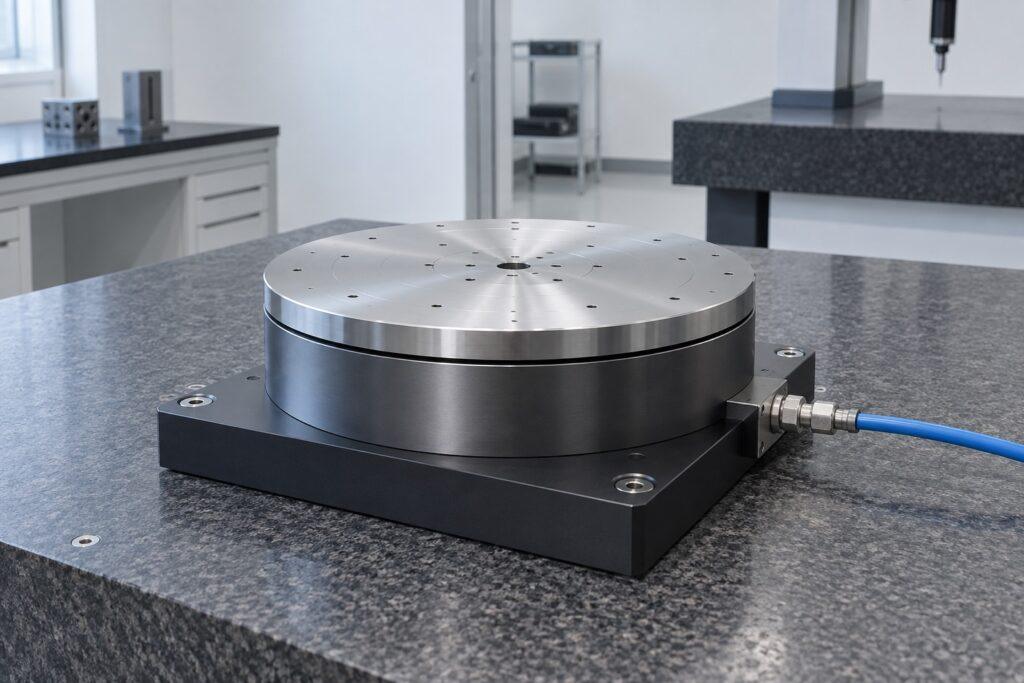
An air bearing turntable uses a controlled air supply to create a thin film between moving surfaces and support the rotor. With the specified air supply in place, the bearing surfaces do not rely on rolling elements or sliding contact to carry the rotation. This reduces contact friction and the stick-slip behavior associated with it. Air-film load capacity depends on factors including supply pressure, supporting area, and operating clearance; the actual capacity must be checked for the specific design and model.
“Air bearing” describes the support method, not the drive. A rotary table may use an external drive or integrate a motor and position feedback. For continuous, steady rotation, check speed stability and permissible speed. For positioning at multiple angles, examine the encoder, controller, and positioning performance under the intended load. Encoder resolution by itself is not the same as system positioning accuracy.
Describe the Real Load Case
Total workpiece mass is only a starting point. An off-center workpiece, a center of gravity above the tabletop, an overhanging fixture, or machining forces can change the overturning moment on the table. Specify axial load, radial load, overturning moment, and peak operating conditions separately. Then ask the supplier to confirm that the selected model can meet those conditions together.
Also distinguish between carrying a load and maintaining the required accuracy while carrying it. Axial, radial, and tilt stiffness are different measures. A lower-profile table does not automatically provide the same resistance to tilting. For metrology or precision machining, ask how published performance was tested: orientation, payload, speed, and mounting conditions all matter. Applying no-load specifications directly to a machine with fixtures and eccentric loads can lead to the wrong choice.
Match Accuracy Measures to the Task
Rotary error motion, positioning accuracy, and repeatability answer different questions. When measuring a rotating surface, axial or radial error motion may be the priority. When stopping at specified angles, angular positioning error and repeatability may matter more. A single “accuracy” figure is difficult to compare unless its test conditions and definition are clear.
Start with the error the machine cannot tolerate. Is it variation in a probe reading over one revolution, or a failure to return to the same angular position? Then compare the supplier’s error definitions, measurement method, speed, payload, and control configuration with that requirement. The flatness and stiffness of the mounting surface also affect the result. Bench-test figures do not automatically represent performance after installation in the complete machine.
Treat Air Supply and Mounting as Part of Selection
An air bearing turntable needs a continuous, clean air supply that meets its model-specific requirements. Confirm pressure, flow, filtration, dryness, and any oil-free requirement against the actual product manual; do not copy values from another manufacturer’s model. The pneumatic system should also account for pressure monitoring and a safe response to loss of pressure, since insufficient pressure can allow normally separated surfaces to touch.
Before installation, check the base dimensions, mounting holes, routing of air lines and cables, and maintenance access. The mounting surface needs adequate flatness and stiffness. Resolve any fixture design that shifts the center of gravity or obstructs the air connections before assembly. If a model has separate thrust and journal air ports, connect them as its instructions require. Do not turn or commission the table before the specified air supply is established.
Build a Quotation That Allows a Fair Comparison
A useful request for quotation describes the combined workpiece and fixture mass, center of gravity and eccentricity, operating orientation, speed or positioning cycle, required rotary error or angular accuracy, and site air supply. Then confirm whether the offer includes the drive, encoder, controller, air preparation equipment, and low-pressure protection. Two tables with similar diameters may have different supply boundaries and cannot be compared on a single price figure alone.
An air bearing turntable is most useful when a task calls for smooth rotation and precise motion and the site can provide suitable air. Evaluating the load case, accuracy definition, and installation conditions together is the practical way to decide whether a specific model fits.