SWBTEC


Why Trust China Internal Gear Slewing Bearing Manufacturers?
Purchasing internal gear slewing bearings from China can not only ensure that the carrying capacity is not compromised, but also save 30% to 45% of the purchase cost compared with taking goods from European suppliers. But to really trust a Chinese factory, you have to find out whether they have their own heat treatment production lines and whether the raw materials can be traced. At present, the top domestic manufacturers have used intermediate frequency induction hardening to process gears, and will provide 1 complete finite element analysis (FEA) reports before row production.
The real difficulty lies in “avoiding the pit”-there are many trading companies on the market. The heat treatment of the gears they sell is not in place, and it is easy to collapse the teeth when they are overloaded. This article is the actual combat guide, teaching you to use accurate engineering indicators to assess Chinese suppliers, to help you control the entire supply chain.
“C.O.R.E.” Audit Matrix: How To Screen Top Manufacturers
B2B buyers are often under pressure when it comes to finalizing overseas suppliers of key chassis components. To put it bluntly, just looking at a few ISO certificates is not useful at all. Experienced purchasing managers and quality control engineers are using the “C.O.R.E.” audit matrix, which can distinguish the real source factory from the assembly workshop at a glance.
C- Capacity and Independent Heat Treatment Capacity
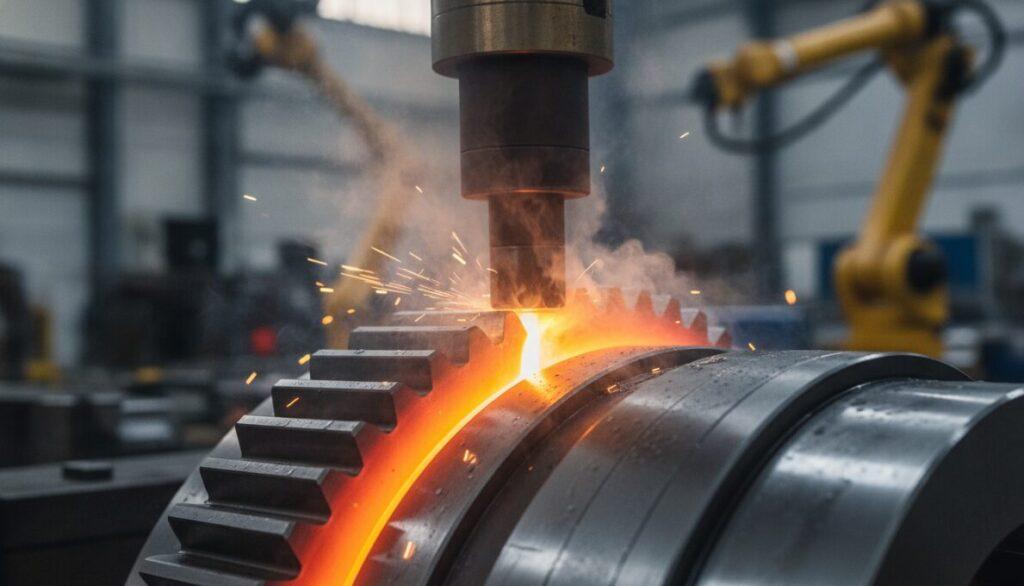
Heat treatment directly determines the service life of the inner gear slewing bearing. The real source of the factory, this key process is absolutely fully controlled in their own hands. If the quenching and tempering are outsourced, the hardening layer depth of the raceway and gear teeth is easily different. You can confidently ask the supplier to show the working video of their CNC IF quenching equipment. If it is a heavy-duty condition, the depth of the hardened layer must be between 3mm and 5mm.
O-raw material traceability, identify 42CrMo4
When encountering impact load, the origin of the steel determines the degree of resistance of the bearing. Low-end suppliers in order to cut costs, will use the kind of smelting process is very rough 50Mn steel, it will not take long to crack. Reliable manufacturers use forgings of the main national teams such as Baosteel and CITIC Steel, and the material is basically 42CrMo4 (national standard 42CrMo) or high-quality 50Mn. You can directly ask them for the material certificate (MTC), and the furnace number on it must correspond to the stamp of your shipment one by one.
R-Runout Tolerance and Gear Accuracy
The internal teeth are extremely demanding on the runout tolerance, otherwise the pinion is easily stuck. Now, domestic manufacturers of five-axis CNC machining centers have become commonplace to achieve DIN 8 or even higher gear accuracy. Remember to ask the supplier for the CMM test report. The measured data of radial runout and axial clearance must be in accordance with your OEM drawing before shipment.
E-Engineering and FEA Validation
If suppliers want to become long-term partners, they cannot do without some independent research and development capabilities. The real factory can produce your own finite element analysis (FEA) simulation report based on your axial load, overturning moment and radial force. This step of verification can avoid the choice of bearing size is too small, help you avoid the catastrophic consequences of equipment in the field of sudden strike.
Authentic Manufacturer vs. Trading Company Checklist
| Evaluation Indicator | Authentic Manufacturer (Factory) | Trading Company (Middleman) | 🔍 Verification Method / Checklist Question |
| In-house Quenching / Heat Treatment | ✅ Yes. Possesses in-house heat treatment furnaces. Strict control over hardness, depth, and metallurgical consistency. | ❌ Nein. Outsourced to third-party workshops. High risk of inconsistent batch quality and delayed timelines. | “Can you provide live videos or recent photos of your in-house quenching furnaces?” |
| Raw Material Traceability | ✅ Full. Complete traceability from the steel mill’s original batch down to the individual finished gear. | ⚠️ Limited. Often broken traceability chain due to switching sub-suppliers based on cost. | “Can you provide the original Mill Test Certificate (MTC) matching our exact batch?” |
| FEA Support (Finite Element Analysis) | ✅ Available. Has an in-house engineering team capable of running FEA simulations for stress, load, and fatigue analysis. | ❌ None. Acts merely as a messenger. Cannot provide deep technical or structural optimization support. | “Can your engineering team provide an FEA simulation report for our custom design?” |
| Getriebe Präzisionsklasse | ✅ High & Stable. Controls grinding and inspection in-house (e.g., DIN 3962 Grade 4, 5, or 6). | ⚠️ Variable. Precision depends entirely on which outsourced factory they use for your specific order. | “Do you have in-house gear measuring centers (e.g., Klingelnberg, Gleason)? Can we see a test report?” |
| Communication & R&D | ✅ Direct communication with R&D engineers. Fast modifications for tooth profiles or material specs. | ❌ Slow technical feedback loop. Information is often lost in translation between buyer and the actual factory. | “Can we schedule a direct video conference with your lead technical engineer?” |
| Factory Audit & Certifications | ✅ ISO 9001 / IATF 16949 certificates match the actual manufacturing facility’s name and address. | ❌ Certificates often show a different company name or explicitly state “Sales of…” instead of “Manufacturing of…”. | “Does the manufacturer name on your ISO/IATF certificate exactly match your business license?” |
| Pricing Structure | ✅ Direct factory pricing. Transparent cost breakdown for materials, machining, and treatments. | ❌ Marked-up prices to cover their commission. Opaque cost structures. | “Are you able to provide a transparent cost breakdown for this component?” |
Beware Of The “Hard Surface Only” Trap
If purchasing engineers find suppliers who have not been strictly inspected, they often encounter the strange thing that gears are scrapped in advance in less than 1000 hours. This is often because trading companies are playing tricks on the back and hiding inferior manufacturing processes.
“Surface Kung Fu” type of quenching scam
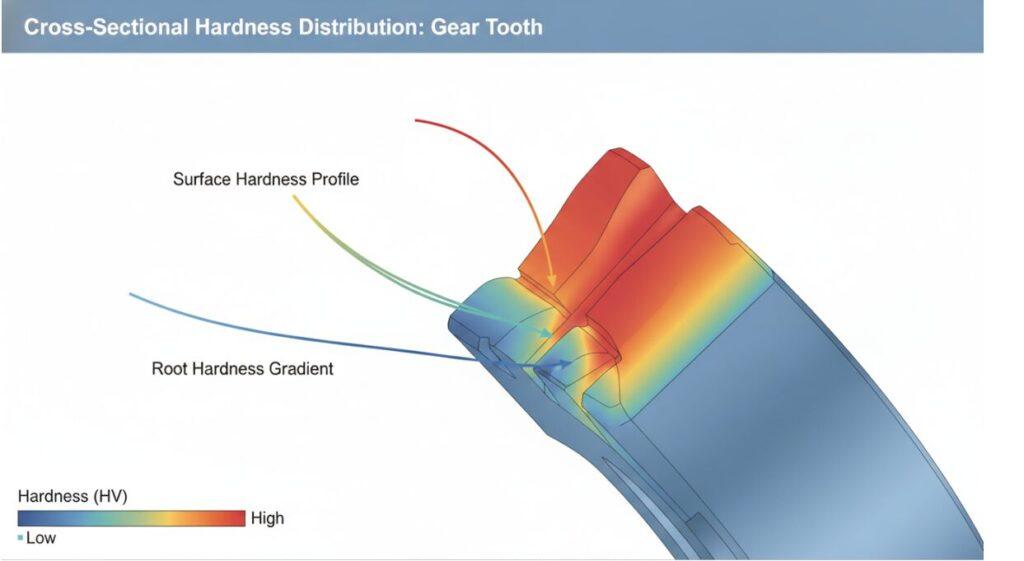
In order to cope with the basic inspection, many suppliers only measure the surface hardness (HRC 50-60) even if it is finished, regardless of whether the tooth root is hard or not. You know, the internal teeth are to withstand the huge torque from the pinion, if the tooth root is soft, it will soon produce metal fatigue and then break the teeth. When placing a purchase order, be sure to write “tooth root induction hardening” in black and white, and have their metallographic laboratory issue a cross-sectional hardness distribution curve.
The “creep” problem of the larger the clearance runs.
If the machining foundation is poor, the clearance will be out of control. Some bearings turned smoothly when they were first received, but they did not carry several loads, and the axial clearance was too large. The reason is that the surface of the raceway is too rough. Once the rolling body runs, the uneven parts are smoothed, and the gap naturally becomes larger. In the technical specification, the raceway surface roughness must be set at Ra 0.4 or better.
China’s First-Line Big Factory PK European Counterparts
The real engineering data prove that China’s head production line can fully provoke the girder. Recently, a third-party mainframe factory that makes mining equipment conducted a cyclic load test and put a 1.2-meter inner tooth slewing bearing produced by a head manufacturer in Luoyang together with a big name in Germany.
This bearing in China uses 42CrMo4V steel, with special tooth surface and tooth root quenching process. After simulating 150 tons of overturning moment and rotating 50000 times, the raceway wear was measured to be 0.08mm. What about Europe? 0.07mm. This performance gap is almost negligible in practical applications, but the delivery time of Chinese manufacturers is 40% faster and the unit price is much cheaper.
Hand In Hand To Teach You To Audit Suppliers
Only by saying that we do not practice fake control can we reduce the risk if the audit is in place. When dealing with potential suppliers of internal gear slewing bearings in China, you may as well follow this process:
- Direct Material List (MTC): Let them take out the material certificate of the latest 3 batch of internal tooth bearings when they are shipped. If the other party faltered and couldn’t get it out, it would be eliminated directly.
- Non-destructive flaw detection (NDT): It is mandatory to do ultrasonic flaw detection (UT) to check whether there are any defects in the steel, and to do magnetic particle flaw detection (MT) to check surface cracks after heat treatment.
- Inventory equipment list: see what brand of machines they have in their workshop. Focus on finding CNC hobbing machines that can process large modules (such as modulus 10 to modulus 30), as well as CNC lathes with large diameters.
- Assault video inspection factory: make a video call at about a time. Let them hold their mobile phones, walk all the way from the raw material warehouse to the machining workshop, and finally directly into the heat treatment workshop to see the scene. Pure trading companies are absolutely afraid to take this move.
Häufig gestellte Fragen
Q: How to verify whether the hardness of the internal teeth of Chinese manufacturers is up to standard?
You can request a destructive cross-sectional cut test on the sample, or have the supplier produce a 1 detailed report of the hardness gradient with a metallographic microscope. The normal situation is that the surface hardness reaches 50-60 HRC, and then the more you go to the core, the hardness decreases gently.
Q: high heavy duty internal gear slewing bearing, with what material is the best?
42CrMo4 (that is, the national standard 42CrMo) is definitely the first choice for heavy loads. Compared with ordinary 50Mn steel, its hardenability, toughness and fatigue resistance are much better, and it can prevent tooth breakage under high torque.
Q: How long is the delivery date of Chinese manufacturers?
Like that kind of customized large diameter bearings, the normal production cycle is about 35 to 50 days. In fact, the length of delivery mainly depends on the reserve of rough forgings. Those manufacturers with iron relations with steel mills will take materials much faster and the delivery time will naturally be shortened.
Q: Can domestic factories customize gear modulus and pitch circle diameter?
Absolutely no problem. The real entity factory has a huge tool library and CNC gear cutting equipment. As long as you provide DWG or STEP drawings, they can accurately cut out the modulus, pitch circle and pressure angle you want, and perfectly engage with the pinion in your hand.
Q: Internal gear slewing ring stuck, usually because of what?
There are 3 main reasons for the stuck: the gear runout tolerance is too poor, the seal failure causes foreign matter to run into the raceway, or the lubrication is not in place. In the factory inspection stage, the tolerance red line of radial runout can be drawn, and the sticking caused by incorrect geometric size can be eliminated from the root.
Q: How do you see through whether the other party is a trading company or a real factory?
The most unique 1: ask to open a video to visit their heat treatment workshop. You know, on this set of equipment not only have to spend a lot of money, but also to complete the complicated environmental protection approval procedures, pure trading companies can not have such hard assets.